The Performance Sedan That Quietly Beats Luxury Rivals On Long-Term Value
9 minutes reading
Sunday, 20 Sep 2026 08:30 0 61 autotech
Performance sedans encourage irrational decisions. The quickest model gets the attention, the most prestigious badge wins the driveway, and an options list turns a $60,000 car into a $70,000 purchase before anyone asks what it will cost to own. That approach works if acceleration is the only measurement that matters. However, keeping one of these cars for five years introduces depreciation, maintenance, repairs, and fuel into the argument. Once those expenses join the conversation, one overlooked American performance sedan starts making several celebrated European rivals look unnecessarily expensive.
The window sticker tells you how much money it takes to bring a car home. It does not reveal how much money the car will consume while sitting in your driveway.
Depreciation is usually the largest hidden expense, but financing, maintenance, repairs, fuel, tires, and brakes also matter. These costs can turn an $11,000 difference in starting price into a much larger financial divide after five years. That is especially true when comparing luxury performance sedans, where an expensive badge often carries expensive insurance and repair estimates.
Kelley Blue Book includes those expenses in its five-year cost-to-own projections. The figures are not guarantees because many factors can vary from one person to another. Still, they provide a consistent way to compare two equivalent model-year vehicles. In this case, the difference is difficult to ignore.
Paying More For Speed Produces Diminishing Returns
A BMW M340i produces 386 horsepower and 398 pound-feet of torque. The Mercedes-AMG C43 raises output to 416 horsepower, while the Audi S5 offers 362 horsepower. These are legitimate performance machines, and the BMW remains one of the segment’s benchmarks.
The problem is how much extra you must spend to enjoy that performance. The 2026 M340i starts at approximately $63,650, while the AMG C43 begins at $67,120. The 2026 Audi S5 starts at $64,595. Options can push all three considerably higher.
One high-performance sedan starts at a much lower price, coming in much closer to $50,000. It is not as quick as the BMW or as powerful as the Mercedes. It does, however, produce 325 horsepower and reaches 60 mph in less than five seconds. Losing a few tenths at the drag strip becomes easier to accept when it potentially saves tens of thousands of dollars elsewhere.
The Cadillac CT4-V Is The Quiet Value Play
A 325-Horsepower Sport Sedan Starting Near $50,000
Blue 2026 Cadillac CT4-V Driving ShotCadillac
The 2026 Cadillac CT4-V is easy to overlook because the CT4-V Blackwing exists. The Blackwing’s 472-horsepower twin-turbocharged V6, six-speed manual transmission, and track-ready hardware understandably attract more attention. Unfortunately, that focus can make the regular CT4-V seem like little more than a trim package, but it certainly is not.
The CT4-V comes with a 2.7-liter turbocharged four-cylinder engine rated at 325 horsepower and 380 pound-feet of torque. A 10-speed automatic sends that output to the rear wheels, but you can have power sent to all four wheels if you choose the AWD version. This impressive luxury sports sedan hits 60 mph in only 4.7 seconds, making it a formidable car on the track.
With a starting price of $52,395, the CT4-V undercuts the rear-wheel-drive M340i by approximately $11,000. That leaves enough money for several years of fuel, insurance, and maintenance before the BMW has traveled its first mile.
Its Chassis Hardware Is More Serious Than Its Price Suggests
Gray 2026 Cadillac CT4-V Rear 3/4Cadillac
The CT4-V’s real strength is not its engine. You can find more horsepower elsewhere. The reason to consider this Cadillac is the chassis supporting that power.
RWD models receive Magnetic Ride Control, which continuously adjusts the dampers to changing road conditions. Cadillac also includes a mechanical limited-slip differential, Brembo front brakes, launch control, performance traction management, and selectable driving modes. The CT4-V weighs approximately 3,616 pounds, making it about 280 pounds lighter than the rear-wheel-drive M340i. That relatively low weight helps the Cadillac change direction without feeling like an oversized luxury sedan.
There is one important configuration warning. Choosing AWD removes Magnetic Ride Control. Buyers dealing with frequent snow may prefer the added traction, but the RWD version delivers the more complete performance package, allowing you to enjoy the CT4-V at its best.
The CT4-V Could Cost About $25,000 Less Than An M340i
Five-Year Projections Put The German Benchmark On The Defensive
2026 Cadillac CT4-V Posed With A 2020 VersionCadillac
Kelley Blue Book currently estimates that a rear-wheel-drive 2026 Cadillac CT4-V will cost approximately $69,746 to own over five years. That total includes $30,438 in depreciation and $39,308 in projected out-of-pocket expenses. They also estimate a five-year cost of $94,784 for therear-wheel-drive 2026 BMW M340i. That includes $35,813 in depreciation and $58,971 in out-of-pocket expenses. The difference is $25,038. That comparison uses the same model year and RWD configurations.
The Cadillac projection contains one important limitation: KBB lists maintenance as unavailable for this CT4-V calculation. Therefore, the $25,038 difference should not be treated as money guaranteed to remain in your bank account. Even so, Cadillac maintenance would have to become extraordinarily expensive to erase the entire projected gap. The CT4-V is a GM product with wide parts support and a domestic mechanic knowledge base.
Insurance And Depreciation Create Most Of The Separation
Gray 2026 Cadillac CT4-V Front 3/4Cadillac
Fuel economy does not give the Cadillac an advantage. The CT4-V returns 20 city/29 highway mpg, which is 23 mpg combined. The mild-hybrid M340i manages approximately 29 mpg combined despite producing more power and accelerating harder.
The BMW’s advantage at the pump is overwhelmed elsewhere. KBB projects five-year insurance expenses of $22,790 for the M340i, compared with $12,800 for the CT4-V. Financing, state fees, maintenance, repairs, and depreciation also add to the difference. Insurance estimates vary wildly among drivers, making personal quotes essential before buying either car. Even if the gap is smaller for you, the Cadillac begins with a lower price and lower projected depreciation. That gives it financial breathing room the BMW must overcome through fuel savings and stronger resale value.
Lower Ownership Costs Do Not Mean Cost-Free Performance
Fuel, Tires, And Brakes Still Require A Performance-Car Budget
2026 Cadillac CT4-V InteriorCadillac
The CT4-V offers better long-term value than several rivals, but it is not an economy car wearing an expensive suit. It requires premium gasoline to deliver its advertised output, and the 23 mpg combined is unimpressive next to the M340i. The CT4-V averages about $3,300 in fuel costs annually, while the BMW M340i costs $2,600 for fuel each year.
Performance tires are another recurring expense. Aggressive driving shortens their useful life, and replacing a complete set will cost more than fitting ordinary all-season tires to a standard CT4. Brembo brakes also offer better stopping performance, but performance pads and rotors are rarely cheap. Long-term value means spending less than comparable luxury rivals, not avoiding ownership costs altogether.
Reliability Is Adequate—But The Long-Term Record Is Still Developing
Red 2026 Cadillac CT4-V Rear Driving ShotCadillac
This is where the argument requires some restraint. The CT4 arrived for the 2020 model year, and the CT4-V has not spent enough time on the road to establish the high-mileage history of a Lexus IS or some older BMW powertrains. Calling it exceptionally reliable would be getting ahead of the evidence.
RepairPal gives Cadillac an overall reliability rating of 3.0 out of 5.0, with an estimated $783 in annual repair costs across the brand. That is acceptable rather than remarkable and does not provide direct figures for the CT4-V. Earlier CT4s also had documented problems. An NHTSA recall covered 2,235 CT4 models from 2020 to 2021 that were equipped with the 10-speed automatic. Excessive transmission-control-valve wear could cause harsh shifting and, in rare cases, momentary wheel lockup. The recall does not include the 2026 CT4-V, but buying a used vehicle of any kind requires verification of completed recalls.
Cadillac offers drivers of new models a four-year/50,000-mile limited warranty and six-year/70,000-mile powertrain coverage. That reduces short-term risk without proving what the car will be like at 150,000 miles.
The CT4-V Makes The Most Sense For Drivers Who Value The Drive
The Cabin And Rear Seat Reveal Where Cadillac Saved Money
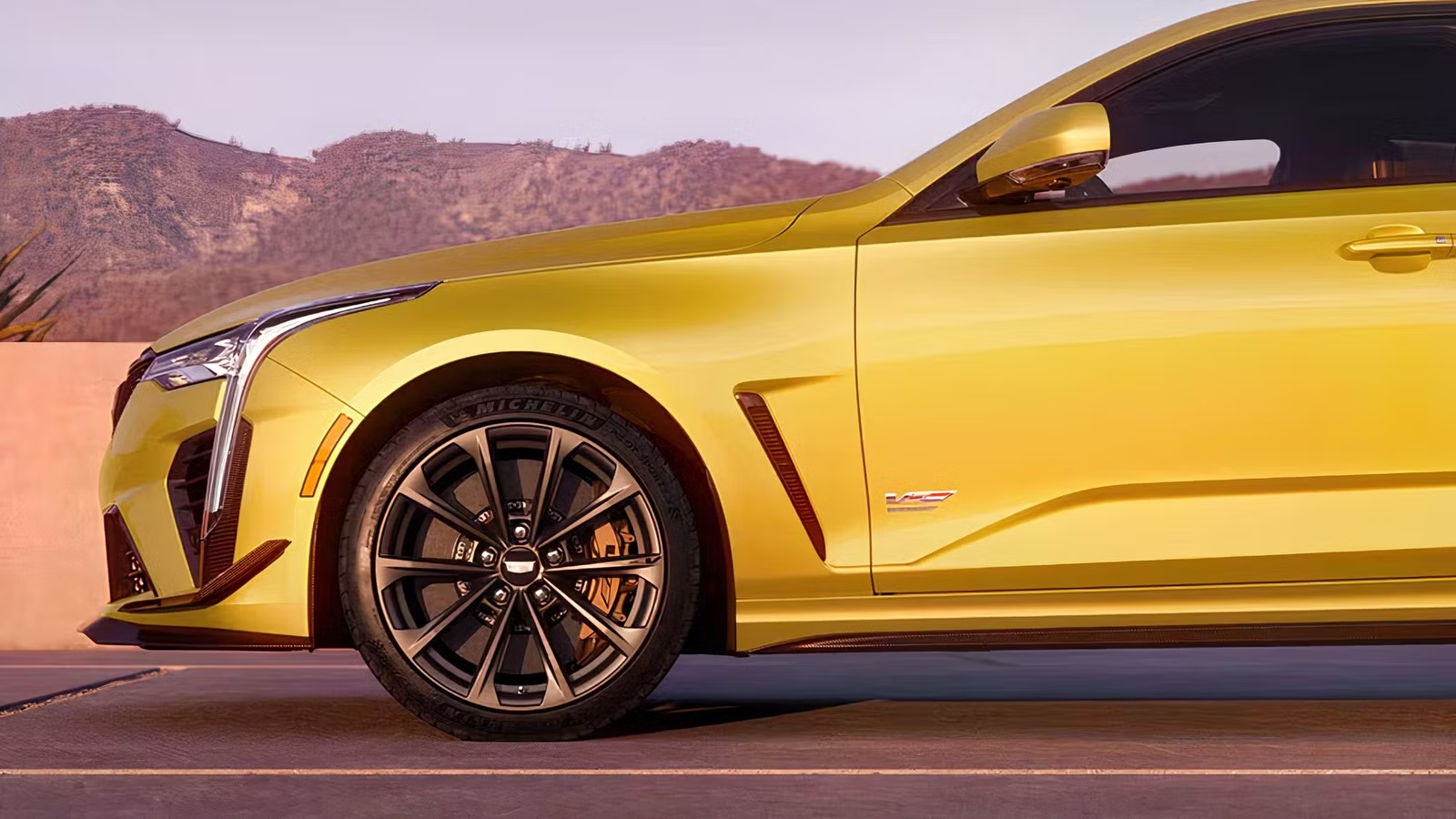
Yellow 2026 Cadillac CT4-V Driving ShotCadillac
The Cadillac does not win every comparison. Its cabin lacks the richness of the Audi S5, while the BMW offers better technology, greater refinement, and more passenger space.
Rear-seat legroom measures approximately 33 inches, and the trunk provides only 10.7 cubic feet of space. The M340i offers about 35 inches of rear legroom and 16.9 cubic feet of cargo capacity. Adults can use the Cadillac’s rear seat, but nobody will mistake it for a spacious family sedan.
It also lacks the steering feedback of many European rivals, which matters given that the hardware suggests a more communicative driving experience. The Cadillac remains agile and composed, but buyers expecting a smaller four-door version of the Blackwing may leave disappointed.
The Verdict: Long-Term Value Matters More Than A Luxury Badge
A Yellow 2024 Cadillac CT4-V Blackwing DrivingCadillac
CT4 production ended in June 2026, leaving dealer inventory and the used market as the remaining paths to ownership. Discontinuation could help the car retain enthusiast interest, but nobody can guarantee it will improve resale value. The Cadillac CT4-V delivers 325 horsepower, RWD, Brembo brakes, adaptive dampers, and a limited-slip differential for approximately $11,000 less than a BMW M340i.
The BMW is faster. The Audi has the better cabin. The Mercedes brings more horsepower. The Cadillac counters with enough performance to make every commute interesting and enough financial restraint to keep ownership from becoming a burden. If you intend to use your performance sedan as a daily driver, the quietest choice in the segment may also be the one delivering the strongest long-term value.
Base Trim Engine
2.7L I4 ICE
Base Trim Transmission
10-speed automatic
Base Trim Drivetrain
Rear-Wheel Drive
Base Trim Horsepower
325 HP @5500 RPM
Base Trim Torque
380 lb.-ft. @ 2000 RPM
Base Trim Fuel Economy (city/highway/combined)
20/28/23 MPG
Base Trim Battery Type
Lead acid battery
Make
Cadillac
Model
CT4-V
Sources: Cadillac, Kelley Blue Book, Edmunds, NHTSA, RepairPal, TrueCar, Fueleconomy.gov










No Comments