
This Forgotten Toyota Supra Rival Returns As A Widebody Monster
The Toyota Supra became a poster-car legend, but Japan produced another twin-turbo heavyweight that attacked the same problem with a lot more technology. It had all-wheel drive, four-wheel steering and enough electronics to make most 1990s sports cars look basic.

This Mitsubishi 3000GT VR-4 restomod drags that forgotten formula into the present with a huge stance, serious aero and the kind of visual menace its complicated hardware always deserved.
This Forgotten Supra Rival Now Looks Like A Supercar
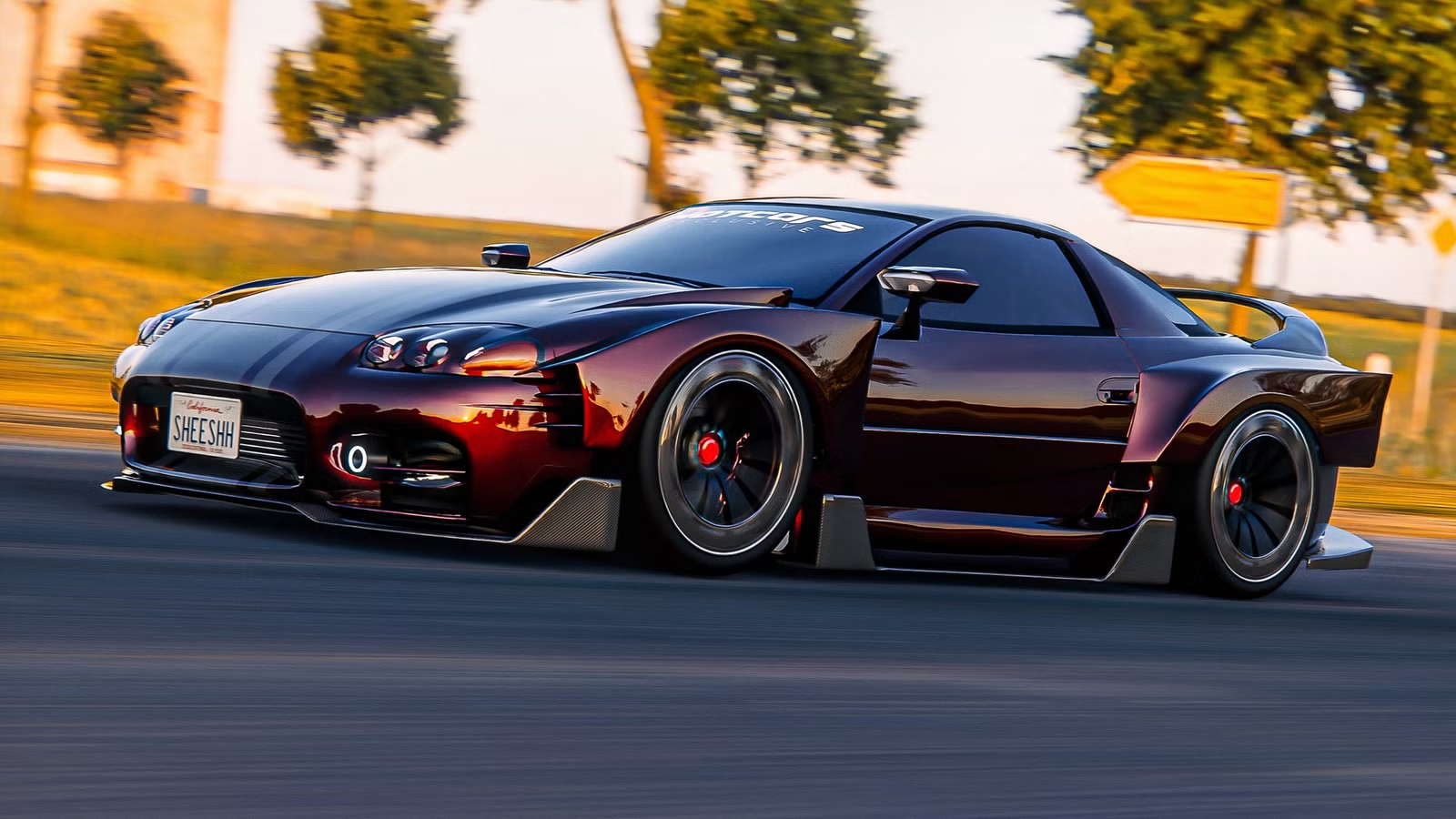
There’s no mistaking the basic 3000GT shape here. The long nose, low roof and thick rear quarters still read like Mitsubishi’s 1990s grand tourer, but everything surrounding them has been turned up. The body sits impossibly low over huge wheels, the arches have been pulled outward, and the front bumper is dominated by a massive central opening, deep splitter and additional vents that make the car look built for a pit lane.

The coolest part is how much of the original face survives. Later 3000GT fixed headlights remain in roughly their familiar position, while the smooth hood and rounded greenhouse keep the silhouette recognizable. The restomod then adds carbon-fiber aero, exposed side blades and hugely extended fenders. Those pieces would need real engineering on a physical build, because a wider track, revised suspension geometry and proper airflow management would matter just as much as the bodywork.
Personally though, it’s at the back where things get fun. The design uses a huge hoop-style wing, a full-width taillight treatment with illuminated Mitsubishi lettering, a deep diffuser and twin exhaust outlets. It looks more like a Japanese tuner hero translated through modern GT3 design than a faithful restoration. That feels appropriate because the original Mitsubishi 3000GT VR-4 was never a simple machine to begin with.
Mitsubishi introduced the VR-4 for 1991, and the flagship arrived loaded with technology. Early cars had full-time all-wheel drive with a 45:55 front-to-rear torque split, four-wheel steering, electronically controlled suspension, active exhaust and active aerodynamics that adjusted the front spoiler and rear wing at speed. That made it one of the most technically ambitious Japanese Performance Cars sold in America.
The 3000GT VR-4 Had More Tech Than The Toyota Supra

Power came from a transversely mounted 3.0-liter DOHC twin-turbo V6. First-generation VR-4s made 300 horsepower and 307 lb-ft of torque through a five-speed manual. From 1994, output climbed to 320 horsepower and 315 lb-ft, while a six-speed Getrag manual replaced the earlier five-speed. For a heavy 1990s grand tourer, the numbers were serious.
To give you a sense of the speed, a 1997 VR-4 weighing 3,737 pounds recorded a 4.8-second 0-60 mph run and covered the quarter-mile in 13.6 seconds. That was enough to run with major performance cars of the era, even if the Mitsubishi carried considerably more mass than some of its Japanese rivals. Its combination of traction, turbocharged torque and all-weather capability gave it a personality very different from the rear-drive Toyota Supra.
Not Bulletproof

Complexity was both the VR-4’s calling card and its long-term problem. Mitsubishi gradually removed active exhaust after 1994, electronic suspension after 1995 and active aero after 1996 as the company worked to reduce weight and cost. Even late cars retained the twin-turbo V6, AWD and four-wheel steering, but they were already simpler than the first cars. A transfer-case recall also affected certain AWD cars because a leak could lower the oil level and potentially damage the unit.
A modern Mitsubishi 3000GT VR-4 restomod needs more than wheels, paint and extra boost. Age-sensitive electronics, AWD hardware, cooling systems, steering components and decades-old rubber would all deserve attention before power is increased. The smartest starting point would be a mechanically solid example with documented maintenance rather than the cheapest twin-turbo project available.
A 500 HP Restomod Could Finally Give It Supra-Level Attention

There’s a strong argument for keeping the original 6G72 V6. Swapping in a newer engine would erase one of the defining features of the 3000GT VR-4 and create a new set of packaging and electronics headaches. A properly rebuilt 3.0-liter twin-turbo engine with modern engine management, upgraded fueling, more efficient intercooling and contemporary turbochargers could preserve the car’s character while making the power delivery cleaner and stronger.
For a road-focused build, roughly 450 to 500 horsepower feels like the sweet spot honestly. That figure is hypothetical, but it’d be plenty in an AWD car if weight could also be trimmed. The goal should be response and repeatability rather than chasing a four-digit dyno number. Stronger brakes, modern coilovers, lighter wheels and current performance tires would probably transform the car as much as the extra horsepower, especially given how much tire and damper tech has advanced since the 1990s.
The Comeback It Deserves

The original all-wheel-drive system is worth keeping if it can be rebuilt properly, and the four-wheel steering is part of the car’s identity. Active aero is easier to rethink. Instead of rebuilding every aging actuator, a restomod could use fixed, carefully developed aerodynamic pieces like the ones shown here. That would keep the dramatic look while reducing some of the complexity that made these cars intimidating to own as they aged.
A build this extensive also makes more sense on the right donor. Just 16,416 VR-4s were produced, and the 1998 model was the rarest coupe year with only 231 built. Later-gen cars have also become significantly more valuable than they once were, which means cutting up an exceptional survivor would be hard to justify. But using a sound, imperfect example to create something like this? That could be exactly how the Toyota Supra’s forgotten tech rival finally gets the comeback it deserves.

Related posts




Latest Post



No Comments