
McLaren Building In-House Engines for First Time in Brand History
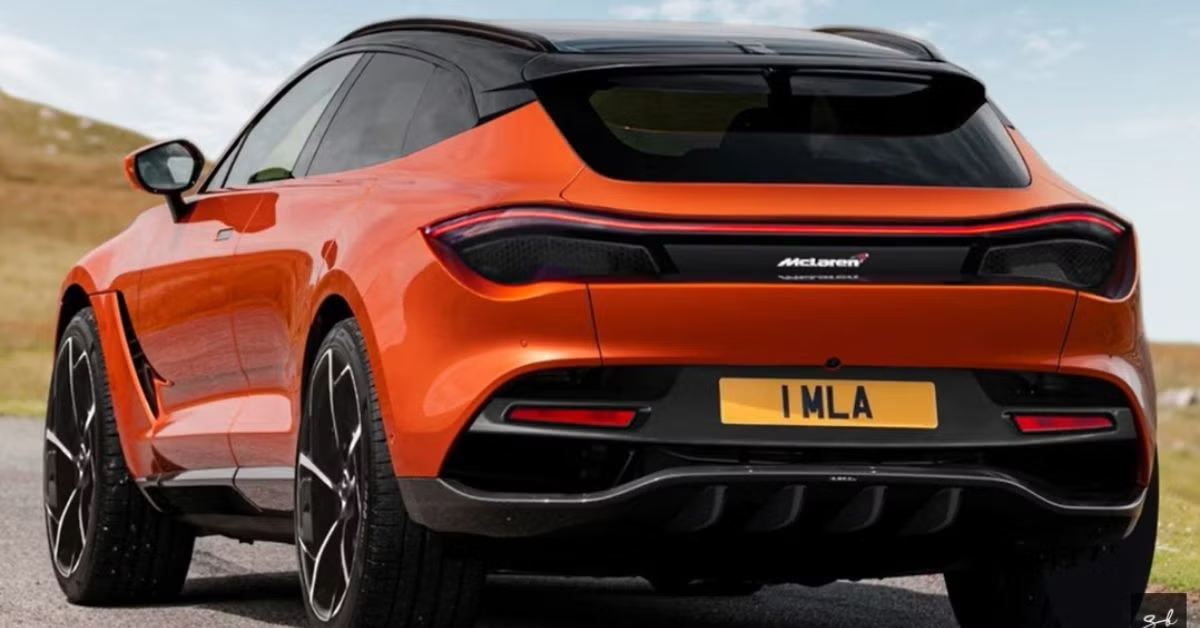
McLaren confirmed a £500 million investment from Abu Dhabi’s L’IMAD sovereign wealth fund this week, and every headline led with the same thing: the SUV. Fair enough — it’s the first time McLaren has officially committed to a high-riding four-door, and it’s a big deal commercially. But buried underneath the Urus-rival news is something that matters far more to anyone who actually cares about what comes out of Woking: McLaren is developing and building its own engines in-house for the first time in the brand’s history.

Since the 12C launched in 2011, every McLaren Automotive road car engine has been constructed by Ricardo, the Sussex-based engineering supplier. That relationship ends with the next generation of powerplants. Two new hybrid engines and their corresponding transmissions are already in development, fully designed and built in McLaren’s own facilities. For a brand that built its reputation on the F1 — arguably the ultimate driver’s car — finally owning its powertrain destiny is a seismic shift.
Why Ricardo’s Exit Changes Everything for McLaren’s Future Cars
The Ricardo partnership has always carried a quiet asterisk next to McLaren’s engineering credentials. The engines were exclusive to McLaren — nobody else was buying a twin-turbo 4.0-liter V8 or the Artura’s 3.0-liter twin-turbo V6 off Ricardo’s shelf — but McLaren didn’t build them. COO Michael Straughan acknowledged the perception gap directly: “Not all of our customers understand that a McLaren engine is a McLaren engine — it isn’t purchased off another brand, it’s designed and developed by McLaren. And for the first time ever, on future generations of engines, we can make the engine in-house.”

That distinction matters beyond marketing. Building engines in-house means McLaren can tune them specifically for each platform from the ground up — matching combustion characteristics to the chassis, dialing in the exhaust note, iterating on hybrid integration without going back to a third party. Straughan was explicit that the engine is “probably the most important element in terms of creating emotion — not only from what you sense in the vibration through the car, what happens when you accelerate, the feel of power and performance, but also in the emotion of the sound that comes out the exhaust pipe.” That’s not a supplier conversation. That’s an in-house one.
Two New Engines, Two Distinct Missions

2025 McLaren Artura Spider
McLaren hasn’t released displacement figures, power targets, or architecture details for either new powerplant. What’s clear from the announcement is that two distinct engine programs are underway, both hybridized, and both paired with new in-house transmissions. The most likely reading of the lineup: a next-generation V6 for mid-engined supercars and a V8 for the front-engined SUV and any derivatives that follow it.
The mid-engined path is already coming into focus. The P34 — McLaren’s next supercar, expected to debut in 2027 as a 2028 model — is reported to use a newly developed twin-turbocharged hybrid V6 producing around 810 horsepower and 800 lb-ft of torque. Those are dealer-briefing figures, not factory-confirmed specs, but if accurate they’d represent a massive step beyond the Artura’s 690 combined horsepower while also eclipsing the torque output of the current 750S’s twin-turbo V8. The P34 is also expected to carry an in-house transmission, making it the first McLaren where the powertrain is entirely Woking’s own work.
On the front-engined side, the SUV is confirmed to use one of these new hybrid powertrains. Dealer sources cited by CarBuzz described it as a hybrid V8 setup — not a plug-in — which aligns with Straughan’s comment that “once you start building engines there are lots of opportunities.” A front-engined V8 hybrid platform also opens the door to other models: Autocar reported that McLaren is already discussing additional front-engined cars, potentially including a grand tourer to fill the gap left by the GT.
The SUV Is the Cash Cow That Makes the Engine Program Possible

None of this happens without the commercial logic of the SUV. McLaren built around 2,000 cars across all models in 2025. Ferrari produces up to 3,000 Purosangues annually, and the Lamborghini Urus sells roughly double that. The financial gap is stark, and it’s precisely why the SUV — long resisted by previous management — is now the cornerstone of the expansion plan.
The £500 million covers a new UK assembly facility, expanded operations at the McLaren Production Centre in Woking, and growth at the carbon-fiber plant in South Yorkshire. At least 1,000 new jobs are targeted by 2032, with McLaren’s manufacturing workforce set to double. The SUV is expected before 2030, will seat five, and is described as closer in character to the Aston Martin DBX than the Ferrari Purosangue — a more traditional tall SUV rather than a low-slung GT. McLaren is still deciding whether to build it around a carbon-fiber tub, which would be a first for any SUV of this type.

2025 McLaren Artura Spider
The Artura, meanwhile, is reportedly on its way out by 2028. Early quality issues and slower-than-expected sales — just 510 US registrations in 2025, down 18 percent in the first half of 2026 — have pushed McLaren toward the P34 as its new entry point. The P34 is expected to price around $313,000 to $315,000 and sit above the Artura’s current position in the lineup.
The SUV will likely outsell every McLaren supercar combined once it arrives. But the real legacy of this investment could be a generation of supercars — starting with the P34 — that are genuinely McLaren’s own from the crankshaft up. Gearheads have been waiting for that since the F1.

Related posts






Latest Post


No Comments