
The Muscle Sedan With Toyota-Tier Reliability And A Hemi V8 Send-Off
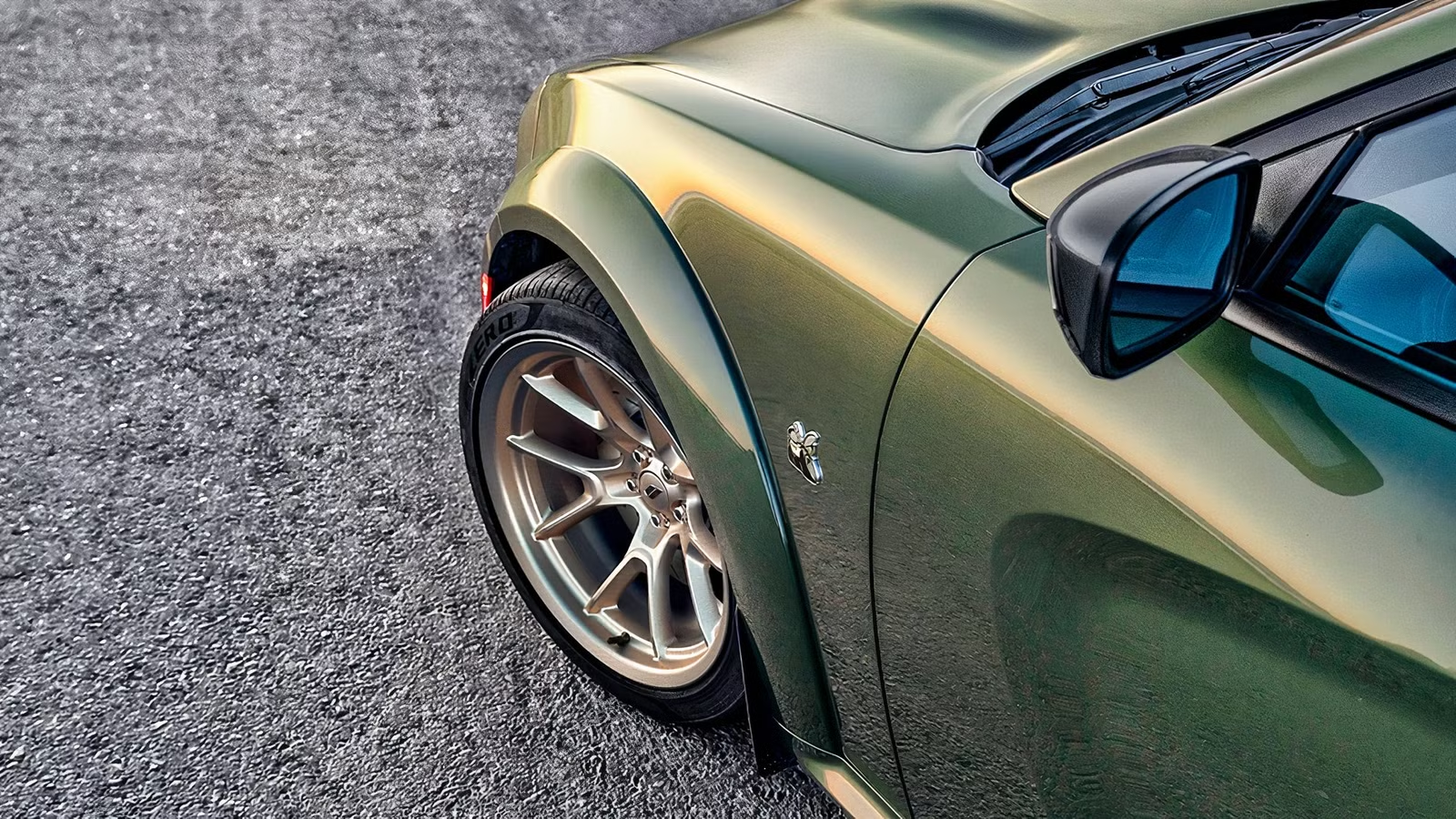
Some modern American muscle cars leave behind quarter-mile times and horsepower records. This one left something stranger: a 92/100 J.D. Power Quality & Reliability score. That put the final Hemi-era four-door in the same neighborhood as a Toyota Camry and ahead of the 2023 Ford Mustang.

The odd part is that this wasn’t some brilliant new redesign. It was the last version of a car that had spent more than a decade being tweaked, fixed, and refined. And just when all those years appeared to pay off, the Hemi V8 era ended.
This Hemi V8 Muscle Sedan Scored In Toyota Territory
J.D. Power’s Quality & Reliability rating measures defects, malfunctions, and design flaws reported by verified owners, covering everything from the engine to the infotainment system. Higher numbers mean fewer reported problems. This particular muscle sedan finished at 92/100, which is already a weird number to associate with something built around big V8s, rear-wheel drive, and tire smoke.

The 92/100 stands out even more against the usual reliability benchmark. J.D. Power puts the 2023 Toyota Camry at 88/100 on the same scale, while the 2023 Ford Mustang comes in at 84/100. The Camry rating uses previous-model-year review data, so nobody should read that as proof this mystery muscle sedan will somehow outlive a Toyota. That’s not what the score says. Still, seeing a Hemi-era American four-door sitting in Toyota territory is enough to make you look twice.

And this wasn’t a sleepy commuter with a muscle-car badge stuck on the trunk. The 2023 lineup stretched from 292 horsepower at the bottom end to a ridiculous 807 horsepower at the top. It was still loud, rear-drive, and available with enough supercharged V8 power to turn a perfectly healthy pair of rear tires into smoke. Reliability wasn’t the part of the sales pitch anyone was supposed to remember.
Yet that’s exactly what makes the 92 interesting. Plenty of new cars launch with cleaner screens, fresher platforms, and years of engineering hype behind them. This one did the opposite. It stuck around. Then it stuck around some more. By the time it posted that score, its basic formula had been living on showroom floors for more than a decade. That sounds like a weakness until you consider what Dodge had been doing all that time.
Dodge Had 12 Years To Quietly Get This Car Right

The car is the 2023 Dodge Charger, and suddenly that 92/100 starts making more sense. The 2011 redesign wasn’t a clean-sheet reset. Dodge kept the familiar basic architecture but reworked the body, suspension, structure, and cabin. Instead of throwing everything away and learning from scratch, Dodge was starting another long development cycle with a car it already knew.
The numbers get more interesting the farther you go. The 2012 Charger scored just 70/100 for Quality & Reliability. By 2018, it was up to 81. In 2019, 87. And then 2023 landed at 92. That’s quite a turnaround for a car that spent so much of its later life being criticized for getting old. It wasn’t a neat year-by-year climb, though, and J.D. Power doesn’t have directly comparable scores for every model year. The point isn’t that Dodge improved the Charger like clockwork. It’s that the car finished this run in a much stronger place than it started.
There can be an upside to getting old. J.D. Power’s separate 2023 U.S. Initial Quality Study found that newly launched models averaged 11 more problems per 100 vehicles than carryover models. That’s not the same study as the Charger’s 92/100 rating, so it doesn’t prove that 12 years of production made the Charger more reliable. But a brand-new car can bring brand-new bugs. An old one has had years to show you where they live.
Horsepower tended to drown out that part of the Charger story. Dodge spent those years finding ways to sell more Hemi, more Hellcat, and more attitude, but it was also building and servicing versions of the same basic sedan year after year. Problems that might surprise engineers in year one aren’t nearly as mysterious in year ten. From the 2011 redesign to the 2023 finale, Dodge had roughly 12 years to learn where the car complained. That’s one heck of a debugging window.
Dodge Got The Hemi Charger Sorted Right When It Said Goodbye

Dodge wasn’t exactly subtle about the goodbye. The Last Call program rolled out seven special-edition Charger and Challenger models, and every 2023 Charger and Challenger got a commemorative underhood plaque. Dodge said 2023 would be the end of both cars in their current Hemi-powered forms, with production wrapping up by the end of the year. If you somehow missed the message, Dodge practically wrote the obituary under the hood.
That distinction matters. The Charger nameplate didn’t die in 2023. The outgoing Hemi-powered Charger and Challenger did. The badge would carry on into a new generation, but the familiar recipe—a big sedan, rear-wheel drive, and a naturally aspirated or supercharged Hemi V8 up front—was done. After more than a decade of being the old-school choice in a rapidly changing market, this version finally ran out of road.

And Dodge made sure it went out making noise. The Last Call cars leaned into heritage colors, old badges, and huge horsepower numbers, including the 807-horsepower Charger King Daytona. That’s the stuff people naturally remember because it’s impossible not to. An orange 807-horsepower sedan is a much easier story to tell than a reliability score.
But that 92/100 may be the more surprising send-off. By the time Dodge was celebrating everything loud, excessive, and slightly ridiculous about the Hemi Charger, the underlying car had quietly reached one of the strongest Quality & Reliability scores of its modern run. It didn’t limp toward retirement while everyone looked the other way. On this metric, the old thing was still getting better right up to the point where Dodge pulled the plug.
Maybe We Remembered The 2011–2023 Charger For The Wrong Thing

Nobody’s going to get misty-eyed over a reliability score at Cars and Coffee. They’ll remember the Hemi rumble, the supercharger whine, the Scat Pack badge, that police-car shape suddenly filling the rearview mirror, and Dodge somehow finding room for even more horsepower in a big four-door sedan while the rest of the market moved on. That’s fair. The Charger didn’t spend 12 years trying to be sensible.
The funny part is that sticking around so long may have helped it become more sensible anyway. The 2011–2023 Charger caught plenty of heat for its age, and some of its tech certainly felt old by the end. But Dodge wasn’t still figuring the car out. It had been building, fixing, and refining versions of the same basic sedan for more than a decade. By 2023, the Charger didn’t feel fresh. It felt finished.

The 92 doesn’t erase the rougher early scores, and it doesn’t turn a Hellcat into a Camry. It does change how the era looks. The horsepower story happened in public, one Hemi badge, Hellcat launch, and burnout at a time. The durability story was much quieter. You had to wait for the years to stack up before it became obvious that the old platform’s age wasn’t only a punchline.
The new Charger gets to write a different story with electric power and turbocharged six-cylinders, and maybe one day it’ll build a reliability record just as convincing. But it doesn’t get to start with 12 years of bugs and the familiarity that came from fixing them. That’s what makes the old Hemi-era Charger’s exit hit a little harder. It went out loud, excessive, and unapologetic—the way enthusiasts wanted it—and somehow took a 92/100 reliability score with it. The quietest flex of the entire run showed up at Last Call.
Sources: Dodge, JD Power

Related posts




Latest Post


No Comments