
The 300-HP V8 Buick Sleeper Buried Under Chrome And Portholes
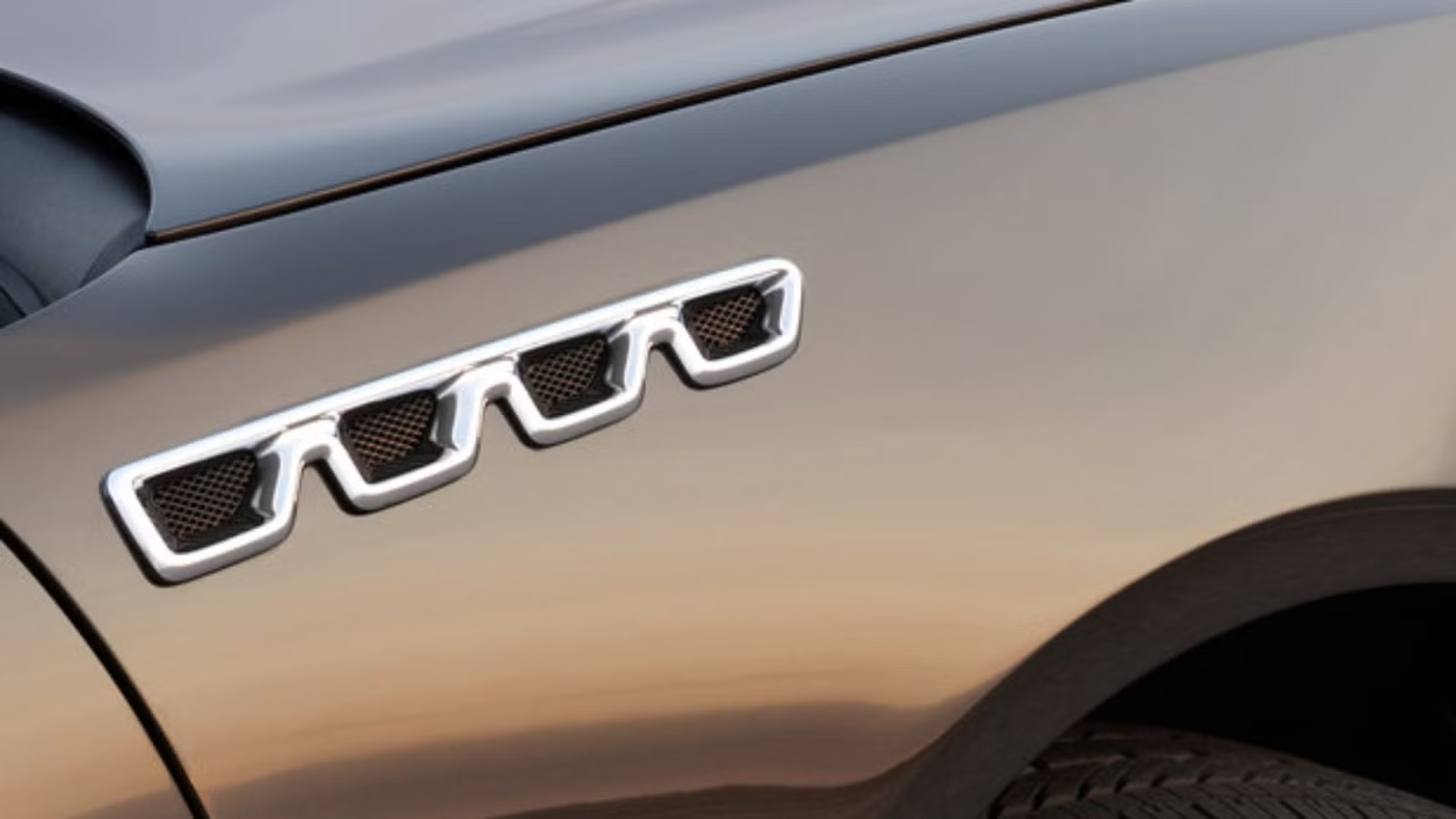
Buick spent two model years selling a sedan with 300 horsepower, four chrome portholes, and a 5.3-liter small-block V8 turning the front wheels. It cost $32,820 new and most people who saw one assumed it was a rental.

The V8 made 323 lb-ft of torque, but the four-speed automatic bolted behind it was not designed to handle that load, and GM built it anyway. That decision killed this car, and three others built on the same idea. The entire experiment of putting American V8 power through the front wheels was gone for good, but the story is much deeper.
GM Built An American V8 Sedan That Drove The Wrong Wheels
The LS4 was the only small-block V8 General Motors ever engineered for front-wheel-drive. Fitting a pushrod V8 to a front-wheel-drive car required a shortened crankshaft, a reworked accessory drive, and a bellhousing built for a transaxle instead of a driveshaft. It also became the first car engine to use Active Fuel Management, or what we call today “Cylinder Deactivation”, dropping to four cylinders under light load to save fuel.

Pontiac started it with the 2005 Grand Prix GXP, then Chevrolet followed in 2006 with the Impala SS and Monte Carlo SS, and Buick joined last with a sleeper sedan in 2008. All four rode on GM’s W-body platform, an architecture introduced in 1988, but it was never designed to manage close to 300 hp.
More than 60% of the weight in these cars sat over the front wheels, which was the root of the problem. Hard acceleration transfers weight rearward, away from the driven wheels, so grip disappeared at exactly the moment it was needed. A rear-drive muscle car gets the effect to its advantage.
The LaCrosse Super Had Four Chrome Portholes And Ran A 14-Second Quarter-Mile

The LaCrosse Super arrived in 2008 making 300 hp and 323 lb-ft, and Buick claimed 60 mph in 5.7 seconds. Period road tests, however, managed 6.2 seconds, plus a 14.6-second quarter-mile at 100 mph. The distance between claims in the brochure and the stopwatch turns out to be this car’s recurring theme.

Its 300 hp peaked at 5,600 rpm and peak torque came in at 4,400 rpm. Every LaCrosse Super used the same four-speed automatic, GM’s 4T65-E HD transaxle designed around the bell housing for front-wheel-drive application. Active Fuel Management let it cruise on four cylinders, so a car this quick could return something close to V6 economy on a highway run. Buick’s LS4 also made three fewer horsepower than the Chevrolet and Pontiac versions thanks to a quieter exhaust. Bilstein monotube struts, larger front and rear rotors, a high-precision steering gear, and recalibrated StabiliTrak were all standard.

The LaCrosse Super was easier to manage than the Impala SS, but rode marginally softer than the firmed-up Grand Prix GXP. This was due to less torque steer than the Chevrolet cars. The Super had noticeable body roll under load despite the grippy tires and a planted chassis, and the rear end went light in hard corners before stability control caught it. The Super was quick in a straight line and composed everywhere else, but it was never a sports sedan and Buick never claimed otherwise.

To visually stand out, four chrome portholes sat on top of each front fender, one per cylinder, borrowed from the functional VentiPorts of 1950s Buicks. Everything else looked identical to the rental-counter LaCrosse it shared a body with, down to the brown interior and fake wood trim, making it somewhat of a sleeper, but a headache for the dealerships to push out the showroom.
The Four-Speed Transaxle Was Not Built To Match The Torque

GM rated the 4T65-E family of transaxles to handle 280 lb-ft of torque, but the LS4 it was mated to produced 323 lb-ft. GM shipped the car anyway, with a 43 lb-ft overage designed from the first unit off the line.
The 4T65-E transaxle was engineered around the supercharged 3.8-liter V6 in cars like the Pontiac Grand Prix GTP, which made 240 hp and exactly 280 lb-ft. The heavy-duty version, RPO code MN7, added stronger internals and a larger torque converter, but reinforcing a gearbox is not that simple. Every V8 W-body inherited a transmission built for a supercharged V6.

GM already knew how to do this properly, because it had already done it. The 4T80-E transaxle had been in production since 1993, developed specifically for high-output front-drive V8s, and the fifth-generation Cadillac Seville STS used it with the 300-hp Northstar. Buick used the same transmission in a 2008 Lucerne. You could get the V6 with the 4T65-E, but order the Northstar V8 and the car came with the 4T80-E instead.
That means Buick sold two Super sedans in 2008. The Lucerne got the transaxle designed for a front-drive V8. The LaCrosse got the one designed for a V6, behind an engine making 43 lb-ft more than its rating.
Failures were common enough for rebuilds or replacements at around 60,000 miles, and a V8 this size in a front-driver always brings torque steer and a heavy nose. Those are two symptoms of one condition, because every bit of torque the front tires couldn’t put down when the nose lifted, went back into the driveline as shock loading.
Dodge Sold More Chargers In One Year Than GM Managed In Five

Chevrolet sold roughly 50,000 front-drive V8 Impala SS models across four model years, against 70,000 of the rear-drive 1994–96 version,
according to Hagerty. The Monte Carlo SS managed about 15,000 over two years and the Grand Prix GXP about 18,000 over four. Those are the mainstream cars in this family, before you get to the Buick.
Dodge sold 114,201 Chargers in the United States in 2006 and 119,289 in 2007. GM’s entire front-drive V8 experiment, across four models and five model years, did not add up to what one rear-drive rival moved in twelve months. Chrysler had only returned to rear-drive in 2005, having abandoned the layout back in 1989. American buyers weren’t rejecting big American V8 sedans, they were rejecting this particular way of building one.

Pontiac killed the Grand Prix after 2008 and replaced it with the G8 GT, a rear-drive sedan carrying a bigger 6.0-liter V8. The Monte Carlo SS ended in 2007, and 2009 took out both the Impala SS and the LaCrosse Super, with GM retiring the LS4 at the same time.
That 2009 Impala SS remains the last car sold with a V8 driving the front wheels, and is now a great used bargain. Chevrolet’s next serious V8 sedan was the Holden-built SS of 2013, which put the power back where the segment had always wanted it. The correction took seven years and four dead nameplates.
A 300-HP Buick That Now Costs Less Than A Used Civic

Kelley Blue Book currently puts a 2008 LaCrosse Super between $3,600 and $4,625 in a private sale, with trade-in values starting around $1,725. Asking prices run higher, and clean cars have been advertised near $10,100, though that figure rests on a single listing and KBB’s estimate for a 2009 car sits closer to $5,675.
Nobody can tell you exactly how many were built. GM never published a Super-only production breakdown by year or market, so every rarity claim attached to this car is an estimate rather than a ledger entry. What is certain is that it ran for two model years, that Canadian buyers got it badged as the Buick Allure Super, and that you almost never see one on the road.

Hagerty specialists don’t see a collector future for the front-drive V8 cars, because serious enthusiasts avoid front-wheel drive, and the values back up the claim.
If you want one, buy it as a cheap, fast, genuinely strange daily driver and leave it stock, because that’s the only version of this car that lasts.
Two decades on, the cheapest way into GM’s most misguided performance idea is still a set of classifieds and about the price of a used Civic. Perhaps it’s come full circle, as the 315-hp Civic Type R (or the 320-hp Integra Type S) is the most powerful FWD car on sale today, albeit with a four-cylinder.
Sources: General Motors, Buick, Hagerty, KBB

Related posts


Latest Post


No Comments