
The Motorcycle Engine That Defined Reliability For Generations
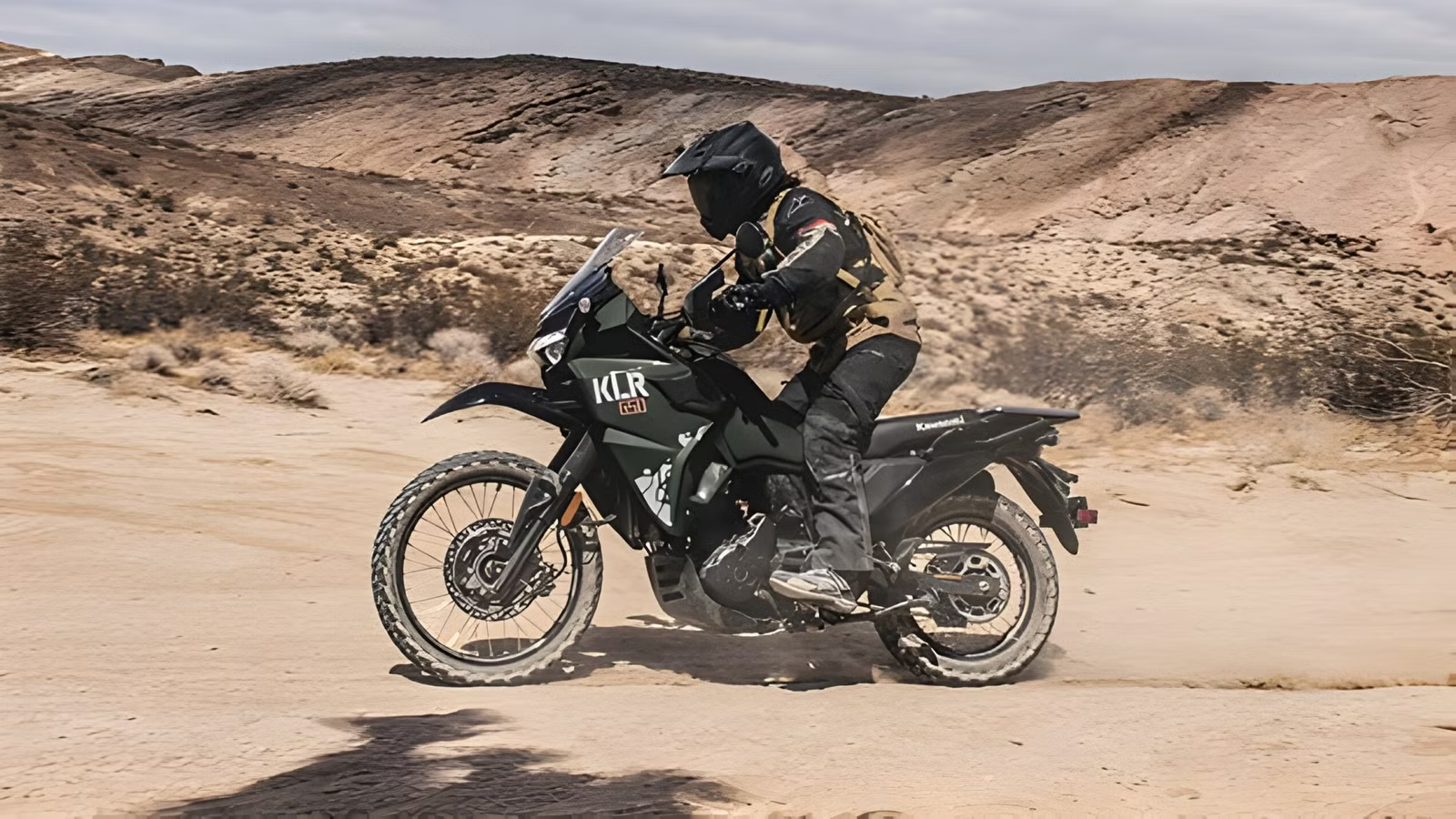
Reliability is having a moment. As adventure motorcycles grow heavier, more electronically complex, and increasingly dependent on dealer-level diagnostics, a growing number of riders are circling back to a simpler question: what actually keeps running? Modern fuel injection, ride-by-wire, cornering ABS, and semi-active suspension are genuinely impressive — but every layer of technology adds a potential failure point. Against that backdrop, one motorcycle engine has quietly kept making the case for a different approach, and it has been doing so for nearly four decades.
What Defines A “Reliable” Engine?

Reliability in a motorcycle engine is not just about whether it starts every morning. It is also about how little drama it creates in between. A reliable engine is one that can sit in traffic, climb a mountain pass, lug through dirt, and spend hours on the highway without constantly reminding the rider that it exists.

In practical terms, that means sensible tuning, manageable heat, predictable maintenance, and a design that does not rely on fragile complexity to feel smooth or modern. The other part of reliability is emotional, almost cultural. Riders trust machines that have earned their reputation the hard way: by being used hard, fixed in driveways, and kept in service for years.
Kawasaki’s 651cc Liquid-Cooled Single Defines Reliability


Kawasaki enters the reliability picture with the KLR650, which it markets around enduring reliability, fuel injection, a flat power curve, and enough torque to handle both trail work and freeway cruising. That is where the KLR650 stands apart. It has never been a poster child for peak performance. It has been a poster child for showing up. That matters, especially in a segment where adventure bikes can quickly become expensive, heavy, and electronically dense.
Understressed Engineering for the Long Haul

One of the clearest reasons the KLR engine has lasted so long is that it simply is not being pushed very hard. Kawasaki rates the current 652cc single at 40 hp at 6,000 rpm and 39.1 lb-ft of torque at 4,500 rpm — modest output for a 650-class motorcycle, particularly in a world full of high-strung twins making considerably more power. But the engine’s job is not to set records; it is to stay alive, stay usable, and stay calm when conditions get ugly.

That low-stress state of tune is part of the KLR’s charm. Because the engine is not chasing big numbers, it delivers its performance without feeling strained. Riders do not need to constantly wring its neck to make it useful. The torque arrives early and stays accessible, which is exactly what helps on rough tracks, loose surfaces, and long loaded rides. In other words, the KLR650’s engine is not exciting in the usual sense. It is reassuring, and that is often more valuable.
Liquid-Cooling In A Simple Package

The KLR’s engine is also liquid-cooled, which gives it a practical durability edge over purely air-cooled rivals in demanding conditions. Kawasaki states that the current bike features a liquid-cooled single-cylinder engine, emphasizing easy starting and dependable operation in colder conditions and at high altitudes. The company also emphasizes the KLR’s “go the distance” character.

Why does that matter? Because stable temperatures generally mean less mechanical stress. An engine that manages heat more consistently is less likely to experience the constant expansion and contraction cycles that can build up wear over time. That is not a flashy argument, but it is an important one. The KLR650’s cooling system is one of those quiet advantages that helps the bike remain useful when the weather is bad, the load is heavy, or the terrain is slow and technical.
A Nearly Four-Decade Evolution: Refining The Heart

The KLR650 entered Kawasaki’s lineup in 1987, and the first generation ran for two decades with only limited changes — on sale from 1987 until 2007. A major redesign followed in 2008, and a third generation arrived in 2022 that brought some significant shifts. Most notably, Kawasaki switched the KLR650 to fuel injection for the first time, improving cold starting, altitude performance, and midrange behavior.
The current engine uses a 40mm throttle body and retains a simple 5-speed gearbox, keeping the bike approachable rather than intimidating. The KLR has never been a machine that intimidates home mechanics. It still feels like something a practical owner could understand with basic tools, patience, and a service manual. That is one reason the bike has held onto its following for so long: the KLR does not hide behind complexity. It invites maintenance, and in a strange way, that builds trust.
Documented Longevity

KLR owners have long traded stories of very high-mileage machines, and the bike’s reputation in the adventure community is built on that kind of lived experience. It is common to hear of stock engines reaching six figures, though exact mileage claims naturally vary from owner to owner. A quick search through forums like Reddit, ADVRider, or KLR.net turns up KLRs with odometers crossing 60,000 or 70,000 miles — and we even found one KLR650 with 172,000 miles on it.

What is harder to dispute is the broader pattern — the KLR650 has been used for commuting, travel, camping, and even around-the-world riding precisely because it has a reputation for enduring use. That reputation is why Dr. Gregory W. Frazier, a prolific writer and motorcyclist, chose a KLR650 for his global circumnavigation ride in 2001 and 2002. It is not uncommon to hear owners praising the engine’s life expectancy in the same breath as a diesel truck.

Compared with many European adventure bikes, the KLR650 often makes a simpler case for solo travelers. It is cheaper to buy, easier to understand, and less dependent on a dense electronic safety net. Even a truck mechanic can work on it if something does go wrong. That does not make it better in every category, but it does make it easier to trust when the road turns uncertain and the nearest dealer is far away. That is a real advantage for a rider who values getting home over winning a spec-sheet contest.
Global Serviceability And Parts Availability

A motorcycle that has been in continuous production for decades develops an ecosystem around it. Parts, knowledge, forums, workarounds, and repair habits all accumulate over time. That is one of the KLR650’s biggest advantages, even if it does not appear on any spec sheet. The KLR’s long, stable production history and its large enthusiast base are exactly the sort of thing that keeps a model serviceable far from home.

For riders crossing states, countries, or even continents, that kind of support network matters as much as the motorcycle itself. A design that has been around for decades is easier to keep alive because someone, somewhere, has already solved the problem before. That is one of the reasons the KLR650 has remained a favorite for long-distance travel.
Managing The Achilles’ Heels

Sing as many praises as you like for the KLR650, and you still cannot deny its imperfections. The biggest complaint about the bike is its tractor-like thumper engine. Yes, it is bulletproof and simple, but it is also quite vibey. Modern single-cylinder engines have come a long way — some are nearly as smooth as twins — but the KLR’s is not among them. Despite dual balancing shafts and rubber-mounted contact points, many riders still report tingling in the fingers after a long highway stint.

Another common complaint is the suspension, which many riders find too soft and lacking in feedback. Those who push the bike hard off-road report that it is easy to bottom out, which is not something you want from a dual-sport. Kawasaki revised the suspension on the latest generation, but it remains a compromise rather than a strength. Beyond vibration and suspension, the bike carries two other well-documented issues: the infamous doohickey and a tendency toward oil consumption on older examples.
“Doing The Doo”: The Idler Shaft Lever

No motorcycle legend is complete without a flaw, and the KLR has one so famous it has its own nickname. The “doohickey” — the balancer chain adjuster lever — became part of KLR folklore after first-generation bikes developed a reputation for weakness in that area, a concern that spread widely across owner communities in North America. Aftermarket companies eventually responded with stronger replacement parts, and the problem became as much a cultural talking point as a mechanical one.

It is worth being fair here. Not every KLR failed in dramatic fashion, and even Kawasaki’s own engineers have pushed back against some of the internet mythology surrounding the issue. Still, the aftermarket developed around it for a reason, and that alone tells you how seriously riders took the concern. The upside is that the KLR community responded with solutions, and those solutions became part of the bike’s identity.
The Oil-Burning Enigma

Another KLR talking point has been oil consumption, particularly on some earlier generations. Certain pre-2008 bikes were noted for excessive oil use, and owners often adopted the practical workaround of carrying extra oil on long trips. That is not especially glamorous, but it is very KLR. The bike has always asked for common sense more than perfection.
The KLR650 Has Very Few Big Single-Cylinder Dual-Sport Alternatives Today

The KLR never completely chased the high-tech trend, and there is a certain honesty in that. It knows what it is: a rugged dual-sport with enough road manners to commute and enough dirt ability to keep life interesting. Kawasaki’s current lineup reflects that balance with multiple trims, including the standard KLR650, the lower-seat KLR650 S, and the Adventure ABS version. Pricing starts around $7,000 for the standard variant, with the ABS version carrying a modest premium.

As for the market around it, the big, simple single-cylinder dual-sport is not as crowded a space as it once was. There are certainly other adventure and dual-sport motorcycles on sale in the U.S., but few combine the KLR’s low price, long history, large fuel tank, and deliberately uncomplicated engineering. Some notable 650cc alternatives include:
- Suzuki DR650
- Honda XR650L
- Suzuki V-Strom 650XT
Source: Kawasaki, online forums

Related posts


Latest Post


No Comments