
The Cobra Jet-Powered Ford Coupe Buyers Shunned Over The Wrong Roof Shape
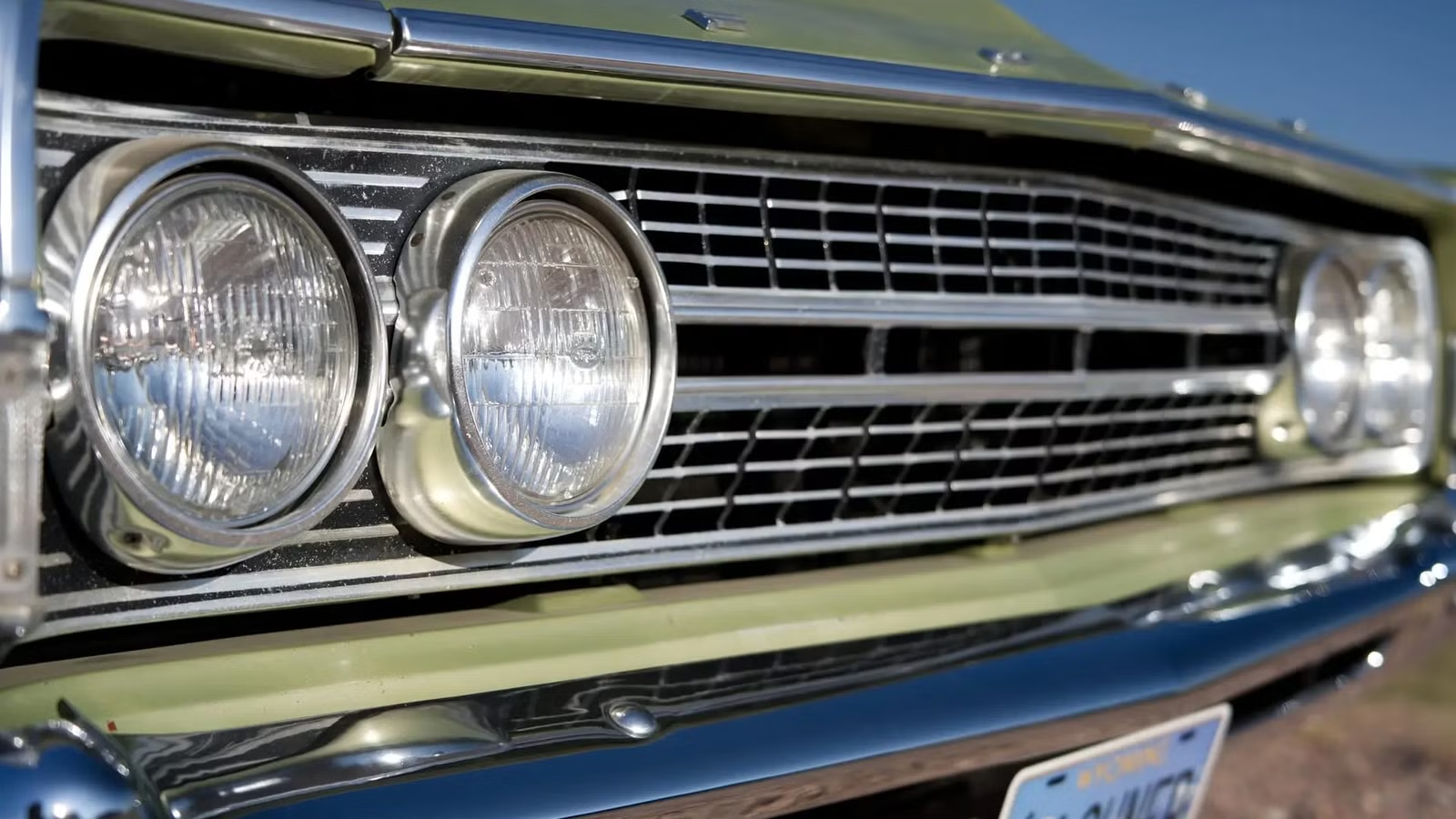
While plain-looking muscle cars are often prized by collectors as rare sleepers, they often got off to a rough start. Without an aggressive, flashy style, many drag strip weapons were dismissed as grocery haulers for families. One Ford coupe was called boring despite having Cobra Jet power hidden under the hood. The primary issue was related to its conservative roof shape that failed to land with muscle car fans of the era. Now collectors have no idea what they’re missing.
Ford Needed To Fight The Chevelle SS And Pontiac GTO

In the late 1960s, Ford lacked an affordable, mid-size option to fight intermediate rivals from General Motors like the Chevrolet Chevelle SS and Pontiac GTO. So, it needed to steal buyers away from competitors — buyers looking for something with more space than a compact car but with less bulk than a full-size vehicle.
Building a price-friendly option was part of the plan, as the more expensive 1968 Ford Torino trim debuted in 1968 for upscale, luxury buyers. The Torino had an original MSRP of between $2,743 and $3,020 depending on the body style of the entry-level model. These prices were a bit steep at the time.
On that note, the 1968 Chevy Chevelle SS started at about $2,899 to $3,102, and the Pontiac GTO had an original MSRP of roughly $3,101 to $3,400 depending on the body style of the base models before any extra power or additional options. Once Ford realized it had the opportunity to undercut these muscle cars, the company went all in.


However, it didn’t want to leave any potential buyers isolated, so the new coupe needed to be ready to compete at various market levels, as everything from a drag strip brawler to a comfortable highway cruiser. Therefore, one model got a bland style while retaining the ability to scare General Motors owners at red lights.
The 1968 Ford Fairlane 500 R-Code Cobra Jet 428 Dominated Drag Strips

In 1968, the Ford Fairlane was redesigned to meet a variety of needs, from intermediate cruisers with more space to athletic and sporty options for luxury-oriented buyers with the upscale Torino trim level. Ford also had a reputation for winning drag races, so the Ford Fairlane 500 R-Code 428 was born. The base model started at close to $2,591 and $2,679, undercutting other cars, but the drag strip power increased the starting cost to $3,737.28.
The 500 R-Code included the 428 cubic-inch (7.0-liter) Cobra Jet V8 with a factory-rated 335 horsepower and 452 lb-ft of torque. However, historians believe these figures are underrated, as dyno tests show that its output is closer to 400 hp and 452 lb-ft of torque. This car flies from 0 to 60 mph in about 5.5 seconds and completes a quarter mile in around 13.9 seconds with a top speed of 125 mph.
With the 428, the Torino could reach 60 mph in nearly 6.3 seconds, with a quarter-mile time of 14.2 seconds and a top speed of 134 mph. The Chevy Chevelle SS 396 L78 delivers 375 hp and 415 lb-ft of torque. It accelerates from 0 to 60 mph in around 5.8 seconds with a quarter-mile time of about 13.6 seconds.
Here’s Why The 1968 Ford Fairlane 500 Hardtop Failed To Compete
The 1968 Ford Fairlane was spread across multiple configurations, including a two-door hardtop with a formal roof, a fastback or sports roof design, a convertible, a four-door sedan, and a station wagon. This made it difficult to stand out in any particular area, especially as it became overshadowed by the more popular Ford Mustang and upscale Torino GT models. Because of its bland, traditional flat-roof hardtop style, the car was seen as a conservative family hauler instead of a high-performance drag strip weapon.
It wasn’t pushed as heavily as the flashier and more aggressively styled Torino. Plus, the smaller Ford Mustang was already benefiting from explosive success as an affordable pony car for younger buyers and racing fans to enjoy.

This caused the Fairlane 500 428 to become hidden in plain sight. Unlike R-Code Mustang models, the Fairlane has a flat hood instead of a functional ram-air hood scoop. But under the body, you will find upgraded heavy-duty suspension components and a robust nine-inch rear axle with a 3.89:1 gearing ratio to manage immense torque.
Plus, the 428 Cobra Jet engine features a single four-barrel Holley carburetor paired with specialized low-riser cylinder heads, heavy-duty blocks, and a cast-iron intake manifold. Power-assist front disc brakes were included to confidently stop this beast. However, to reduce its weight for racing, the interior was stripped down and lacks creature comforts like a radio, air conditioning, and power accessories.
Collectors Still Sleep On The 1968 Ford Fairlane 500 Hardtop

Now the formal-looking car still gets passed up by buyers for flashier options despite having Cobra Jet power. It’s quite rare, as only about 22 models may have been built. 1968 Ford Fairlane 500 R-Code 428 models in average condition typically sell for around $45,000, but models in excellent condition go for nearly $100,000. Some models in pristine condition with the fastback roof will push towards $120,000.
Meanwhile, 1968 Ford Torino GT 428 models fetch between $60,000 and over $100,000. 1968 Ford Mustang Cobra 428 Cobra Jet models in good condition sell for between $80,000 and $100,000. Models in excellent condition fetch roughly $110,000 to $150,000, as pristine examples cross the auction block for over $150,000.
The more powerful and popular 1968 Chevrolet Chevelle SS model with the 396 ci L78 engine sells for between $40,000 and over $100,000, depending on condition and configuration. Models with the four-speed manual transmission fetch higher premiums. About 62,785 models were made, making it remarkable that it commands prices on par with the much rarer Fairlane 500 R-Code.
Source: Ford, How Stuff Works, Classic Cars Arena

Related posts




Latest Post


No Comments