
The Bike That Offers Harley Presence With Japanese Reliability
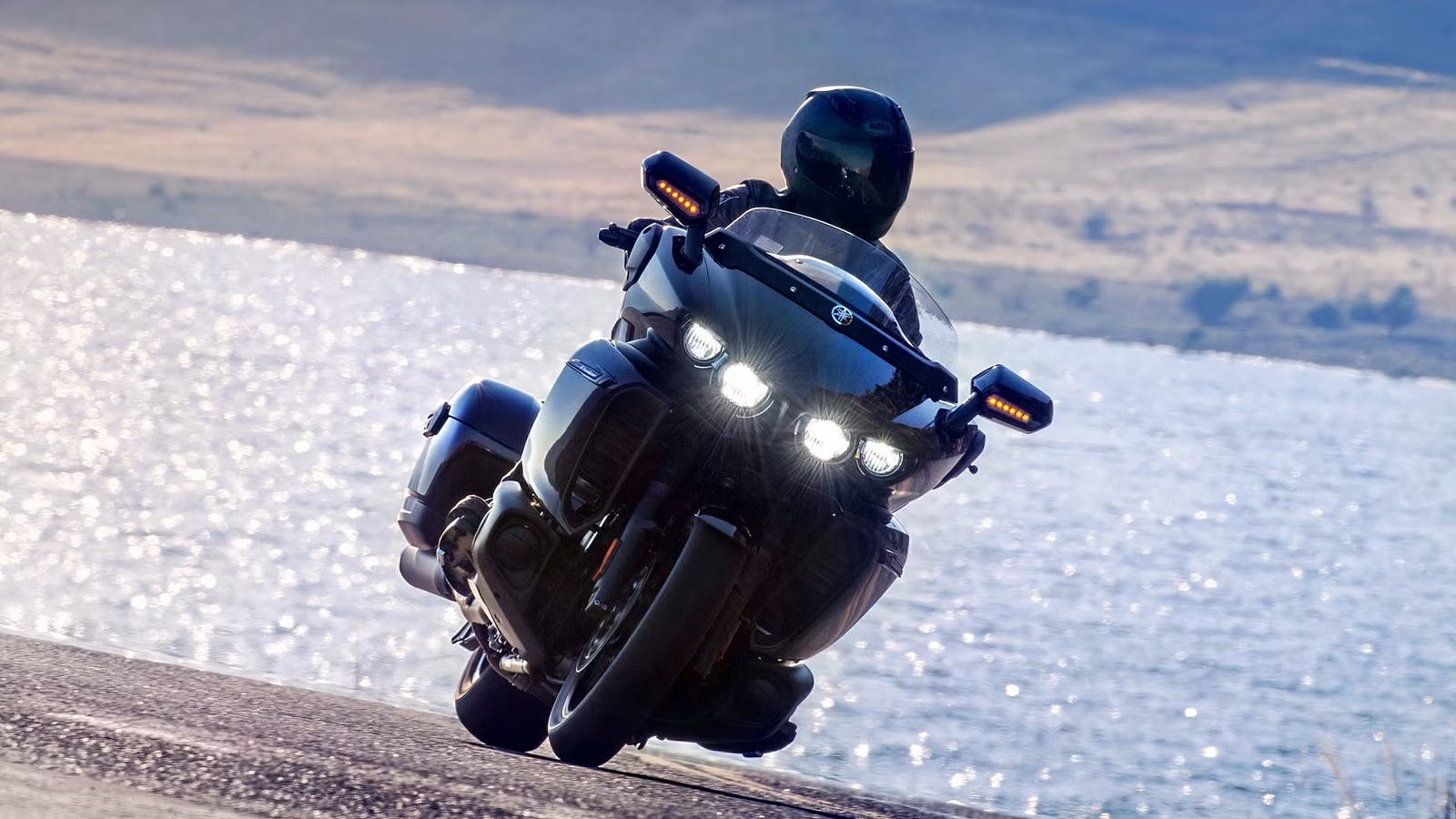
America made the bagger a rolling statement for the world. It’s a category of motorcycle that combines a broad fairing, hard saddlebags, a huge V-twin, all making up for substantial road presence, and that’s part of its appeal that still woos customers with the look. And there’s function to the form as well. Big touring motorcycles cross states, come heat, rain, wind, traffic, and the occasional questionable overnighter in motels. They haul luggage, passenger gear, and enough paraphernalia to support a small expedition.

Yamaha understood that touring motorcycles have a niche popularity stateside, enough to take a dig at it with its own offering. Its existing heavyweight touring motorcycle already looked ready for Main Street in Sturgis, yet its equipment list reflected the detailed thinking that’s expected from a Japanese manufacturer. The result stood apart from the usual American bagger formula while still embracing the parts that make these motorcycles special. Today, this is a used bargain like no other.
American Bagger Presence Has A Purpose
Harley-Davidson sits at the emotional center of the bagger market and with reason, as its touring lineup established the bagger template over four whole decades. The 1965 Electra Glide paired a big V-twin with hard saddlebags and a windshield, while a factory fairing was fitted to it in 1969, becoming standard in 1971. Years later, the 2006 Street Glide sharpened the formula with a chopped windshield and trunk-free, slammed profile.


This evolution is what created the silhouette of the modern-day American bagger. Indian offers another deeply American interpretation of its own, blending vintage cues with modern equipment. While BMW, with products like the K 1600 B, and Honda both approach touring from a more technical direction, often favoring performance, convenience, and long-distance capability over traditional cruiser theatrics. But a true bagger needs to satisfy both sides of the equation.
But Reliability Is Equally Important

Riders picking up this category of cruiser expect a low, yet comfortable seat, wind protection, large storage capacity, and massive low-end torque to cruise comfortably at highway speeds. The chassis also needs poise when a loaded bike meets rough pavement or to withstand a gust of wind from a passing semi. There are well-rounded luxury tourers, but they can feel overly insulated and uninvolving, while stripped cruisers ask their owners to build the touring ability through accessories. The sweet spot combines the drama and character of a large-displacement V-twin with enough equipment for a 500-mile day.

In 2018, Yamaha entered the category aiming squarely at that sweet spot. It paired a huge air-cooled V-twin with modern tech like traction control, linked ABS, cruise control, keyless ignition, and an ambitious infotainment suite. The styling carried a distinctly modern edge, with sharp bodywork and blacked-out details. Its mission, however, was to cover America’s open roads in comfort while looking suitably imposing to go up against the established big dogs of the segment.
The Yamaha Star Eluder Was A Japanese Take On The American Bagger

The Yamaha Star Eluder made its appearance in 2018 following the Star Venture luxury tourer, as the sleeker sibling. Yamaha removed the Venture’s trunk and passenger backrest, fitted a shorter windshield, and gave the Eluder darker finishes. Those changes cut 82 pounds from the larger touring platform while retaining its key mechanical components.

At 875 pounds wet, the Eluder was closer to a full-size bagger, and its 67.6-inch wheelbase, wide fairing, long floorboards, and 200-section rear tire created a substantial silhouette. A 27.6-inch seat height kept it approachable for a wide range of riders, also being a useful trait when muscling nearly 900 pounds of motorcycle. At the time, the standard Eluder carried a $22,499 price tag, rising to $23,999 for the GT Option Package that added navigation, SiriusXM radio capability, a CB radio, and an alarm.

Both versions came with keyless ignition, cruise control, and traction control. Yamaha equipped it with a 6.6-gallon fuel tank, estimating 34 mpg for the Eluder for a theoretical range of roughly 224 miles. Elsewhere, its locking saddlebags and right fairing pocket offered 19 gallons of total storage capacity, which was enough room for genuine touring gear rather than an overnight bag with just the essentials.
A 113 Cubic Inch V-Twin Built For Highway Miles

The Star Eluder used Yamaha’s 1,854cc, 48-degree, air-cooled V-twin. That equals 113 cubic inches, placing the engine squarely in big-bore bagger territory. Yamaha rated it at 126 lb-ft at 2,500 rpm, figures that explain its relaxed, low-rev character that’s expected of a bagger. Pushrods and air cooling gave the engine its classic V-twin visuals while dual counterbalancers and composite engine mounts kept the vibrations in check.

The result kept the mechanical character present while making extended highway riding easier on a rider’s hands and backside. A six-speed transmission with fifth and sixth gears serving as overdrives and a belt final drive fits the Eluder’s touring mission just as much. Yamaha also included a hydraulic slipper-and-assist clutch, which reduced lever effort in traffic and helped smooth aggressive downshifts.
The Eluder’s Chassis Complimented The Engine

Yamaha fitted the Eluder with ride-by-wire throttle control and riding mode settings labeled Touring and Sport. Touring softened the initial throttle response, while Sport gave the engine a sharper alter ego. The rider could choose calm, measured inputs for about-town cruising or quicker reactions for freeway merges and overtaking, and at all times be covered by the restraint of the traction control system.

The steel double-cradle chassis used a die-cast aluminum rear subframe to support the added weight of luggage and a passenger while being suspended by a 46mm fork providing 5.1 inches of travel up front. The rear suspension used a linkage-assisted shock with remote preload adjustment and 4.3 inches of travel. Dual 298mm front discs with four-piston calipers paired with a 320mm rear disc for handling braking duties. Yamaha’s Unified Brake System linked both brakes, while ABS and electronic brake-force distribution added a welcome safety net for a motorcycle of this size.
The Star Eluder’s Touring Technology Set It Apart

Being a fairly recent bagger, the Eluder packed a good level of tech. A seven-inch touchscreen looked thoroughly modern alongside its analog speedometer and tachometer. Yamaha fitted Bluetooth connectivity, USB input, Pandora integration, voice-command functions, and trip information to the screen. GT models further added navigation, while riders could access the touchscreen functions through the left-hand controls.

The system asks for some familiarization, especially compared to today’s smartphone-first interfaces, but its breadth of tech is still impressive for a 2018 bagger. Four LED headlights gave the Eluder a distinctive front-end signature and strong nighttime illumination. Yamaha also fitted a 750-watt electrical system, providing ample capacity for accessories. As it’s only available on the used market, the bike inspection should definitely include a thorough check of the infotainment system, Smart Key functions, saddlebag latches, and every electronic control.
Yamaha Star Eluder Rivals Still Include Harley-Davidson and Indian

The Star Eluder’s strongest argument now comes from its used prices. Nationwide listings show asking prices from $11,665 to $14,999, averaging $13,548 on Cycle Trader. Kelley Blue Book, on the other hand, puts a 2018 Eluder in good condition with typical mileage at $10,700 for dealership trade-in value. If you consider the value packed into this bagger versus a current showroom alternative like the $25,999 2026 Harley-Davidson Road Glide or even the retro Indian’s $23,999 Springfield for 2026, then the Eluder is quite simply an astonishing bargain.

Of course, the newer Harley and Indian models bring major advantages with stronger engines, deeper rider-assistance packages, and their displays feeling generations newer. There’s the added advantage of both brands providing active dealer network support. But then again, for a rider chasing big-bagger presence alongside genuine touring equipment, the Yamaha Star Eluder offers uniqueness at roughly half the price, making it a compelling value play.
Source: Yamaha, Cycle Trader, KBB

Related posts

Latest Post


No Comments