
The Three-Wheeler That Quietly Changed Touring Forever
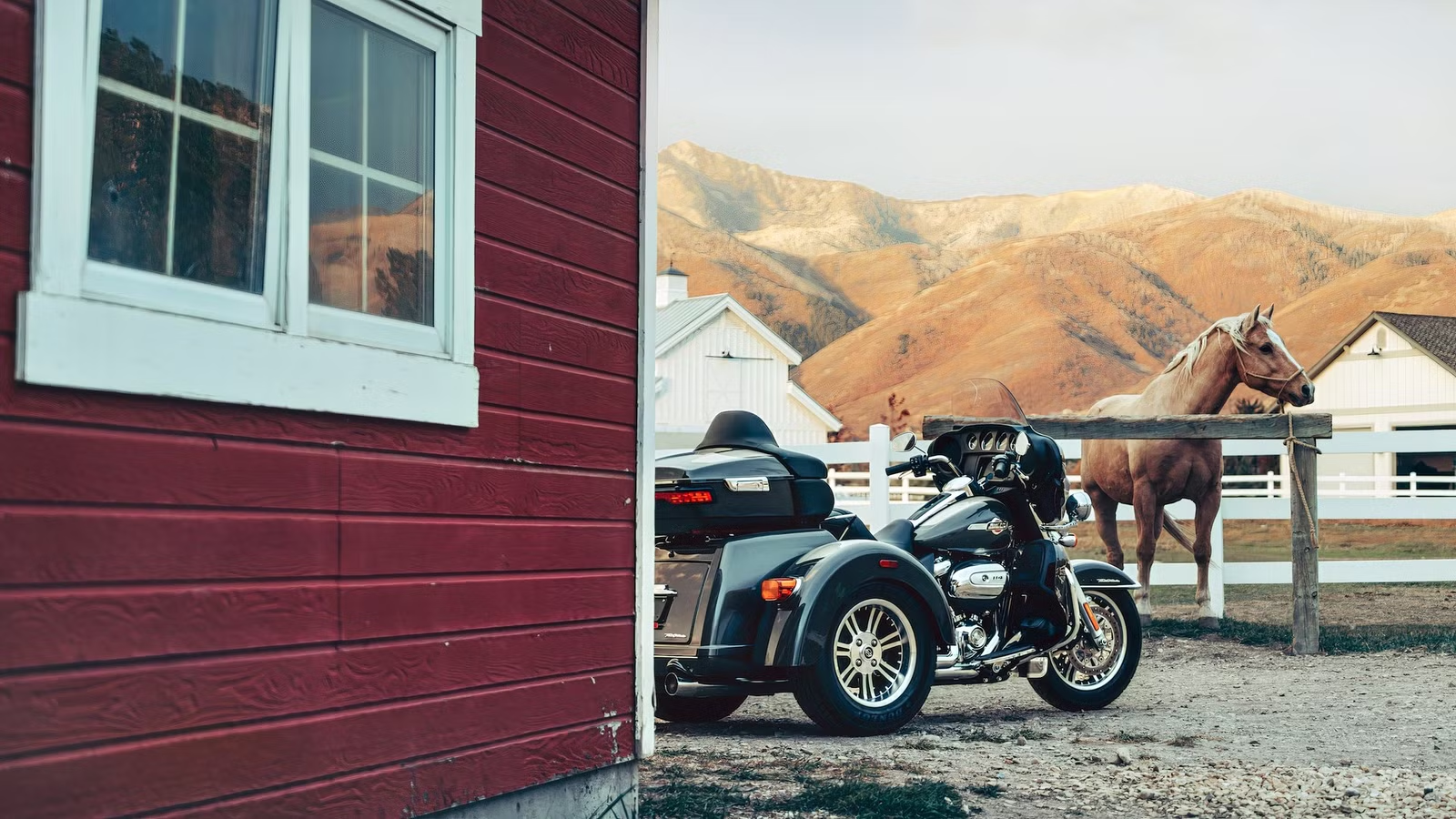
Three-wheel touring was already well established by the late 2000s, but buying one at the time usually meant converting an existing motorcycle. This was executed in the aftermarket, as there were no factory-produced alternatives. So people used Honda Gold Wings and Harley touring motorcycles as starting points, yet the finished machine depended heavily on the conversion kit and the shop that installed it.

That left room for something more cohesive, backed with the kind of support that comes with a regular two-wheeled motorcycle directly from the manufacturer. Rather than treating the trike as an aftermarket niche, one Harley-Davidson decided to engineer, sell, and service one as a complete motorcycle with factory warranty. Nearly two decades on, three-wheel tourers remain firmly embedded in its lineup.
Factory Trikes Were Ready To Become Mainstream
Harley-Davidson had its own three-wheel history through the Servi-Car, going back all the way to 1932 and remaining in production until 1973. By the 2000s, however, riders wanting a touring trike generally relied on specialist conversions as nothing existed in the interim. Harley recognized that demand and entered a partnership with Lehman Trikes in 2006 before taking the concept considerably further.


Instead of simply approving a conversion, Harley developed a dedicated chassis and integrated the bodywork, steering geometry, braking system, luggage, and drivetrain around three-wheel use. Customers could consequently buy the finished motorcycle through Harley dealers complete with a two-year factory warranty. That shift from aftermarket conversion to an original-equipment product would prove far more significant for trikes at the end of the decade in the 2000s.
The Harley-Davidson Tri Glide Ultra Classic Was The Turning Point

The 2009 Harley-Davidson Tri Glide Ultra Classic arrived with a staggering $29,999 price for the time, and carried most of the familiar long-distance equipment from the Ultra Classic Electra Glide. Beneath it, though, was a chassis developed specifically to handle the different loads generated by a three-wheeler. The initial final assembly was carried out by Lehman before Harley moved its trike production to the York, Pennsylvania facility for the 2011 model year.
Its Twin Cam 103 Was Geared For A Much Bigger Job

The Tri Glide used Harley’s air-cooled 1,690 cc Twin Cam 103 V-twin, officially rated at 101 pound-feet of torque. It retained the six-speed Cruise Drive transmission and belt final drive, although Harley revised the overall gearing to suit the considerably greater mass of the three-wheeler. More important for day-to-day use was the optional $1,195 electric reverse, which operated through the rear differential and was controlled from the handlebar, and was a necessity on a machine weighing well over 1,000 pounds.
In 2014, revised marketing dropped the “Classic” name from the model, and Harley moved the Tri Glide Ultra to the Twin-Cooled Milwaukee-Eight 107 for the 2017 model year as part of the new engine family’s rollout across its Touring range. Two years later, the 2019 Tri Glide stepped up again to the larger 1,868 cc Milwaukee-Eight 114, bringing more displacement and torque to a machine that had always asked plenty from its engine given the extra weight.
The Chassis Was Designed Around Three-Wheel Steering

It’s a well-known fact that a conventional motorcycle leans to change direction. A trike has to be physically steered, as the physics are similar to that of a car, which means it leans outwards in a turn. This places very different loads on the front end of a trike and, to compensate, Harley lengthened the fork by nearly 1.8 inches and increased the rake from 29.25 to 32 degrees. These changes helped reduce steering effort by as much as 25 percent, as per Harley. A steering damper also helped manage unwanted movement from road inputs.

Passenger and luggage weight compensation also had to be accounted for as much as handling. So at the rear sat a new axle assembly with an aluminum center section and steel axle tubes, supported by twin air-adjustable shocks. Brembo dual front discs worked with Hayes dual rear discs, while a mechanical parking brake was incorporated into the rear system. It remained a heavy machine to hustle through corners, but the engineering addressed the fundamental problem of turning a heavyweight tourer into a usable trike rather than simply adding another wheel at the back.
Touring Practicality Was Built Into The Design

The Tri Glide inherited much of what had already made the Ultra Classic a serious distance machine. Cruise control, the fork-mounted batwing fairing, lower fairings, a Harman/Kardon audio system, CB radio, intercom, passenger backrest, and King Tour-Pak were all part of the package. A six-gallon fuel tank meant that fuel stops were decently spaced out too.
The more important change sat behind the passenger. Harley designed a 4.5-cubic-foot rear trunk into the bodywork, taking the combined luggage volume with the Tour-Pak to 6.56 cubic feet and providing an 80-pound carrying capacity. That made the Tri Glide a genuine two-up touring motorcycle rather than merely a mobility-focused adaptation.
The Real Breakthrough Was Factory Integration

Aftermarket trikes could already provide stability, luggage capacity, and long-distance comfort. What the Tri Glide changed was the process of getting all three together from the factory. Buyers no longer had to purchase a motorcycle, sift through a selection of conversion kits, find an installer who could execute the job reliably, and then deal with a machine assembled from components supplied by different companies.
With the Tri Glide Ultra, Harley offered a complete vehicle with matching paint, integrated bodywork, purpose-designed chassis hardware, dealer servicing, as well as factory warranty coverage. In hindsight, that sounds obvious, but in 2009, it represented a major shift in how large touring trikes were sold, and Harley has continued developing the format ever since.

Nearly two decades later, the 2026 lineup shows just how far the idea has traveled. Harley’s current trikes receive a newly engineered rear suspension that substantially reduces unsprung mass and provides 5 inches of rear-wheel travel, addressing one of the biggest dynamic compromises of the older solid-axle machines. The latest Street Glide 3 Limited also produces 105 horsepower and 129 pound-feet from its 1,923 cc Milwaukee-Eight 117 while adding a 12.3-inch Skyline OS display and modern rider-assistance technology.
Used Prices Make The Original Tri Glide An Interesting Alternative

Years of depreciation have made the Harley-Davidson Tri Glide Ultra Classic considerably cheaper. Kelley Blue Book’s typical U.S. listing price for a 2009 model hovers at around $12,350 in good condition with typical mileage, while current asking prices generally fall in the $13,000 to $18,000 range depending on mileage, condition, and accessories. That is far below Harley’s current line of trikes.
As a refresher, the 2026 Road Glide 3 starts at $35,399, while the more touring-focused Street Glide 3 Limited starts at $39,199. Both bring the newer Milwaukee-Eight 117, modern electronics, and Harley’s redesigned rear suspension, so the engineering gap is also substantial. The Can-Am Spyder RT Limited is another strong alternative at $31,999, pairing a 1,330cc Rotax triple with a semi-automatic transmission, reverse, stability control, and a fundamentally different two-front-wheel and one-rear-wheel layout.

The old Tri Glide is therefore a value play rather than a performance or technology pick. It remains heavier to steer, less sophisticated, and far more basic electronically, but it delivers the original factory-built Harley touring-trike formula for a fraction of the cost of a new equivalent. More importantly, it is the model that proved there was a growing market for Harley to keep refining that formula nearly two decades later.
Source: Harley-Davidson

Related posts

Latest Post


No Comments