
This $15K Plymouth Embarrasses Road Runner Owners Paying Six Figures
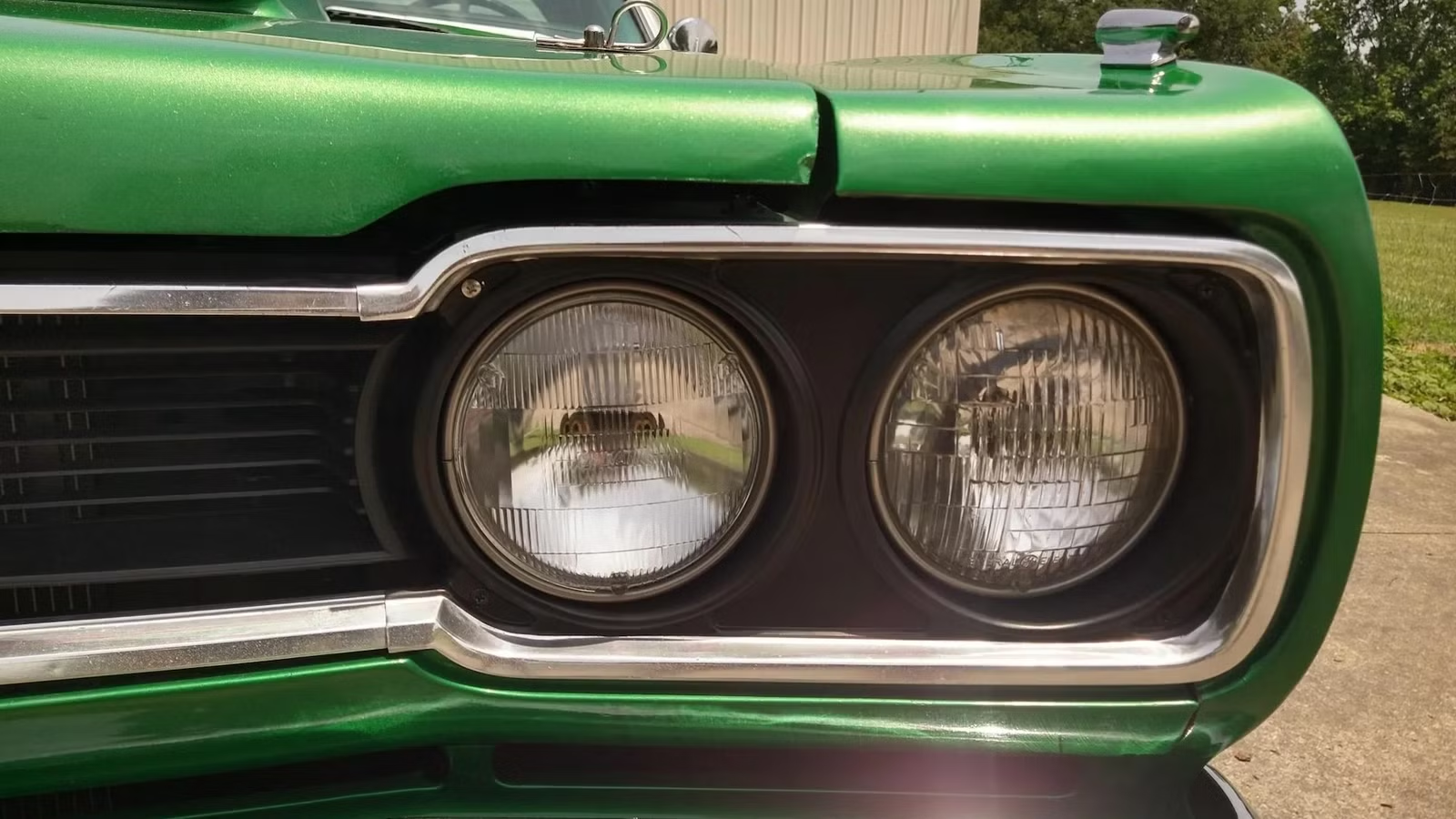
An iconic muscle car sits in the shadow of the Plymouth Road Runner, yet it runs the same 383 engine for far less. At first, both B-body models differed by only $70, but now you can save thousands with this forgotten powerhouse. It’s a mechanical twin of the Road Runner but doesn’t have the expensive badge tax that prices collectors out of the market. It is a bargain with nearly a $26,000 spread.

In the late 1960s, Plymouth felt like something was missing from the lineup. It wanted to build a muscle car to slot between the Plymouth Road Runner and the Plymouth GTX. Even though the Plymouth Road Runner can fetch over $100,000 today, it started as a budget-oriented model. The interior was spartan with no frills, so Plymouth sought to provide a more refined level of comfort.
But on the other end of the spectrum, the Plymouth GTX was seen as a gentleman’s muscle car with upscale luxury and opulence. It is also a high-performance car that features more standard components, such as a heavy-duty suspension package, to better handle more power at higher speeds without compromising comfort.
On top of needing an intermediate model, Plymouth wanted to refresh its brand and image by moving away from the aging Belvedere moniker. The older badge was in use for nearly two decades with a traditional reputation as a family car, while the muscle car craze was escalating. Dropping the name also helped simplify the lineup.

The 1968 Plymouth Sport Satellite Borrows From The Road Runner And GTX

The intermediate gap was filled by the 1968 Plymouth Sport Satellite, which was built on the B-body platform, like the Road Runner and GTX. It was available with the 383 cubic-inch (6.7-liter) big-block V8. The four-barrel high-performance option delivers 335 horsepower and 425 lb-ft of torque.
It can accelerate from 0 to 60 mph in about 5.9 seconds and complete a quarter mile in around 14.5 seconds at roughly 95 mph. This car has a top speed of about 125 mph. While it didn’t originally come with the 440 engine, it’s a popular swap since the Sport Satellite shares the same basic body as the GTX, as well as the fact that a 383 and 440 are largely interchangeable—short of some internals and top end components. Also, the Road Runner didn’t get the 440 engine until the middle of 1969, making it and the Sport Satellite closer siblings than many might have thought.
It’s a mechanical twin of the Road Runner with the same suspension setup, steering systems, and chassis components. The Sport Satellite also shares core structural inner panels, doors, and exterior contours with other B-body models. It has the same blacked-out grille with horizontal blades that was paired with the original Road Runner.

Like the GTX, the Sport Satellite features the same torsion-bar front suspension, exterior sheet metal, die-cast trim components, and high-end body moldings. These cars are both available with two-door hardtop and convertible body styles with an identical interior layout and luxury offerings like front bucket seats, a full-length center console, and pseudo-wood dash.
Why Collectors Sleep On The 1968 Plymouth Sport Satellite

Unfortunately, the middle child didn’t do as well as its siblings. During its run from 1968 to 1970, it sold about 67,275 units. About 20,014 were two-door hardtops. Meanwhile, the Road Runner sold about 162,500 to 169,000 units. The Plymouth GTX sold only about 42,248 units, but has more of a cult following today, since it had more standard power and racing components.
The Sport Satellite was marketed as an upscale model with plenty of comfort instead of a lightweight, budget-friendly muscle car like the Road Runner. It features more chrome trim and is designed with a softer suspension for a smooth ride rather than drag strip dominance. The Road Runner had more appeal for youthful buyers looking for thrilling raw power.

Plus, the Road Runner became a pop-culture icon as it won Motor Trend’s Car of the Year in 1969. It features the name, image, and unmistakable “beep-beep” of the Warner Bros. cartoon Road Runner, which still resonates with enthusiasts today. It captured the rebellious spirit of the golden era of muscle car culture.
The Plymouth GTX benefited from being marketed as an uncompromising, high-end, high-performance model with a standard 440 cubic-inch V8 and an available 426 Street HEMI engine. The Sport Satellite was also available as a four-door sedan and station wagon, giving it a reputation as a family hauler, while the GTX was exclusively offered in two-door body styles.
Now The Plymouth Sport Satellite Is A Bargain

Back in the day, the Plymouth Sport Satellite had a similar price to the Road Runner. The two-door hardtop option added about $255, bringing the starting price to about $2,966, making it roughly $70 more than the 1968 Plymouth Road Runner, which had an original price of roughly $2,896. Now, as a Road Runner or GTX alternative, it offers thousands in savings.
Values for the Plymouth Sport Satellite range between $7,600 and $16,500 for models in project condition. The cost for models in average condition ranges between $20,100 and $37,000. Models found in pristine condition or rare convertible options fetch from $29,400 to over $52,000. Recent examples of hard-top and convertible models with 440 engines have been selling around the $30,000 mark.

1968 Plymouth Road Runner models in project condition fetch between $14,450 and $20,000. Then cars in good, running condition sell for about $33,500 to $48,000 depending on the engine options. Models in pristine condition sell for over $57,300, while rare configurations or models with the 426 Hemi go for well over $100,000.
1968 Plymouth GTX models in project condition sell for about $18,000 to $20,000, even if they need a full restoration. Cars found in good condition go for an average of $46,000 to $55,000. Then models in pristine condition cross the auction block for between $75,000 and $110,000, while rare convertibles or models with the HEMI engine go for between $135,000 and over $187,000.
Source: How Stuff Works, Hagerty, Mecum

Related posts






Latest Post


No Comments