
The Fuel-Injected Pontiac That Beat The GTO To The Muscle Car Movement
Pontiac’s place in American muscle car history now feels inevitable, but the division entered the late ’50s with a very different problem. Younger buyers weren’t exactly plastering Pontiac posters on bedroom walls.

Then General Motors decided Pontiac needed horsepower more than another helping of respectability. The resulting performance push produced a factory hot rod years before the Pontiac GTO turned the same basic idea into a nationwide obsession.
Pontiac Had An Image Problem Before It Had A Performance Problem
When Semon E. “Bunkie” Knudsen took charge of Pontiac in 1956, he inherited a brand that had become painfully easy to overlook. Pontiac occupied the middle of GM’s hierarchy, but its conservative image wasn’t helping it attract the younger American buyers who were increasingly interested in horsepower and performance. Chevrolet felt more youthful, while Pontiac risked becoming something your father bought after deciding he was too sensible for a Cadillac.
Knudsen understood that an image problem couldn’t be fixed with another chrome strip. Pontiac began abandoning styling cues associated with its older identity, including the familiarSilver Streak trim, while performance and racing became far more important to the division’s public image. The goal was to make Pontiac desirable over and above everything.
It’s just that, at the time, it wasn’t particularly convenient. The 1958 recession hammered U.S. auto sales, with domestic production falling from roughly 6.1 million vehicles to around 4.3 million. Mid-priced American cars were particularly vulnerable, so Pontiac was trying to reinvent itself in the kind of market that gives accountants pause. Knudsen pushed ahead anyway, and the hardware soon became much more interesting.
Bunkie Knudsen Started Building The Muscle Car Formula Early

Pontiac’s 1958 transformation went much deeper than advertising. Its V8 grew from 347 cubic inches to 370 cubic inches through a larger bore, allowing its engineers a stronger foundation for the sort of factory performance Pontiac wanted to sell. The division could now offer ordinary buyers substantially more power without asking them to visit a speed shop afterward.
Pontiac also moved its performance flagship onto a 122-inch wheelbase, two inches shorter than the Star Chief’s, and limited the body choices to a two-door hardtop and convertible. That last bit is key here because, when looking back at American muscle car history, the basic thinking had started to resemble what Detroit would later turn into an entire industry: put serious V8 performance into a desirable two-door and make increasingly powerful engines available from the factory.
Party Starter

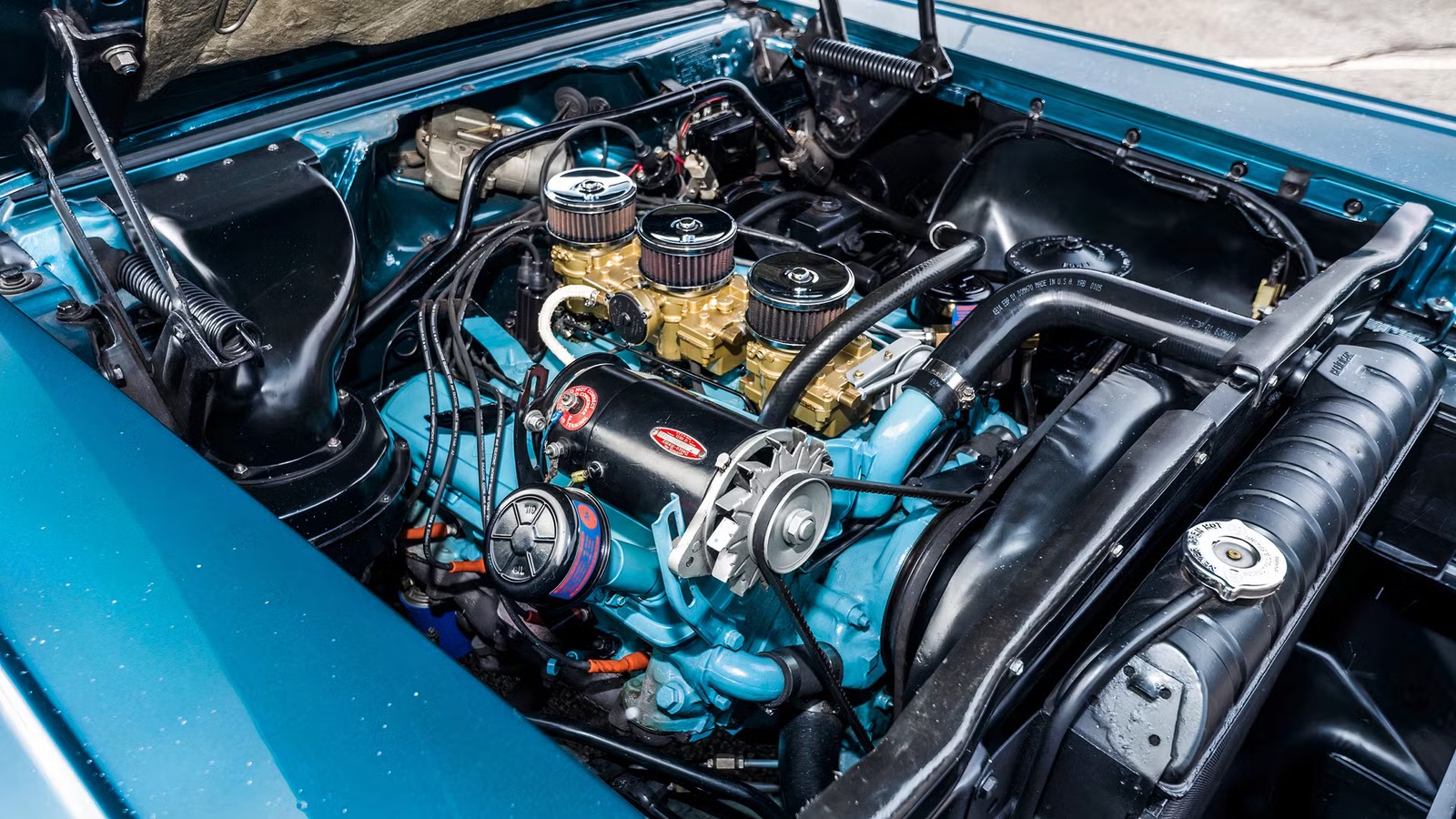
To that effect, the engine ladder drove the point home. The standard four-barrel version of the 370 V8 produced 285 horsepower, while Pontiac’s Tri-Power setup raised output to 300 hp using three two-barrel Rochester carburetors. Above both sat something far more sophisticated: a mechanically fuel-injected 370 rated at 310 hp.
That hierarchy gave American performance buyers something Pontiac desperately needed: choice. You could buy into the look and still get respectable V8 power, or keep selecting options until the engine compartment resembled something dreamed up after hours at a performance shop. Six years before the Pontiac GTO arrived, much of the muscle car formula was already taking shape.
The 1958 Bonneville Put That Formula On The Street

The car tying all of this together was the 1958 Pontiac Bonneville. After appearing in 1957 as a limited-production convertible, the Bonneville became a standalone Pontiac series for 1958 and was offered only as a hardtop coupe or convertible. Pontiac built 9,144 hardtops and 3,096 convertibles, turning what had been an exclusive halo car into something much more visible in American showrooms.
Under the hood, the 1958 Pontiac Bonneville could be ordered with the 285-hp four-barrel 370 V8 or upgraded to the 300-hp Tri-Power setup for just $93.50. At the top sat Rochester mechanical fuel injection, which raised output to 310 hp and gave Pontiac one of the most technically adventurous American performance cars of the era.
That makes the 1958 Pontiac Bonneville Fuelie a pretty cool early chapter in muscle car history. It paired a two-door body with a large V8 and multiple levels of factory performance, then added fuel injection when most American buyers were still completely comfortable with carbs. The 1964 Pontiac GTO would eventually make the formula cheaper, smaller, and enormously more influential, but Pontiac had already experimented with the ingredients in 1958.
Rochester Fuel Injection Made 310 HP The Hard Way

Pontiac’s Rochester fuel injection system was mechanical rather than electronic, as microprocessors at the time were still confined to occupying entire rooms rather than managing a 370ci V8. The system continuously delivered fuel to each intake port, with a distributor-driven pump providing pressure. Combined with a 10.5:1 compression ratio, it helped the Pontiac 370 V8 produce 310 hp at 4,800 rpm and 400 lb-ft of torque at 3,400 rpm.
Those were substantial numbers for a full-size American car in 1958. A later run with a preserved fuel-injected Bonneville weighing roughly 4,480 pounds produced a 0-60 mph time of 8.0 seconds. The quarter-mile took 16.1 seconds at 87 mph. Today’s family SUV can embarrass that stopwatch, but context is the point here. This was a six-passenger Pontiac carrying enough chrome to fill a showroom floor.
Tech, But At What Cost?

The bigger problem was that Rochester fuel injection demanded more patience than its spec sheet suggested. Contamination could upset the system, long periods of inactivity could create problems inside the fuel-metering hardware, and the high-pressure pump arrangement could become another source of expensive headaches. Many mechanics were also more comfortable diagnosing carburetors, which made an unusual mechanical injection setup a difficult proposition once the warranty had expired.
Tri-Power suddenly looked pretty sensible. It delivered 300 hp, only 10 fewer than the Fuelie, while using familiar carburetor technology that owners and mechanics understood. Pontiac had created the more advanced system, but its customers were discovering something performance-car buyers still appreciate today: the coolest engineering solution isn’t always the one you want to explain to a mechanic on Monday morning.
The GTO Won The Trophy, But The Bonneville Wrote The Playbook

The price completed the picture. Rochester fuel injection cost $500 on the 1958 Pontiac Bonneville, compared with only $93.50 for the 300-hp Tri-Power package. The Fuelie therefore asked buyers to spend more than five times as much for an extra 10 hp. Even in America’s horsepower-hungry late ’50s, that was difficult math to ignore.
That brutal pricing gap explains why the fuel-injected Pontiac Bonneville became so rare. Surviving accounts disagree over exactly how many were built, with some estimates falling dramatically below others. The safest conclusion is that fewer than a few hundred 1958 Bonnevilles received Rochester fuel injection. Against total Bonneville production of 12,240 cars, the Fuelie was a tiny sliver of an already important model year.
Before Its Time

Pontiac dropped the fuel-injection option during 1958, but the experiment left behind a pretty useful lesson. American performance buyers clearly wanted factory horsepower, yet affordable horsepower won when the alternatives became too expensive or complicated. Pontiac’s carbureted performance path proved easier to sell, and Tri-Power would become deeply associated with the brand as its reputation grew hotter.
Then came the 1964 Pontiac GTO. By placing a large V8 into a smaller, relatively affordable package, the GTO helped ignite the American muscle car movement and became one of the defining performance cars in the United States. Its reputation is deserved, but the 1958 Pontiac Bonneville Fuelie shows that Pontiac had been working toward the same destination years earlier.
Sources: Pontiac, RM Sotheby’s.

Related posts





Latest Post


No Comments