
How Much A 10-Year-Old Lexus Hybrid Battery Could Cost To Replace
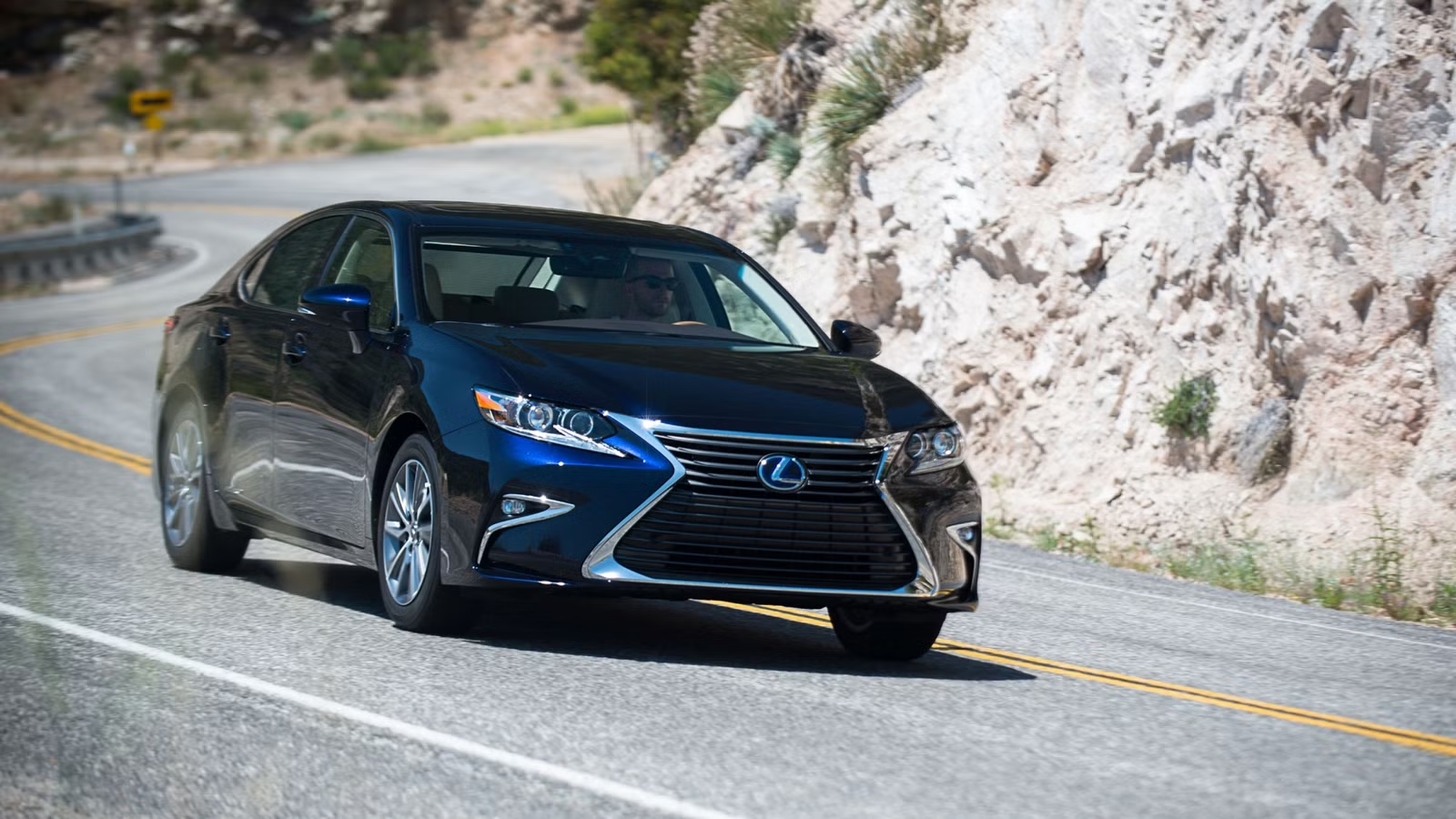
Lexus vehicles enjoy a stellar reputation for longevity, luxurious comfort, and mechanical reliability. Much of this prestige traces back to the refinement of Toyota’s Hybrid Synergy Drive, adapted for Lexus luxury sedans, hatchbacks, and crossovers.

When considering a decade-old Lexus hybrid, prospective buyers and long-time owners inevitably face a critical financial question of battery replacement costs. Around the 10-year mark, factory warranty coverage expires across most states. Consequently, you as the owner will have to bear the financial burden of any major high-voltage component repairs out of pocket.
How Lexus Has Approached Hybridization Over The Last Decade
Over the past decade, Lexus transformed its hybrid department from a niche luxury efficiency option into the core foundation of its global product strategy. Ten years ago, Lexus hybrid models primarily relied on second- and third-generation nickel-metal hydride setups focused strictly on smooth power delivery and modest city fuel savings.

Engineering updates delivered lighter lithium-ion battery packs, more compact electric motor-generators, and refined power control software. These developments improved overall efficiency while removing early hybrid drawbacks such as sluggish throttle response and CVT rubber-band acceleration.

Lexus expanded its hybrid portfolio further by introducing plug-in hybrid electric vehicles alongside high-output performance hybrids. The luxury automaker increased its electrified sales mix dramatically by standardizing hybrid powertrains across popular volume models. This continuous refinement transformed Lexus hybrids into benchmarks for long-term mechanical dependability, minimal maintenance overhead, and better electrical performance.
The financial investment required to replace a high-voltage traction battery pack in a decade-old Lexus varies across the brand’s lineup. Total replacement expenses depend heavily on physical pack dimensions, vehicle platform layout, cell chemistry, and internal module count. A decade-old lineup spans from entry-level compact hatchbacks to ultra-luxury flagship sedans. Sourcing factory components versus third-party reconditioned alternatives establishes distinct price tiers for each vehicle segment.
Lexus’s Entry-Level Hybrids Are Relatively Affordable To Repair

The 2016 Lexus CT 200h compact hatchback shares core powertrain engineering with the third-generation Toyota Prius. High manufacturing volumes and smaller physical battery dimensions keep overall replacement expenses manageable. Owners selecting a new original equipment manufacturer unit directly through an authorized dealership pay $3,000 to $4,200 for parts and installation. Sourcing a remanufactured or aftermarket battery pack through an independent hybrid repair shop drops the installed price to $1,500 to $2,500.

Executive sedans like the Lexus ES 300h and IS 300h utilize midsize hybrid architectures shared with platform relatives like the Toyota Camry Hybrid. These mid-tier battery packs balance elevated electrical output with widespread component availability. Replacing the high-voltage pack with a factory OEM assembly from a dealership costs between $3,800 and $5,000, including labor costs. Choosing an aftermarket or professionally reconditioned alternative lowers out-of-pocket costs to $2,000 to $3,000 installed.
Things Become More Expensive In The Advanced Models

Larger luxury models like the RX 450h crossover SUV and GS 450h sport sedan pair performance V6 engines with complex, multi-module battery architectures. Extracting these heavy, high-capacity battery packs requires additional labor effort due to rear chassis trim and seating layouts. A new factory OEM battery replacement at a franchise dealership costs between $4,500 and $6,500. Independent hybrid specialists installing remanufactured or new aftermarket units typically charge between $2,800 and $4,000.

The ultra-luxury Lexus LS 600h flagship sedan occupies the top bracket for replacement costs. The vehicle features a specialized high-voltage system engineered to work alongside a powerful V-8 engine. Sourcing a factory OEM replacement unit from a dealership costs between $6,000 and $8,500 or more, accounting for complex installation procedures and high component costs. Specialist aftermarket or reconditioned battery packs offer a lower entry point, running between $3,600 and $5,500 installed.
Three Options For Sourcing Your Hybrid Lexus Battery

Sourcing hardware for a Lexus hybrid battery replacement presents three distinct pathways. Brand-new OEM packs come directly from Lexus dealership parts counters, supplying nickel-metal hydride or lithium-ion assemblies with factory reliability, optimal cell matching, and full dealership warranty backing. However, these original units represent the highest upfront financial outlay.
Alternatively, aftermarket packs with new cells utilize brand-new, modern cells housed within refurbished original casings. Independent manufacturers produce these units to deliver longevity comparable to OEM components at up to a 35 percent discount. Remanufactured or reconditioned packs offer a third option, where third-party refurbishers disassemble failed units, replace degraded modules, and rebalance the assembly. While cost-effective, their operational lifespan remains shorter than new assemblies.
The Labor Costs Involved With Replacing The Battery

Labor and shop fees constitute the remaining portion of the overall replacement expense. High-voltage electrical work demands trained technicians equipped with specialized insulated tools. Franchise Lexus dealerships typically bill between $180 and $260 per hour for labor, whereas independent hybrid specialty shops charge between $110 and $170 per hour.
Time requirements vary by vehicle architecture. Replacing a battery in a CT 200h or ES 300h takes roughly two to three hours, while complex luxury models like the RX 450h or LS 600h require four to six hours due to extensive interior trim, rear seat, or trunk subframe disassembly. Finally, dealers and suppliers require the old battery core to recycle or reconstruct its components, assessing an additional core fee ranging from $500 to $1,000 if an owner fails to return the original pack.
How Lexus’s Standard Warranty Affects Current Ownership

Lexus modified factory hybrid battery warranty terms across recent production years. Vehicles from the 2020 model year and newer feature coverage for 10 years or 150,000 miles, whichever occurs first. Pre-2020 models, including 10-year-old units, feature an eight-year or 100,000-mile base warranty in standard states. Vehicles sold and registered in states that adopted California Air Resources Board (CARB) requirements received extended 10-year or 150,000-mile coverage on high-voltage components.
Consequently, factory coverage for a 10-year-old Lexus has either reached full expiration or sits on the verge of expiring based on mileage limits. When owners purchase a replacement battery out of pocket, third-party warranty terms vary significantly. Remanufactured units typically include a 12-month to 24-month limited warranty, while new aftermarket packs offer 36-month to 48-month warranties with frequent unlimited mileage options. Sourcing a new OEM unit yields a 12-month dealer parts warranty, which extends to 36 months when installed by an authorized Lexus service center.
Assessing Whether A New HEV Battery Is Worth It

Determining whether to invest $2,000 to $5,000 into a 10-year-old Lexus requires weighing total market value against ongoing maintenance expenses. Lexus vehicles retain resale value effectively compared to luxury competitors. A decade-old Lexus RX 450h or ES 300h in sound mechanical condition with 120,000 to 160,000 miles routinely retains a private-market value between $9,000 and $15,000. If the chassis and powertrain remain sound, a clean service history exists, and the owner intends to retain the vehicle for three or more years, installing a $3,000 replacement battery restores full fuel economy, engine smoothness, and long-term driving capability.
This outlay remains logical compared to purchasing a new or newer pre-owned vehicle. However, if the vehicle suffers from severe structural rust, transmission faults, internal engine issues, or accumulated deferred maintenance that pushes total repair costs past current valuation, spending thousands on a high-voltage battery pack yields diminishing returns. In those scenarios, selling the vehicle with a disclosed battery fault or trading it in offers a practical alternative.
What To Expect When Your Battery Reaches The End Of Its Lifespan

When a high-voltage traction battery pack in a Lexus hybrid reaches the end of its operational lifespan, its ability to store and discharge electrical energy diminishes significantly. This failure triggers a distinct sequence of mechanical, electrical, and performance symptoms.
Initial signs appear as a drop in fuel efficiency. Because degraded internal cells cannot hold a charge, the gas engine runs continuously to power the vehicle and maintain electrical systems. Drivers experience sluggish acceleration alongside rapid fluctuations on the dashboard battery state-of-charge gauge, which quickly swings between full and empty.

Simultaneously, the rear battery cooling fan operates loudly at maximum speed to dissipate excess internal heat generated by deteriorating modules. As failure progresses, the vehicle triggers dashboard alerts, including a red master warning symbol and the text prompt Check Hybrid System.
To protect internal electrical components, the hybrid control module initiates a protective fail-safe mode, cutting electric motor assistance. Complete battery pack failure disables the vehicle entirely. Because Lexus hybrids rely on high-voltage motor-generators powered by the main traction battery to crank the gasoline engine, a dead high-voltage battery leaves the vehicle unable to enter its operational state or start.

Available Models
Lexus
- Founded
-
1989
- Founder
-
Eiji Toyoda, Toyota
- Headquarters
-
Nagoya, Japan
- Owned By
-
Toyota Motor Corporation
- Current CEO
-
Takashi Watanabe (President)
Sources: Lexus, Fastlane Import Auto Repair, GreenTec Auto, and RepairPal.

Related posts



Latest Post


No Comments