
Mitsubishi’s New Boss Calls The Lancer Evo A ‘Treasure’—And Hints At A Future Return
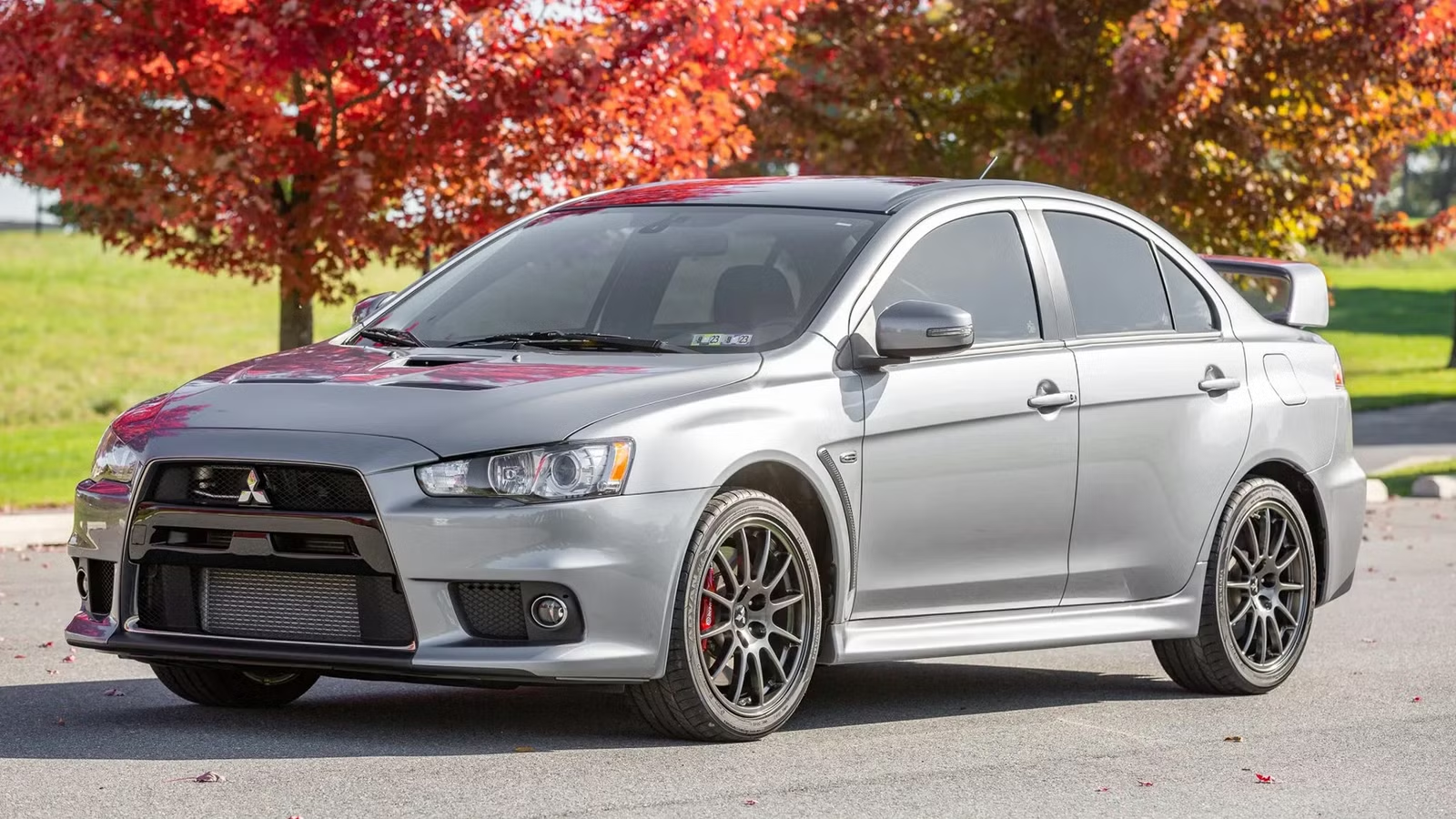
Mitsubishi’s newly appointed president just gave Evo faithful the clearest signal they’ve heard from the top in years. Keisuke Kishiura, who took the helm at Mitsubishi Motors in 2026, went on record calling the Lancer Evolution—along with the Diamante and Galant—”very important cars for Mitsubishi Motors” and a company “treasure.” No launch date, no confirmed platform, no specs. But the words came from the president’s mouth, and that matters.

Kishiura also revealed that his first car was a manual-transmission Lancer Turbo—a rear-wheel-drive machine he drove to ski resorts despite the obvious disadvantages. That detail isn’t throwaway color. It tells you this isn’t a suit reading talking points. When he says he wants to make Mitsubishi “one that can once again produce such cars in the future,” he’s speaking from a place of genuine attachment to what the nameplate represents.
What Kishiura Actually Said—And What He Didn’t
Asked about the possibility of reviving iconic models and returning to the World Rally Championship as a factory team, Kishiura was careful but direct. “At this point, we do not have any concrete plans to introduce these cars again,” he said, “but in order to meet everyone’s expectations, we would like to make our company one that can once again produce such cars in the future. I will be at the forefront of this effort.”

That’s not a product announcement. It’s a statement of intent—and a personal one. Kishiura pledged to lead the effort himself, which is a different kind of commitment than a PR team floating a revival rumor. For a nameplate that went dark after the final 2015 Lancer Evolution Final Edition rolled off the line, it’s the most substantive executive-level signal in over a decade.
Why The Evo Still Commands This Kind Of Loyalty

The Lancer Evolution’s absence from showrooms hasn’t dimmed its reputation. The nameplate earned its cult status the hard way—through WRC dominance in the 1990s and early 2000s, where Tommi Mäkinen and later Petter Solberg pushed Mitsubishi machinery through stages that destroyed lesser cars. The road cars that followed those rally machines, particularly the Evolution IX with its 4G63T turbocharged four-cylinder, became benchmarks for all-wheel-drive performance sedans.
That legacy shows up in current market values. A clean 2015 Evo Final Edition—the last of the line—recently closed on Bring a Trailer, with Car & Driver noting it represented the end of an era for the sport compact segment. Collector interest hasn’t cooled. If anything, the gap since production ended has sharpened the appetite.
The Realistic Path: SUVs First, Halo Cars Later

Kishiura’s enthusiasm is real, but the road to a new Evo runs through the mainstream market first. Mitsubishi is currently working to double its U.S. lineup, with a revived Montero—previewed to dealers in June 2026—among the most anticipated additions. A successful SUV portfolio generates the margins and shareholder confidence that make halo projects viable. Performance sedans are expensive to develop and rarely profitable on their own; they exist to build brand identity, not balance sheets.
Mitsubishi’s Ralliart sub-brand has already returned, though critics have noted it’s currently applied to badge and decal packages on existing SUVs rather than dedicated performance hardware. That gap between the Ralliart name and genuine performance product is exactly what a new Evo would close—but closing it requires the financial foundation that mainstream SUV success provides.
Electrification Is The Likely Path For Any New Evo

Mäkinen
Kaoru Sawase, Mitsubishi’s Engineering Fellow and the architect of the S-AWC (Super All-Wheel Control) torque-vectoring system, said last year that electrification is the ideal way to enhance vehicle dynamics in the current global environment — and that the Evo’s return remains a dream that isn’t dead. That framing aligns with where the broader performance market is heading. The Rimac Nevera has demonstrated what instant torque and per-wheel control can do on a track, and BMW’s upcoming electric M3 will bring that technology to a direct competitor segment.
For Evo purists, the honest tension is between what electrification enables dynamically and what it removes from the experience. A torque-vectoring electric Evo could be faster and more capable than the 4G63T-powered IX on almost any surface. Whether it would be as tunable, as mechanical, or as culturally resonant is a different question—and one that won’t be answered until Mitsubishi is actually in a position to ask it seriously.
Kishiura’s comments don’t put an Evo in showrooms. But they put a genuine enthusiast—one who learned to drive in a manual Lancer on snow—in the chair that decides whether it ever gets there. That’s not nothing.
Sources: Autoblog, Carscoops, Motor1, Carbuzz, Car And Driver.

Related posts



Latest Post


No Comments