
The High-End Motorcycle That’s Now Priced Below A Kawasaki Versys 650
Finding a genuinely great motorcycle at a bargain price feels like stumbling onto a cheat code — and right now, the used market is quietly serving one up. Adventure-sport tourers have never been more capable or more desirable, yet depreciation is doing what it always does to premium iron: dragging prices down to levels that would have seemed impossible when these bikes were new. If you know where to look, you can land a machine with superbike DNA, semi-active suspension, and a full suite of rider electronics for roughly the same money as a brand-new middleweight commuter.

The Kawasaki Versys 650 has always struck a good balance between performance and practicality. But for the same money, you can get something that’s much better.
The Kawasaki Versys 650 Is The Ultimate Do-It-All Bike
The Kawasaki Versys 650 may not be the best bike out there, but it is easily one of the most balanced bikes you can buy today. It features a decently powerful parallel-twin engine that’s known for its smooth, linear power delivery and bulletproof reliability. The frame is tuned to be nimble, while the semi-adjustable suspension lets you fine-tune the ride quality. Plus, its tall stance makes for a comfortable riding position for most riders.


But let’s be honest, the Versys 650 is no one’s dream bike. It’s about as ordinary as a bike can get today, and it also has a bit of an identity crisis. While that ordinariness is precisely what makes it such a practical all-rounder, riders looking for a little more finesse won’t be impressed. It also starts at just over $10,000 brand new — affordable, but still a significant outlay for many riders.

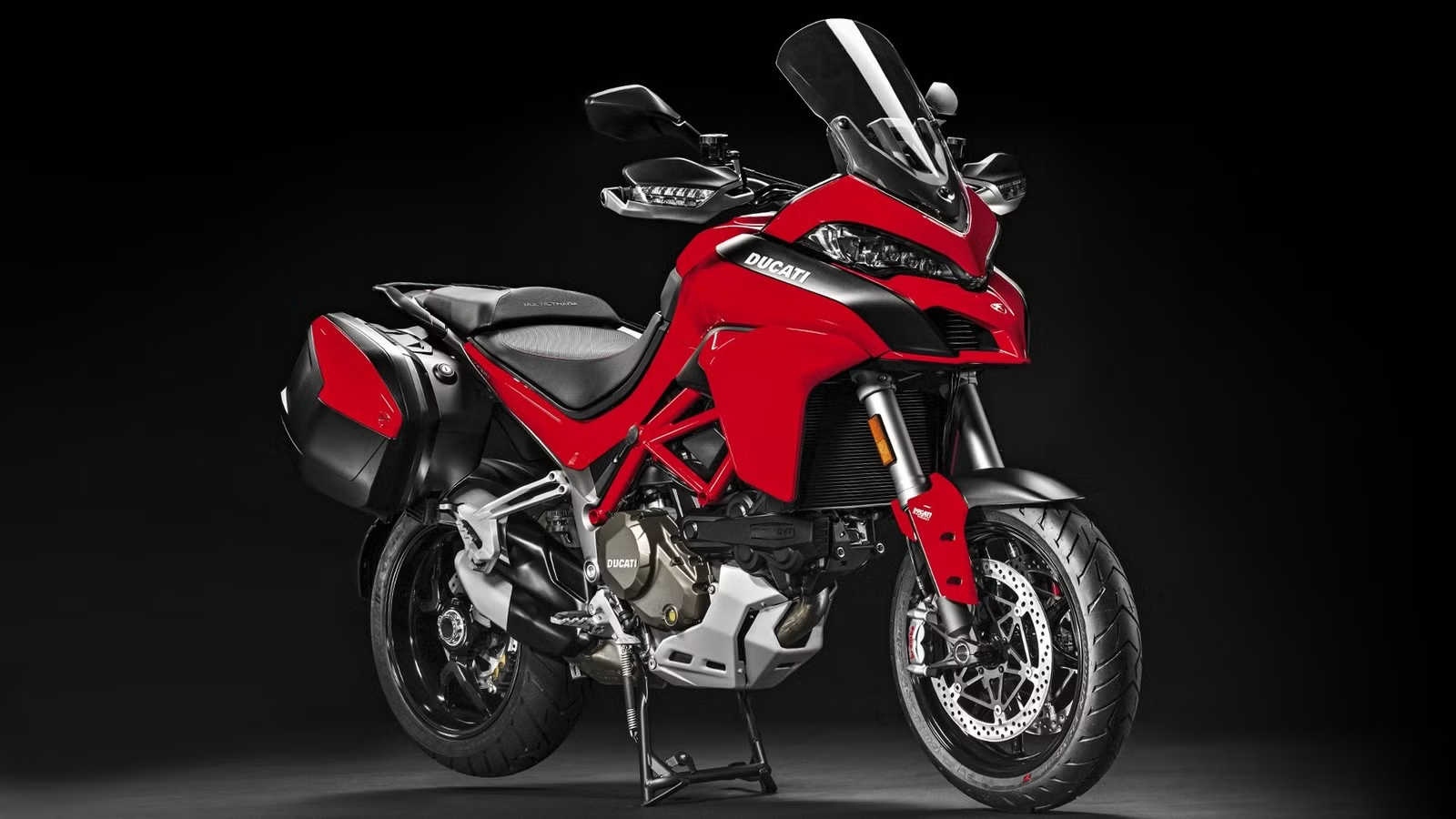
That raises an obvious question: what if you could get a proper premium touring experience for the same price? That’s exactly what this Ducati adventure tourer delivers. It costs around the same as the Versys 650 yet offers an experience worth considerably more. You get more performance, sharper handling, and a head-turning design that has aged remarkably well. So, if you have $10k to spare, you’d be better off with this Ducati than the Versys 650.
The 2017 Ducati Multistrada 1200 S Is Now Priced Below A Kawasaki Versys 650
Typical Listing Price: $9,739

Regardless of the model, used prices tend to drift lower each year while new prices creep upward. With high-end bikes, however, depreciation hits harder and faster — which is why we’re now seeing the Multistrada 1200 S trading for less than budget-friendly tourers like the Versys. It’s also worth noting that this generation of Multistrada has largely reached the floor of its depreciation curve, meaning you won’t necessarily lose much if you decide to move it on down the road.
Trade value is currently sitting at around $6,390 — roughly a third of what the bike would have cost new in 2017, depending on which options the original owner specified. Retail value sits just above $9k, a full $1,000 less than a new Versys 650. Admittedly, you don’t have the security of a warranty, but it’s still pretty hard to overlook how much bang for the buck is on offer here.
The Ducati Multistrada 1200 S Has A Superbike-Derived Engine
Power Output: 160 HP

The 1198 engine made its first appearance in the 1098 R superbike back in 2008 — a machine that served as the basis for Ducati’s WorldSBK entry and won titles in 2008 and 2011 (by which point it had evolved into the 1198 R). Suffice to say, racing DNA is baked into this powertrain. That said, a superbike engine doesn’t always translate seamlessly to real-world riding, and by 2015, Ducati needed to make changes.
It Is Not Without Its Quirks

2015 brought a significant powertrain update. Ducati gave the twin variable valve timing and called it DVT (Desmodromic Variable Timing), extending the platform’s life for another two years before it was updated again. The DVT system added 10 horsepower at the top end but also introduced a slight flat spot at around 5,000 RPM. With 160 horsepower and a selection of ride modes on tap, that quirk is easy enough to live with — though some riders may disagree.
The Multistrada 1200 S Has A High-End Electronic Suspension

Even by current standards, the Multistrada 1200 S is a sophisticated motorcycle. That 2015 update also added lean-sensitive traction control and cornering ABS. The S model received Ducati’s famed Skyhook semi-active suspension, which layers genuine comfort onto an already capable chassis. The steel trellis frame works in tandem with that suspension to deliver a thrilling ride when you want it, and it’s capable of making some modern superbikes look sluggish on a decent canyon road.
Chassis, Suspension, And Weight Specifications
|
Chassis |
Steel trellis |
|
Front Suspension |
48mm electronically adjustable semi-active inverted Sachs fork (6.7-in travel) |
|
Rear Suspension |
Electronically adjustable semi-active Sachs shock (6.7-in travel) |
|
Weight |
518 lbs |
The Multistrada 1200 S Gets The Other Bits Right, Too

With superbike-level performance and compliant suspension covered, there’s a lot more to love about the Multistrada 1200 S. For starters, this is a genuinely gorgeous motorcycle — and despite being the better part of a decade old, it still commands attention on the road. The front-heavy design is anchored by a fairing that houses a tall windscreen, providing solid wind protection at highway speeds. An upright riding triangle adds to the comfort, making long days in the saddle far more manageable.

The Multi 1200 S was never intended to be a proper adventure bike, so it runs on 17-inch wheels at both ends. It feels nimble and confidence-inspiring on the road, though off-road excursions are best avoided. Braking duties are handled by two 330mm semi-floating discs up front, gripped by radially-mounted Brembo Monobloc Evo M50 calipers — more than enough stopping power even at serious speeds. If you’re lucky, you might find an example equipped with one of the optional packages, which can add heated grips, luggage, auxiliary lights, and more.

Despite its age, the Multistrada 1200 S packs a suite of electronics and rider aids that have only recently become commonplace on production motorcycles. An IMU enables a Bosch-Brembo ABS 9.1ME cornering braking system, alongside Ducati Traction Control (DTC) and Ducati Wheelie Control (DWC). The TFT display runs the Ducati Multimedia System (DMS), offering four selectable riding modes. Cruise control and LED headlights with Ducati Cornering Lights (DCL) round out the package.
The Multistrada 1200 S Faced Some Stiff Competition
In recent years, the crossover — or “sports bike on stilts” — segment has exploded in popularity. But back in 2017, it was still in its infancy, and the Multistrada faced only a handful of rivals in this more elite space. Both of those competitors have been hit equally hard by depreciation and are also quite affordable today.
2017 BMW S 1000 XR

For around the same money, you could have the S 1000 XR. It was still a relatively new model in 2017, having launched just a couple of years prior, but it has since exploded in popularity and now dominates this segment. If anything, the BMW leans slightly more toward the sporty end of the spectrum.
2017 KTM 1290 Super Adventure S

The 1290 Super Adventure S can actually be found for less than the Ducati, too. It also boasted a long list of features, including semi-active suspension. It certainly lacks the finesse of the Italian and German bikes, but compensates with a dose of genuine off-road competence.
Neither the KTM nor the much-loved BMW is a bad option — both represent excellent value on the used market. But, even with its quirks, the Ducati offers something a little extra. It was never trying to punch above its weight like those bikes were in period. It was always an exclusive model and, as such, simply delivers a better, more refined all-round package.
Source: Ducati, Kelley Blue Book

Related posts



Latest Post


No Comments