The BMW X5 Is Getting Outclassed On Resale By A Toyota Keeping 68.9% Of Its Value
7 minutes reading
Saturday, 12 Sep 2026 19:30 0 7 autotech
Every automaker claims its SUV “holds value.” Few can prove it the way Toyota’s Land Cruiser does. New resale data ranks the nameplate as the best resale performer in the large SUV segment, retaining 68.9 percent of its value after five years. The BMW X5, priced to compete in the same luxury space, tells a very different story. This isn’t a marginal gap between two capable SUVs; it’s a structural mismatch in how each brand’s ownership costs actually play out, and the numbers are stark enough to change how a shopper should think about “premium.”
That structural mismatch starts at the sticker price — where the Land Cruiser does something unusual for an expensive SUV. The 2026 Land Cruiser isn’t cheap. Current pricing puts the modelbetween $58,080 and $64,155, positioning it squarely as a premium purchase rather than a budget one. What separates it from other expensive SUVs is what happens after the sale. Depreciation analysis shows a new Land Cruiser loses 34.4 percent of its value after five years, leaving a resale figure around $37,532.
For context, the broader hybrid large SUV category it competes in loses 35.2 percent over the same period, while the average for all SUVs sits at 44.9 percent and the market-wide average across all vehicles is 41.5 percent. That means the sticker shock at purchase is doing something unusual. It’s buying a vehicle that depreciates roughly ten percentage points slower than the average SUV.
2025 Toyota Land Cruiser 1958 front shotLyndon Conrad Bell – TopSpeed
A high MSRP is normally a depreciation liability: the more a car costs new, the more raw dollars it typically sheds. The Land Cruiser inverts that math. Its price tag reflects genuine scarcity and demand rather than badge markup, and the used market treats it accordingly. Instead of punishing the buyer for paying a premium, the resale curve rewards them for it.
68.9% Retention Shows Why Toyota’s Reliability Reputation Has Real Dollar Value
2025 Toyota Land Cruiser 1958 side shotLyndon Conrad Bell | TopSpeed
The headline number, a 68.9 percent five-year resale value that makes the Land Cruiser the top performer in the large SUV segment, isn’t an accident of supply timing. It’s the visible output of a reputation built over decades. Resale scoring for the model ties directly to reliability performance, and the Land Cruiser’s standing reflects that pairing, carrying near-identical high marks for both reliability and value retention in current industry rankings.
Close-up shot of 2025 Toyota Land Cruiser engine bayLyndon Conrad Bell | TopSpeed
That correlation matters because it’s not unique to this one model. Toyota as a brand dominates the resale conversation across body styles. The 4Runner leads midsize SUVs at 74.6 percent retention, the C-HR tops crossovers at 75.6 percent, and the RAV4 leads compact SUVs at 75 percent. When an entire lineup shows the same pattern, it stops looking like a fluke and starts looking like a pricing signal the used market has learned to trust. Buyers aren’t just betting that a Land Cruiser will still run in five years; they’re betting on a brand-wide track record, and secondhand pricing reflects that confidence dollar for dollar.
Used-Market Scarcity Creates A Resale Feedback Loop German Luxury SUVs Struggle To Break
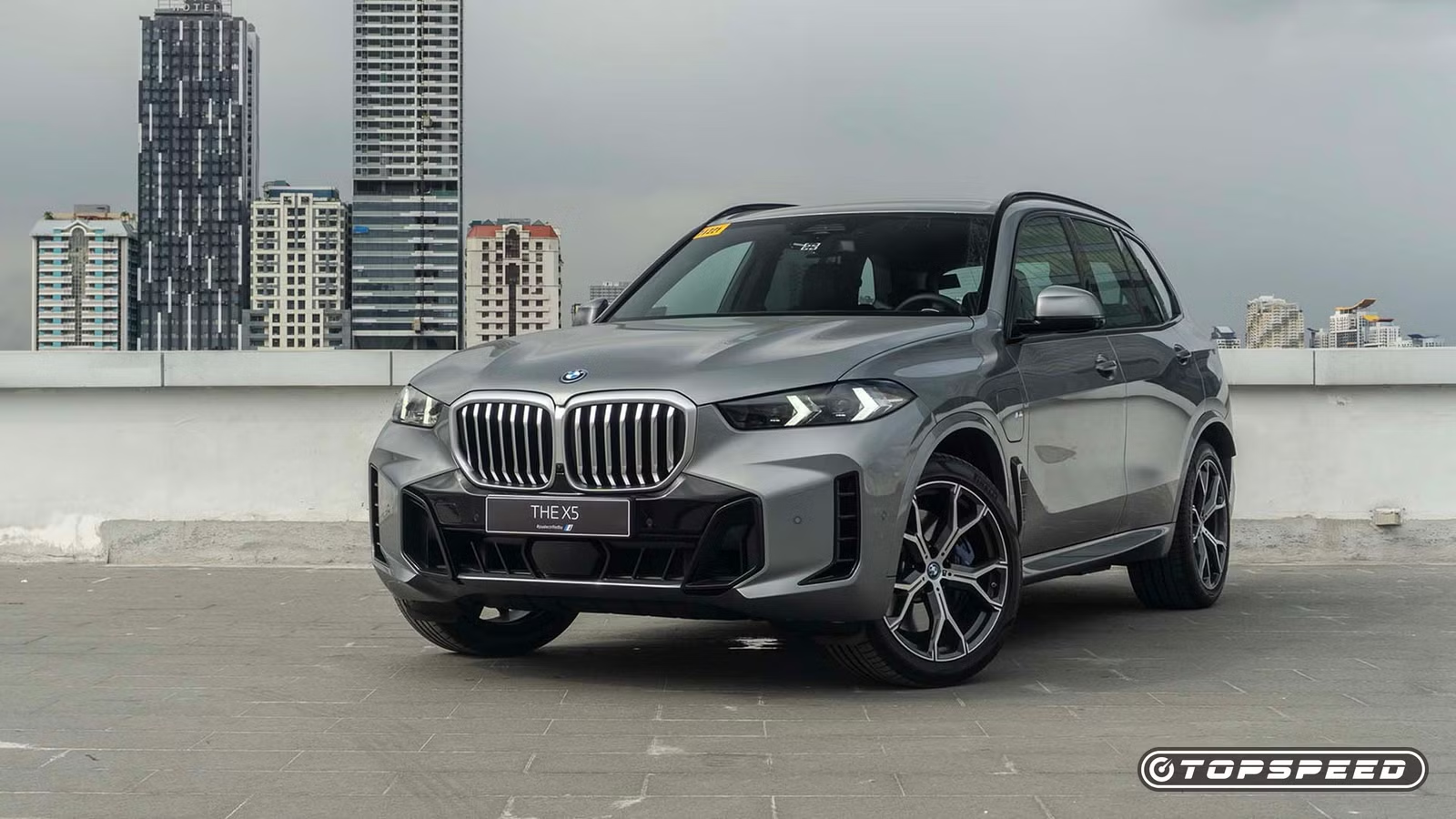
Dynamic shot of the 2026 BMW X5 xDrive50eIsaac Atienza | TopSpeed
Reliability explains part of the gap, but it doesn’t fully explain why the spread between Toyota and BMW is this wide. The other half is a self-reinforcing scarcity loop that premium German brands have a much harder time replicating. Land Cruisers that hold their value attract fewer lease returns and fewer owners eager to flip them early; nobody rushes to dump a vehicle that’s still worth most of what they paid.
That shrinks the pool of used Land Cruisers hitting the market at any given time, and a thinner supply against steady demand keeps prices elevated. Elevated prices then reinforce the reputation that started the cycle in the first place. The BMW X5 sits on the opposite side of that loop. Luxury midsize SUVs like the X5 are disproportionately sold through leases, and lease-heavy models flood the used market in predictable three-year waves.
Rear 3/4 view of the 2026 BMW X5 xDrive50eIsaac Atienza | TopSpeed
That steady churn of off-lease inventory keeps supply high and used prices soft, the exact conditions the Land Cruiser avoids. It’s a structural disadvantage baked into how German luxury brands typically move metal, not a one-year blip that a strong sales quarter can fix. Breaking that pattern would require BMW to change how it distributes new X5s in the first place, not just how it prices used ones. What that structural disadvantage actually costs an X5 buyer in dollars — across a $69,750 starting price — is more dramatic than the percentage gap suggests.
The BMW X5’s $69,750 Starting Price Looks Different When Depreciation Enters The Equation
Front 3/4 shot of 2025 BMW X5 xDrive50e parkedBMW
On paper, a $69,750 starting MSRP buys genuine luxury-SUV credentials. Five years into ownership, that number tells a much less flattering story. Current depreciation figures put the X5 at 53.1 percent five-year depreciation, leaving a resale value of just $31,676; and that’s before accounting for the X5’s higher real-world starting price.
Applied to the $69,750 MSRP, that depreciation rate translates to roughly $37,000 in lost value inside five years, essentially handing back more than half the purchase price for a set of keys and a used-car listing. It’s not an isolated result, either. Recent trim-level analysis shows the pattern holding across the X5 range.
Rear 3/4 action shot of 2025 BMW X5 xDrive50eBMW
The conventional gas X5 retains 45.2 percent of its value after five years, while the plug-in hybrid variant does slightly worse at 43.6 percent, both figures comfortably behind the Land Cruiser regardless of powertrain. Consumer-facing resale ratings back this up in plainer language, marking the X5 as “below average” for resale within the luxury midsize SUV class. A near-$70,000 starting price should, in theory, buy insulation from steep depreciation. In the X5’s case, it buys the opposite.
Five-Year Ownership Reveals The Land Cruiser’s Biggest Luxury: Money Still Sitting In The Driveway
Line the two vehicles up side by side after five years and the contrast stops being abstract. The Land Cruiser owner is sitting on roughly $37,500 in vehicle equity from a purchase that started in the high-$50,000s to low-$60,000s. The X5 owner, starting from a higher $69,750 price, is left with around $31,700, less total dollar value despite a bigger initial outlay. The Land Cruiser owner has more money physically parked outside their house than the X5 owner does, even though the X5 cost more to begin with.
Running costs narrow the picture further without closing the gap. Cost-to-own estimates put Land Cruiser maintenance at roughly $1,322 per year, a figure used here over a lower third-party estimate because it’s built specifically for this kind of ownership comparison, factoring in scheduled service intervals a generic calculator often misses. Even at that higher maintenance figure, the Land Cruiser’s five-year resale advantage over the X5 comfortably outweighs the added service spend.
2025 Toyota Land Cruiser InteriorWilliam Clavey | TopSpeed
The real luxury the Land Cruiser is selling isn’t leather or badge prestige; it’s the ability to walk away from five years of ownership with meaningfully more of the original purchase price intact. For shoppers cross-shopping the segment purely on emblem and interior trim, that’s the number that should actually move the decision.
Base Trim Engine
2.4L I-FORCE MAX I4 Hybrid
Base Trim Transmission
8-speed automatic
Base Trim Drivetrain
Four-Wheel Drive
Base Trim Fuel Economy (city/highway/combined)
22/25/23 MPG
Base Trim Battery Type
Nickel metal hydride (NiMH)
Make
Toyota
Model
Land Cruiser
Segment
Full-Size SUV
Sources: Toyota, BMW, iSeeCars, CarEdge, Kelley Blue Book.












No Comments