
Lexus UX Discontinued in 2027 With No Replacement Announced
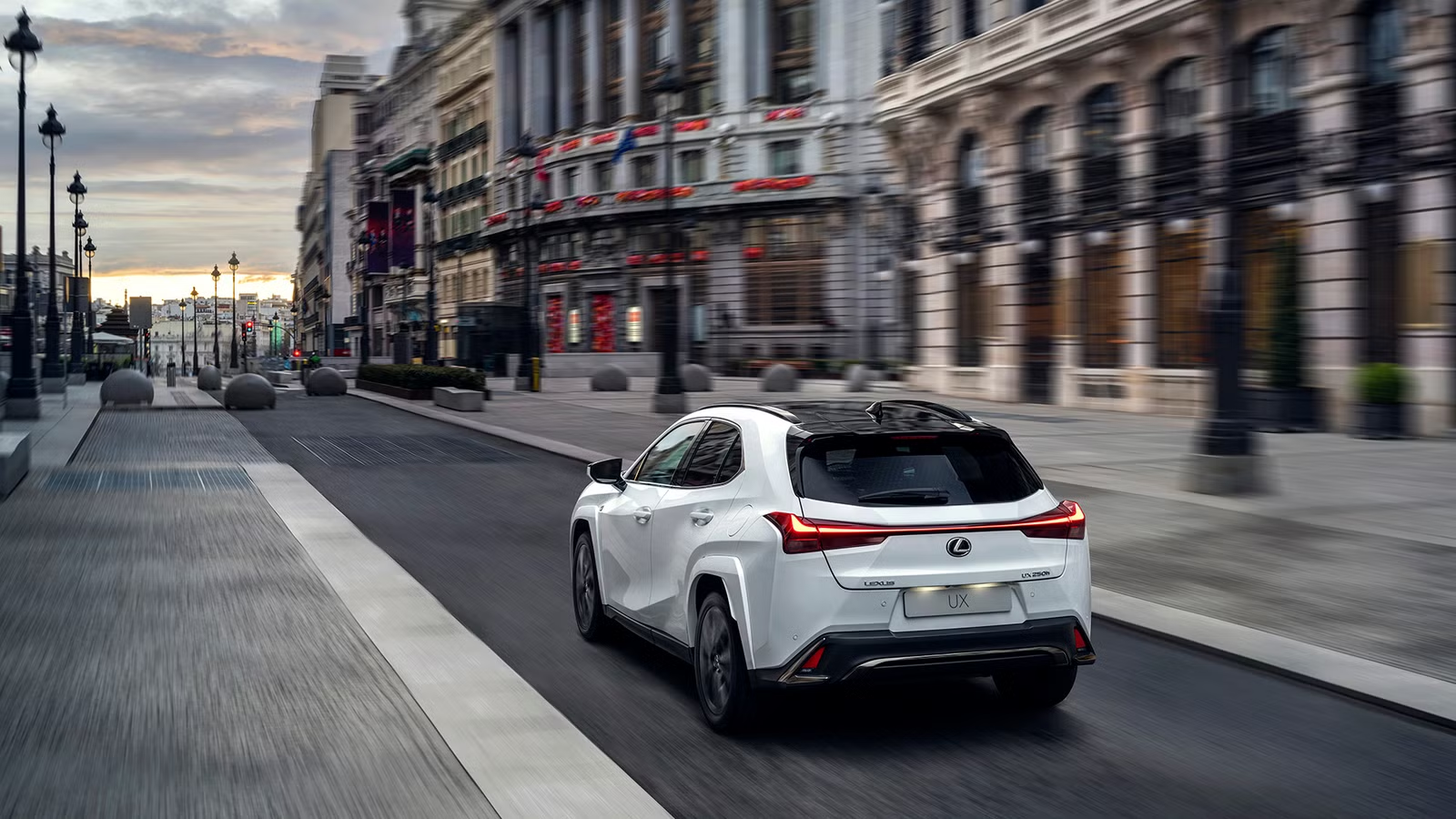
Lexus Japan has posted an official end-of-production notice for the UX, confirming that the brand’s entry-level compact SUV will stop rolling off the line in February 2027. Order books for at least one trim and one exterior color have already closed, and the language on the Japanese consumer site leaves little room for interpretation: the UX isn’t being refreshed — it’s being retired.

What makes the announcement striking isn’t the discontinuation itself. It’s what Lexus doesn’t have waiting in the wings. No second-generation UX has been announced, no test mules have surfaced, and when American Lexus representatives were asked directly, the response was a flat “We have nothing to announce about UX at this time.” For a segment that BMW, Audi, and Mercedes-Benz treat as a critical entry point for younger buyers, that silence is loud.
Eight Years, One Generation, and a Sales Problem
The UX launched for the 2019 model year as Lexus’s smallest SUV, built on a platform shared with the Toyota Corolla and positioned to take on the BMW X1 and Mercedes-Benz GLA. It has spent its entire life in a single generation, receiving only minor updates along the way — a lifespan that would be unremarkable if the numbers told a better story.

They don’t. Through the first part of this year, the UX has moved just 6,519 units in the United States, making it the second worst-selling SUV in the Lexus lineup. It barely edges out the LX — a flagship SUV that starts well north of $100,000 and was never meant to be a volume model. The Lexus RZ, an all-electric SUV that’s newer and more expensive, has already passed the UX with nearly 10,000 sales. By Lexus’s own internal lifecycle standards, eight years on a single generation is overdue for action. BMW typically cycles its models on a six-to-seven-year cadence, with a mid-cycle refresh built in. The UX has had neither.
The Performance Gap That Hurt It Most

The UX’s core issue was never just age. The model has only ever been offered with what CarBuzz describes as “somewhat anemic powertrains” in the US market. The current UX300h hybrid produces 196 horsepower from its four-cylinder petrol-electric setup — a figure that feels economy-car modest in a segment where the BMW X1 and Audi A3 deliver around 250 horsepower paired with turbocharged torque. The UX was also consistently criticized for a cramped interior, a meaningful disadvantage against German rivals that have grown roomier with each successive generation.
In Australia, where both the UX and the smaller Lexus LBX are sold, the competitive gap is even more visible in the sales data. The BMW X1 and iX1 outsell the UX by more than five to one. The Mercedes-Benz GLA runs at nearly four times the UX’s volume. Even the Audi Q3 moves roughly twice as many units. The UX was never a segment leader, but those margins suggest buyers shopping the space weren’t finding enough reason to choose it over the alternatives.
No Replacement Means a Real Gap in the Lineup

The more consequential question isn’t whether the UX deserved to be discontinued — it’s whether Lexus has a plan for what comes next. Right now, the answer appears to be no. No concept has been shown, no trademark filings have pointed toward a UX successor, and Lexus has made no public commitment to staying in the compact luxury SUV segment.
Lexus does sell the LBX in some markets, a smaller city-oriented SUV related to the Toyota Yaris Cross. But the LBX isn’t offered in the United States or China — the brand’s two largest markets by volume — which means it can’t simply absorb the UX’s role. Some speculation in the enthusiast community has pointed to a possible next-generation UX going fully electric on a platform shared with the Toyota C-HR, which would align with Lexus’s stated goal of going all-electric by 2035. That remains unconfirmed speculation; no hardware has been spotted.

For buyers currently shopping the entry-level luxury SUV space, the practical read is straightforward: if you want a Lexus in this size class, the window is closing. For BMW and Audi, Lexus’s retreat — whether temporary or permanent — clears one more competitor from a segment they already dominate. An entry-level model matters beyond its own sales figures; it’s how brands recruit younger buyers who return later for larger, more profitable vehicles. Without one, Lexus risks ceding that pipeline entirely.
Lexus has sold roughly 400,000 UX units across more than 80 countries since the model launched in 2018 — a respectable global run for a car that was never a blockbuster. Whether the nameplate returns in a new form or quietly follows the LC into retirement, the brand’s next move in the compact luxury SUV space will say a lot about where Lexus sees itself competing in the years ahead.

Related posts




Latest Post


No Comments