The Badge Tax: How Much More X5 and GLE Owners Lose Than MDX Buyers
9 minutes reading
Tuesday, 23 Jun 2026 21:30 0 78 autotech
Luxury SUV shoppers spend most of their energy comparing horsepower figures, cabin materials, and the relative cachet of a roundel versus a three-pointed star. The number that actually determines how much an ownership experience costs almost never makes the brochure, and it is depreciation.
Fresh data from iSeeCars, CarEdge, and Kelley Blue Book shows the BMW X5 and Mercedes-Benz GLE sliding past the halfway mark in lost value within five years, while the Acura MDX holds onto roughly half its sticker price over the same stretch. That gap, translated from abstract percentages into real dollars on comparably specified trims, stops looking like statistical noise and starts looking like an actual cost of admission for a German badge.
The Luxury SUV Depreciation Wake-Up Call Nobody Talks About
Front 3/4 shot of 2025 BMW X5 xDrive50e parkedBMW
Every luxury SUV launch event leans on the same talking points: refined cabins, adaptive suspensions, badge heritage. What rarely gets discussed on a press loop is the moment that prestige starts evaporating, which for most German luxury models begins the day the first owner drives off the lot. The average new vehicle in the United States retains 44.7 percent of its original sticker price after 60 months, a baseline that already sounds discouraging until you see how far below it the segment’s biggest sellers fall.
The BMW X5 and Mercedes-Benz GLE, two of the best-selling nameplates in the midsize luxury SUV class, bothshed more than half their valueinside that same five-year window according to iSeeCars’ ownership-cost modeling. That puts them not just below the luxury segment’s better performers but below the broader new-vehicle average entirely, despite carrying price tags well north of $60,000 at purchase. For buyers financing or leasing these vehicles, that depreciation curve is not an abstraction; it is the difference between trading in with healthy equity and writing a check to cover the gap between what is owed and what the SUV is actually worth.
Front 3/4 shot of 2025 Mercedes-Benz GLE Class SUV in silver parkedMercedes-Benz
It also explains a pattern that is becoming harder to ignore on used-car lots and trade-in counters: shoppers who once treated badge prestige as the deciding factor are increasingly running the actual numbers before signing anything. A German nameplate still wins plenty of test drives. It does not automatically win the five-year cost-of-ownership conversation, and the data behind that conversation is what the rest of this piece unpacks.
10 Luxury SUVs With Surprisingly Affordable Maintenance Costs
Luxury SUVs don’t always come with sky-high upkeep. These 10 models deliver premium features with maintenance costs that won’t break the bank.
How The Acura MDX Quietly Retains More Value Than The BMW X5 And Mercedes-Benz GLE
2026 Acura MDX Type S group shotKatie Sikora | TopSpeed
Acura does not get invited into the same depreciation conversation as Lexus, but the brand’s residual performance deserves a seat at that table. Autoblog’s analysis of five-year retained value puts Acura at 53.2 percent, the third-best performance of any mainstream or luxury brand tracked, trailing only Lexus and Mercedes-Benz at the brand-wide level.
Base Trim Engine
3.5L V6 ICE
Base Trim Transmission
10-speed automatic
Base Trim Drivetrain
Front-Wheel Drive
Base Trim Horsepower
290 HP @6200 RPM
Base Trim Torque
267 lb.-ft. @ 4700 RPM
Base Trim Fuel Economy (city/highway/combined)
19/26/22 MPG
Base Trim Battery Type
Lead acid battery
Make
Acura
Model
MDX
That brand-wide Mercedes-Benz figure is worth pausing on, because it blends sedans, coupes, and lower-volume models with the GLE, and it is a useful reminder that aggregate brand statistics can mask model-specific weak spots. The GLE, as one of Mercedes’ highest-volume SUVs competing in a brutally cross-shopped segment, depreciates considerably faster than its parent brand’s overall average suggests.
Compound Savings At Its Finest
2026 Acura MDX Type S front shotKatie Sikora | TopSpeed
The MDX itself holds onto close to 50 percent of its value after five years, a figure that comfortably beats both German rivals on a model-for-model basis even though it undercuts both of them on starting price. The X5 loses an estimated 58 percent to 59 percent of its value over the same period according to iSeeCars’ direct comparison data, while the GLE lands in the 53 percent to 53.5 percent range, also per iSeeCars. The practical result is that a five-year-old MDX owner is statistically sitting on a larger share of their original investment than a five-year-old X5 or GLE owner, despite having spent less to get into the vehicle in the first place.
10 German SUVs That Depreciate The Most After 5 Years Of Ownership
These upmarket utes deliver a premium experience, though they struggle to retain their value.
Calculating The Badge Tax: The Real Five-Year Dollar Losses Side By Side
2025 Acura MDX Type S rear 3/4 shotGuillaume Fournier | TopSpeed
Percentages are easy to wave away. Dollar figures are not, so here is the same comparison run against real sticker prices, for an apples-to-apples base-trim comparison. The entry-level 2026 Acura MDX at $55,450, the entry-level 2026 BMW X5 sDrive40i at $68,300, and the entry-level 2026 Mercedes-Benz GLE 350 at $62,250, all including destination.
Applying the MDX’s roughly 50 percent retained value puts its five-year loss at approximately $27,700. The GLE, depreciating 53 percent per iSeeCars, loses $33,000 over the same period, a badge tax of about $5,300 above the MDX. The X5 is where the source data genuinely disagrees, and that disagreement deserves disclosure rather than a quiet pick of whichever number flatters the narrative most.
iSeeCars’ head-to-head comparison data puts X5 five-year depreciation at 58.4 percent to 58.9 percent, which works out to roughly $40,200 lost on that $68,300 base price, a badge tax near $12,500 over the MDX. CarEdge’s separate estimate, cited at 46 percent depreciation, would put the X5’s loss closer to $31,400, narrowing the badge tax to $3,700. Even using the more conservative CarEdge figure, the X5 still loses more total dollars than the MDX; using the iSeeCars figure, that gap more than triples. Readers cross-shopping a specific trim should run their own numbers against current Edmunds or KBB pricing, since options packages widen these spreads further in the German vehicles’ favor of losing more, not less.
The Direction Of The Gap Stays Consistent Between Publications
2025 Acura MDX Type S front third quarter viewGuillaume Fournier | TopSpeed
Nobody’s data has the X5 or GLE losing fewer dollars than the MDX over a five-year hold. The size of that gap moves depending on which source’s depreciation curve is applied, but the existence of the gap itself does not, and that is the more durable, defensible claim for a piece built on this kind of comparison. A buyer financing any of these three vehicles over five years should treat these figures as a floor for how much equity gap they could be carrying at trade-in time, not a ceiling, since options packages, mileage above the modeled average, and regional market softness can all push real-world losses higher than the base-trim math shown here.
Luxury Sedans That Depreciate Faster Than Sports Cars
While these models offer posh accommodations and sophistication, they fail to retain value better than the average sports car.
Why Honda-Based Engineering Gives Acura An Advantage In Long-Term Ownership
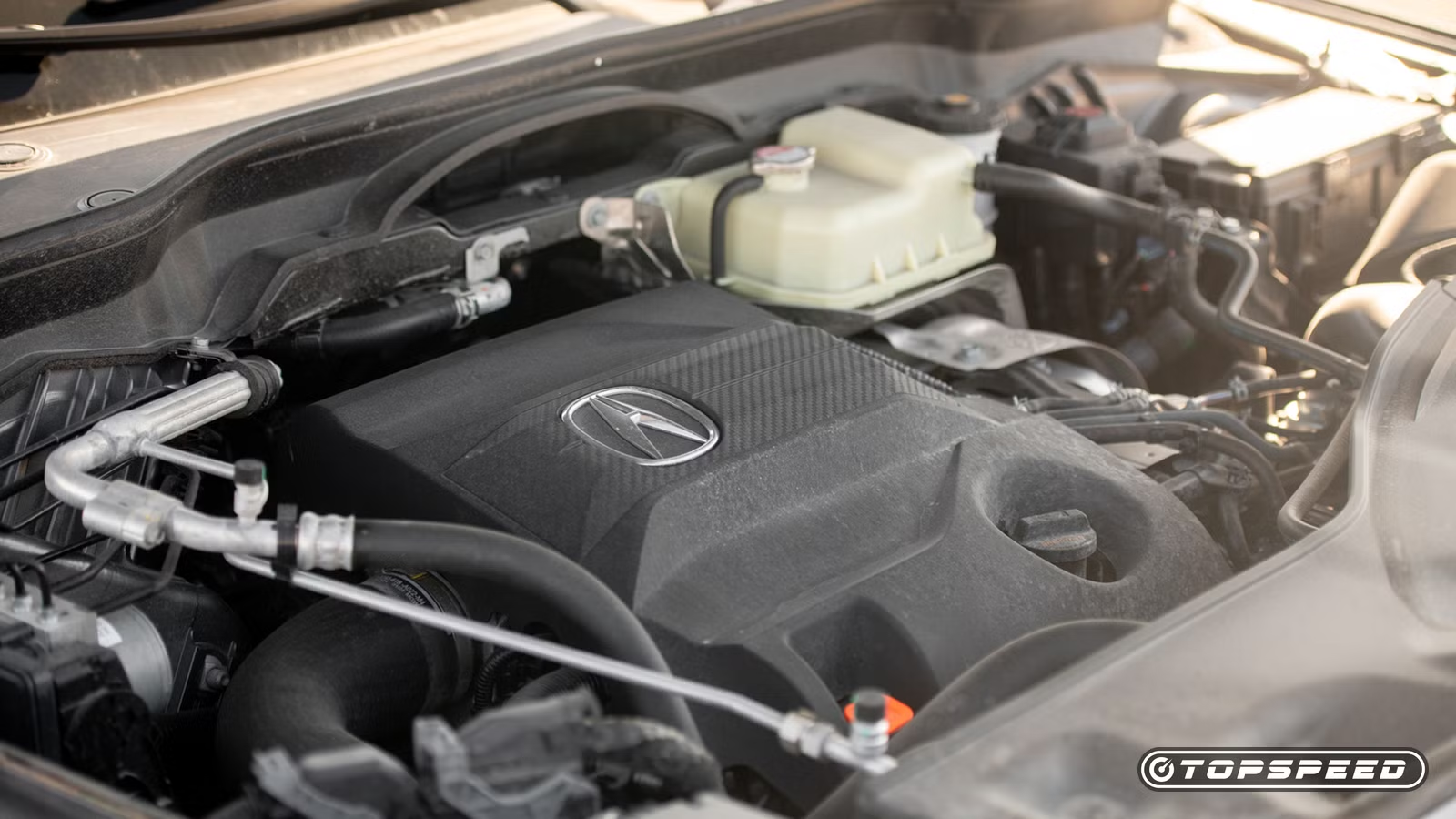
A 2024 Acura MDX engineAcura
The Acura MDX’s residual strength is not a lucky data point from one good model year; it is downstream of decisions made on the engineering side that show up directly in resale math. The MDX shares its platform, much of its drivetrain, and a substantial parts catalog with the Honda Pilot and other high-volume Honda products. That shared architecture means replacement parts are cheaper to source and more widely stocked, independent shops can service the vehicle without specialized German diagnostic equipment, and the used-buyer pool factoring future maintenance costs into their offer prices sees a lower-risk proposition than they would with an X5 or GLE.
The X5 and GLE, by contrast, carry adaptive air suspension components, complex electronic architectures, and dealer-dependent service requirements that drive up the perceived and actual cost of ownership past the warranty period. Used-car buyers price that risk in before they ever sit in the driver’s seat, which depresses what they are willing to pay for an out-of-warranty German luxury SUV relative to a comparably aged Acura. None of this is about which vehicle drives better when new. It is about which one a rational used-vehicle buyer trusts to stay affordable to own for another five years, and that calculation consistently favors the Honda-engineered alternative.
2025 Acura MDX Type S side shotGuillaume Fournier | TopSpeed
This is also why the MDX’s residual advantage has held across multiple model generations rather than showing up as a single anomalous year in the data. Platform-sharing with high-volume Honda products means parts supply stays deep and prices stay stable even a decade after a given MDX generation goes out of production, which keeps long-term ownership costs predictable in a way that relatively low-volume German components, sourced through narrower supply chains, generally cannot match.
Why Two-To-Four-Year-Old MDXs Make The Strongest Financial Case
If the goal is maximizing value rather than maximizing badge prestige, the sweet spot in this data is not a brand-new MDX, an X5, or a GLE. It is a two-to-four-year-old MDX. Depreciation curves across the entire industry are steepest in the first 24 to 36 months of ownership, the stretch where a German competitor’s value erodes fastest and an MDX’s already-gentler curve compounds the advantage further. A buyer picking up a two-to-four-year-old MDX captures most of the vehicle’s remaining useful life and warranty coverage while letting the original owner absorb the steepest portion of the depreciation hit on a model that was already losing value more slowly than its German rivals.
That combination, a vehicle that depreciates less aggressively in the first place, purchased after its steepest depreciation years have already passed, is what makes pre-owned MDX shopping look less like a compromise and more like the financially literate move in this segment. German rivals depreciated fast and started at a higher price. The MDX depreciates more slowly and starts lower. Buyers chasing the badge on a new-car lot are paying a tax that pre-owned MDX buyers have already opted out of, and the dollar figures above show exactly how much that tax is currently running.
Sources: Acura, iSeeCars, CarEdge, & Kelley Blue Book


















No Comments