
The 330 hp Hyundai Wagon That Could Undercut The RS6 Avant By $80,000
Performance wagons have long offered the best of both worlds, combining everyday practicality with the kind of pace usually associated with sports cars. Yet affordable versions have all but disappeared from North America, leaving expensive models such as the Audi RS6 Avant to carry the torch for the segment.

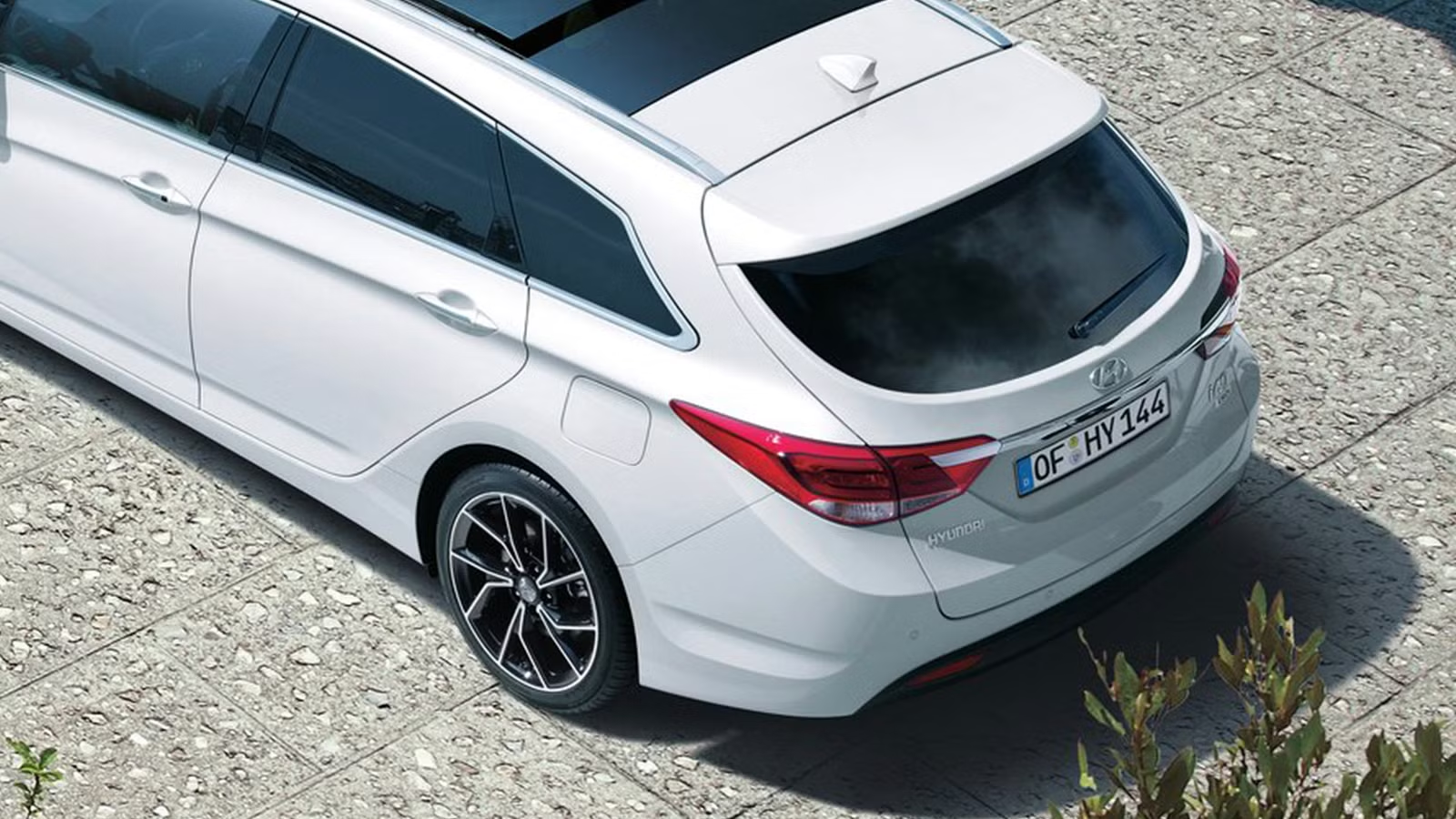
Now, a new CGI concept raises an intriguing question: what if a mainstream automaker transformed a compact performance sedan into a long-roof wagon, powered by a roughly 330 hp turbocharged four-cylinder engine? Unlike many digital fantasies, this one is based on mechanical ingredients that are already becoming reality.
The Performance Wagon Has Become A Luxury-Only Proposition
The affordable performance wagon has become an increasingly rare proposition in North America. As buyers have shifted toward crossovers and SUVs, manufacturers have steadily withdrawn practical long roof models, leaving enthusiasts with far fewer choices. Even Volkswagen keeps its Golf R wagon away from the U.S., despite offering it in Europe.

At the opposite end of the spectrum sits the Audi RS6 Avant, which shows just how extreme the surviving performance wagon formula has become. Its twin-turbo 4.0-liter V8 produces 621 hp and 627 lb-ft, enough for a 0-to-60 mph acceleration time in 3.3 seconds, while retaining the space and versatility expected from a family wagon. The catch is its $130,000 starting price, before options, putting this ultimate combination of speed and practicality firmly into luxury car territory.
One Render Shows How Easily The Formula Could Work

A CGI concept from Carscoops makes a surprisingly convincing case for stretching Hyundai’s latest compact sedan into a performance estate. Rather than simply adding cargo space, the rendering reshapes the rear with a longer roof, steeply raked D-pillars, and separate rear quarter windows, giving the car a distinctly long-roof silhouette. The transformation also appears to suit the sedan’s muscular proportions, with flared arches and a broader stance looking more natural on the extended body.
The N treatment takes the idea further with a prominent front splitter, deeper intakes, larger wheels, red brake calipers, side skirts, and a rear diffuser incorporating quad exhausts. The result is a compact wagon that looks purposeful rather than merely practical, showing how little would need to change visually to create a convincing high-performance wagon.
The Engine Underneath Is Far From Fiction

The most important part of this hypothetical wagon may be the hardware hiding beneath its extended bodywork. Rather than inventing an engine for the render, Carscoops bases the concept on the 2.5-liter turbocharged four-cylinder expected to power the next generation of Hyundai’s N performance sedan. Hyundai has already confirmed that the model is in development, while test mules have been spotted in South Korea and are believed to be running the larger engine.
The projected figures are approximately 330 hp and 311 lb-ft of torque for the new application, representing a substantial step beyond the current engine. However, those numbers are projections, not Hyundai specifications. The automaker has not yet confirmed the final output, and earlier comments from former N boss Albert Biermann suggested the larger engine could initially deliver similar power to the existing unit.
The New Platform Gives Hyundai Room To Play

The latest Elantra is already a substantially larger car, giving any potential performance derivative more room to work with. The eighth-generation model measures 4,765 mm (187.6 inches) long and 1,855 mm (73 inches) wide, representing increases of 55 mm (2.2 inches) and 30 mm (1.2 inches), respectively. Its wheelbase has also grown by 30 mm (1.2 inches) to 2,750 mm (108 inches). Hyundai says the extra dimensions improve cabin space, while the wider body creates a more substantial footprint.
That growth could be particularly useful if the sedan’s architecture were adapted into an estate. A longer roof could add cargo capacity without making the underlying vehicle feel undersized, while the additional width would provide a useful foundation for a more aggressive chassis. The N version is already expected to receive a wider track and chassis-focused upgrades, suggesting that a performance wagon could theoretically share much of its hardware with the sedan rather than requiring an entirely new platform.
Hyundai Is Doing Almost The Exact Opposite

The biggest obstacle to this idea is not engineering but Hyundai’s own product strategy. The automaker is preparing to retire the i30 Wagon when the current generation reaches the end of its production run, with no successor planned. Hyundai Europe CEO Xavier Martinet said demand for wagons is no longer growing, while describing the i30 as historically being largely a fleet vehicle with relatively low profits.
The reasoning is straightforward from a business perspective. Hyundai says shoppers in markets including the U.S. and China are increasingly choosing crossovers and SUVs instead of wagons, while SUVs generate more money for the company. That makes allocating engineering and development resources to a niche wagon increasingly difficult to justify. A performance wagon could attract enthusiasts, but its limited sales potential would have to overcome the stronger financial case for putting those resources into another SUV.
North America Has A Huge Performance Wagon Blind Spot
Europe has not completely abandoned the compact performance estate, even if North America has. Volkswagen still sells the Golf R Variant, combining the practicality of a wagon with the brand’s most potent compact performance hardware. Skoda offers the Octavia vRS wagon, while Cupra’s Leon Sportstourer VZ provides another interpretation of the same formula. These cars demonstrate that there is still a market for smaller, fast wagons when manufacturers are willing to build them.
The situation is very different across the Atlantic. None of these models is offered in the United States, leaving American buyers without a direct compact performance wagon equivalent. That creates an unusual gap in the market: there are plenty of performance SUVs and expensive luxury wagons, but almost nothing occupies the middle ground. For a manufacturer prepared to accept the risks of a niche enthusiast model, that gap could represent an opportunity rather than a liability.
Hyundai Could Build The Poor Man’s RS6

Hyundai N already has most of the ingredients needed to turn this concept into a compelling enthusiast car. The division has established its performance credentials, while the next-generation model brings a larger platform and a new turbocharged engine that could provide serious pace without exotic hardware. The render itself demonstrates that the sedan’s design can be transformed into a convincing long-roof shape with relatively modest changes.
A roughly 330 hp wagon would not need to challenge the Audi RS6 Avant on outright performance. Its appeal would come from delivering the same basic recipe: strong acceleration, sharp handling, and enough rear space to make it genuinely useful, but at a fraction of the price. Carscoops estimates it could cost around a third as much as the Audi, although our guess would be closer to half the price. That would give North American enthusiasts something they currently cannot buy: an attainable, genuinely fun performance wagon that puts practicality ahead of prestige.
Sources: Hyundai, Carscoops

Related posts



Latest Post


No Comments