
The Yamaha Sleeper Smart Riders Are Quietly Snatching Up
Yamaha has been a pioneer of the engineering ethos that prioritizes rider connection over numbers that look good on a spec sheet. It put its money where its mouth is when introducing the original crossplane YZF-R1. When that motorcycle launched, it had one of the lowest power outputs in the segment, but it was a wild success because it deliberately traded outright peak horsepower for better feel at the rear wheel. This philosophy is now followed by every single manufacturer in MotoGP, proving that Yamaha’s philosophy was right. Other manufacturers have since applied the same philosophy to some of their roadway products, while Yamaha has expanded it across its range.
Spec-Sheet Obsession Diluted The Middleweight Class

While applying and marketing the rider-focused connection in a liter-class superbike segment is easy, things are a little more challenging when it comes to the middleweight segment. Like the performance machines, middleweight motorcycles have also been chasing figures that look good on a spec sheet, and the only way to do this is by increasing complexity, which in turn makes prices soar.
More often than not, middleweight motorcycles started getting peaky power deliveries that were more suited to a racetrack than the real world, so once again Yamaha decided to pivot and offer a product that gave riders what they actually need from a versatile daily machine.
The Crossplane Philosophy Shifted From Superbikes To Daily Riders

Yamaha’s divergent path has fundamentally changed the middleweight landscape. It took the crossplane engineering from the YZF-R1’s CP4 engine and whittled it down into something that was small, light, and fun. It also gave it so much flexibility that it was capable of powering everything in Yamaha’s portfolio, whether it was a supersport motorcycle, a middleweight adventure tourer, or a roadster. It proved that simplicity and unbreakable reliability will win over complexity and spec sheet figures, no matter what kind of motorcycle customers are looking for.
Stripped-Down Fun Established A New Segment Formula


Yamaha’s middleweight products have proven to be very popular with customers, whether they like playing in the dirt, getting a knee down at a racetrack, or cruising down the boulevard on weekends. However, it all began with one naked motorcycle. This motorcycle was conceived as a pure, stripped-down motorcycle designed to be affordable while still remaining manic fun. This naked bike established a standard for modern everyday motorcycling, and it is the Yamaha that quietly wins over riders year after year.
The MT-07 Balances Real-World Usability With Bulletproof Reliability

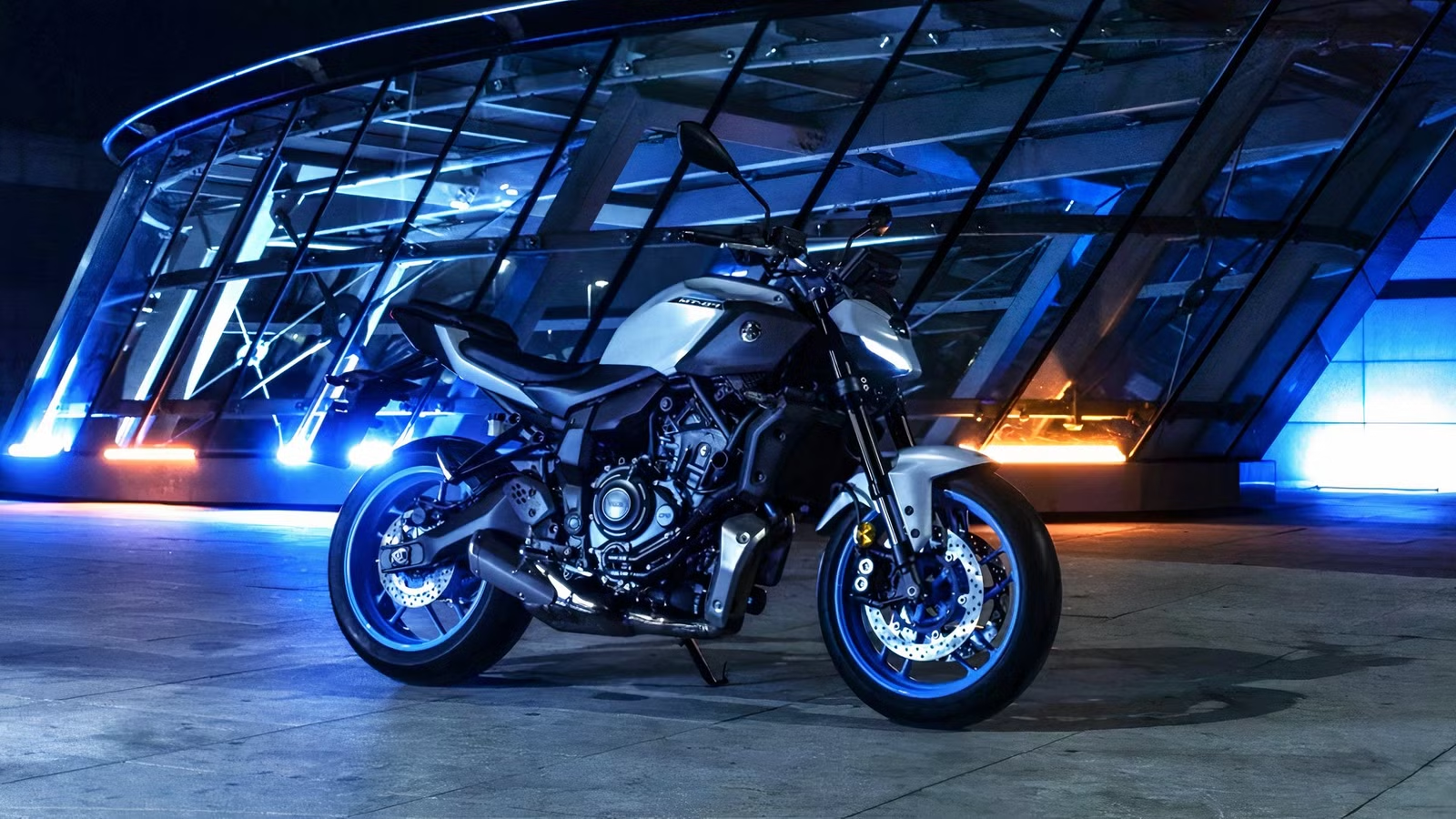
The original Yamaha MT-07 redefined what a middleweight naked motorcycle should be by offering character and real-world performance combined with unshakable reliability instead of complex electronics and high power figures. It might also be the best used bike on earth. At the heart of it all is the legendary 689 cc CP2 parallel-twin engine that offers instant torque.
Yamaha then doubled down on this by giving it an extremely light chassis with upright ergonomics, and finally gave it a few electronics last year to help tame its character a little bit and appeal to a much wider audience. At the same time, it has not let go of its core tenet of reliability; this motorcycle will run easily for 100,000 miles without breaking a sweat. But what actually makes it so bulletproof — and why do riders keep choosing it over bikes with more power and more tech?
An $8,599 MSRP Positions The MT-07 In A Competitive Sweet Spot

The MT-07’s price puts it in the middle of the segment, with some competitors that are more affordable and others that are more expensive. For the features it offers, especially with the latest update, it is comfortable and easy to own. Another point in its favor is that it is extremely reliable, which means ownership costs will be low. At $8,599, it sits squarely between bargain rivals and premium alternatives — but whether it earns that price depends entirely on what’s underneath the tank.
The 270-Degree CP2 Twin Prioritizes Usable Low-End Punch

The MT-07 is powered by the same engine that also does duty in the YZF-R7 and the Tenere 700. This CP2 crossplane parallel twin has a 270-degree firing order and generates 72.4 horsepower at 9,000 RPM and 50.2 pound-feet of torque at 6,500 RPM from 689 cc.
These figures might not sound like much, but given the light weight of the MT-07 and the excellent low- to mid-range torque spread of the engine, it makes for a bike that is built for real life. The six-speed gearbox always had an assist and slipper clutch, but the recent update has given it a two-way quickshifter. Yamaha also claims 57 MPG, which means it is very efficient.
Budget-Friendly Cycle Parts Keep Maintenance Low But Limit Racetrack Pace

The MT-07 has a diamond frame made out of steel tubes and uses the engine as a stressed member. It is paired with a 41 mm inverted fork at the front and a link-type single shock at the rear. KYB provides the suspension. There is adjustable preload only for the rear shock and 5.1 inches of travel at both ends.
The brakes are twin 298 mm discs at the front with radially mounted four-piston fixed calipers and a 245 mm disc at the rear with a single-piston caliper. 17-inch alloy wheels and tubeless radial tires are fitted. The MT-07’s light weight makes it a very enjoyable motorcycle in most places, but the mostly non-adjustable suspension can show its limitations if you push it extremely hard at speed. Overall, it is a motorcycle that reminds you why riding is fun.
A 54.9-Inch Wheelbase Maximizes Urban Flickability
The MT-07 strikes the perfect balance of size, speed, and simplicity, with a length of 81.3 inches, a width of 30.7 inches, and a wheelbase of 54.9 inches. The seat height is regular for the class at 31.7 inches, and it has genuinely good ground clearance at 5.9 inches. The fuel tank can hold 3.7 gallons, and the wet weight is quoted at 403 pounds. This is an extremely light motorcycle with a short wheelbase, and that can only mean one thing: fun!
Ride-By-Wire Throttle And TFT Tech Bring Modern Refinement

The MT-07 has been getting it right for years, and part of that reputation is thanks to its simplicity. However, a recent update has given it all the features you want from its class of motorcycle, beginning with a five-inch TFT instrument display. You can set one of four themes on it, and it also has smartphone connectivity and turn-by-turn navigation. The turn signals have a lane-change feature and are self-canceling as well. There is all-LED lighting, and the wheels are SpinForged to reduce weight.
It now has a by-wire throttle and therefore multiple throttle and power maps with a custom mode as well. The traction control can be set to multiple levels of intervention and can be switched off. Dual-channel ABS is standard as well. Yamaha has retained the essence of the simple, reliable motorcycle that made it win over riders year after year.
Suspension Damping And Highway Comfort Remain The Core Weaknesses

The MT-07 knows exactly what it is, and as such, it has very few negatives. For how good the engine and chassis are, adjustable suspension would have been great. It can be a very fatiguing ride on the highway because the engine prefers to make most of its torque in the low and mid sections of the rev range. The seat is too thinly padded for long rides, and the pillion seat is quite inadequate as well. Still, it outsells more glamorous rivals for a reason.

There are some very strong contenders from Japan, Europe, and even China that compete in the middleweight naked bike segment. The most affordable of the lot is the Kawasaki Z650 ($7,249). This is anyone’s match as far as reliability is concerned, but this is also an old platform, so it is down on power. Like the Yamaha, it recently got an update which gave it a 4.3-inch TFT display.

Further up the ladder is the Honda CB750 Hornet E-Clutch ($7,999), which gives you premium features without a premium price. This makes a very good case for itself as the best in the segment, because not only does it have the only semi-automatic gearbox in the segment, it also has aggressive looks that will appeal to the widest audience. It possesses a genuinely enjoyable engine and chassis combination that makes it one of the quickest in the segment.

Chinese giant CFMoto weighs in with its 800NK ($8,699), which is one of the naked bikes that punches way above its price tag. We’ve matched it on price rather than the 675NK, which is closer on specs. As always, it offers performance that is half a segment higher for a very reasonable price. However, it still needs more time to prove its longevity, especially given the competition here.

The latest entrant into the segment is the $8,745 Triumph Trident 660. This is a great all-around machine and brings a unique flavor to the segment with its inline three-cylinder engine. Some might not like the part-TFT, part-LCD instrument cluster, but there is no doubt that it brings a different level of safety to the segment with its six-axis IMU and cruise control.

At the top of the heap sits the Suzuki GSX-8S ($9,249) that excels at almost everything. It has a larger displacement engine like the CFMoto, but it also has some strange choices, like its TFT instrument cluster not offering Bluetooth or navigation even as options. Still, this is an enjoyable motorcycle to ride, and it is based on a known driveline from the V-Strom 800, so it will be reliable.
Source: Yamaha Motorsports

Related posts


Latest Post


No Comments