
Detroit’s Most Overpowered Family Car Of The Muscle Era
Few corners of automotive history are as entertaining as the moments when common sense took a back seat. The muscle car era is celebrated for its purpose-built coupes and convertibles, but some of its most fascinating stories unfolded in the last place anyone expected: the family station wagon. When the ordering books were wide open and nobody was saying no, a handful of determined gearheads found a way to stuff genuinely outrageous power into the most sensible vehicle on the lot. What followed was one of Detroit’s great accidental performance machines.
The Ford Country Squire Was Never Supposed To Be A Performance Machine

Upon its release in 1950, Ford never had any intention of the Country Squire being some sort of performance statement. By the late 1960s, it sat firmly in Ford’s lineup as the quintessential family station wagon, built around space, comfort, and long-distance travel. This was Ford’s premium full-size wagon, designed for growing families, road trips, and everyday hauling at a time when wagons were still the default family vehicle across America.
By 1967, the Country Squire had become a fixture in Ford’s lineup — long, wide, and heavy, riding a body-on-frame chassis tuned for comfort above all else. Everything about this machine was predictable, reflecting its natural purpose with wide bench seats, a flat cargo floor, and available third-row seating that made it practical first and foremost. The signature woodgrain trim was never about sportiness. Instead, it was a visual signal that this was a well-appointed family hauler meant to look sharp in a 1960s driveway. Ford’s own marketing reinforced that message, with period brochures pitching the wagon as the ultimate rig for family road trips and interior room over long miles of travel. Plain and simple, the Country Squire was presented as a solid choice for vacations and daily life, not something designed to be ridden hard and put away wet. That intent is also reflected in the engines most wagon owners actually ordered.

The standard and most commonly selected V8s focused on reliability and smooth delivery. Performance was never top of mind when it came to family wagons. Even when larger engines like the 428-cubic-inch Thunderbird Special were approved through special-order channels, they were still alternatives layered onto a platform that was never engineered to deliver any kind of wow factor — performance was simply never supposed to be the goal. Well, except for the gearheads who demanded it.

How The 428 Thunderbird Special V8 Ended Up In A Full-Size Station Wagon

What’s key to this story is that Ford never set out to create an overpowered family car, but they weren’t looking to say no to the idea either. In the classic good cop, bad cop scenario, Ford was definitely playing the good cop. Introduced in the mid-1960s, the 428 Thunderbird Special was developed to deliver smooth, effortless torque in large, heavy vehicles rather than to chase outright performance. This big-block prioritized low-end pull and relaxed highway cruising. Ford initially deployed it in luxury-oriented models like the Thunderbird and full-size sedans, and by 1967, the engine was available through special-order channels. Savvy gearheads who understood the order sheet — or dealers willing to work through Ford’s internal systems — could spec combinations that looked like someone with zero restraint got hold of the order book. And that, folks, is exactly how the 428 Thunderbird Special found its way into a full-size station wagon.
The 428 Country Squire Is A 1960s Unicorn
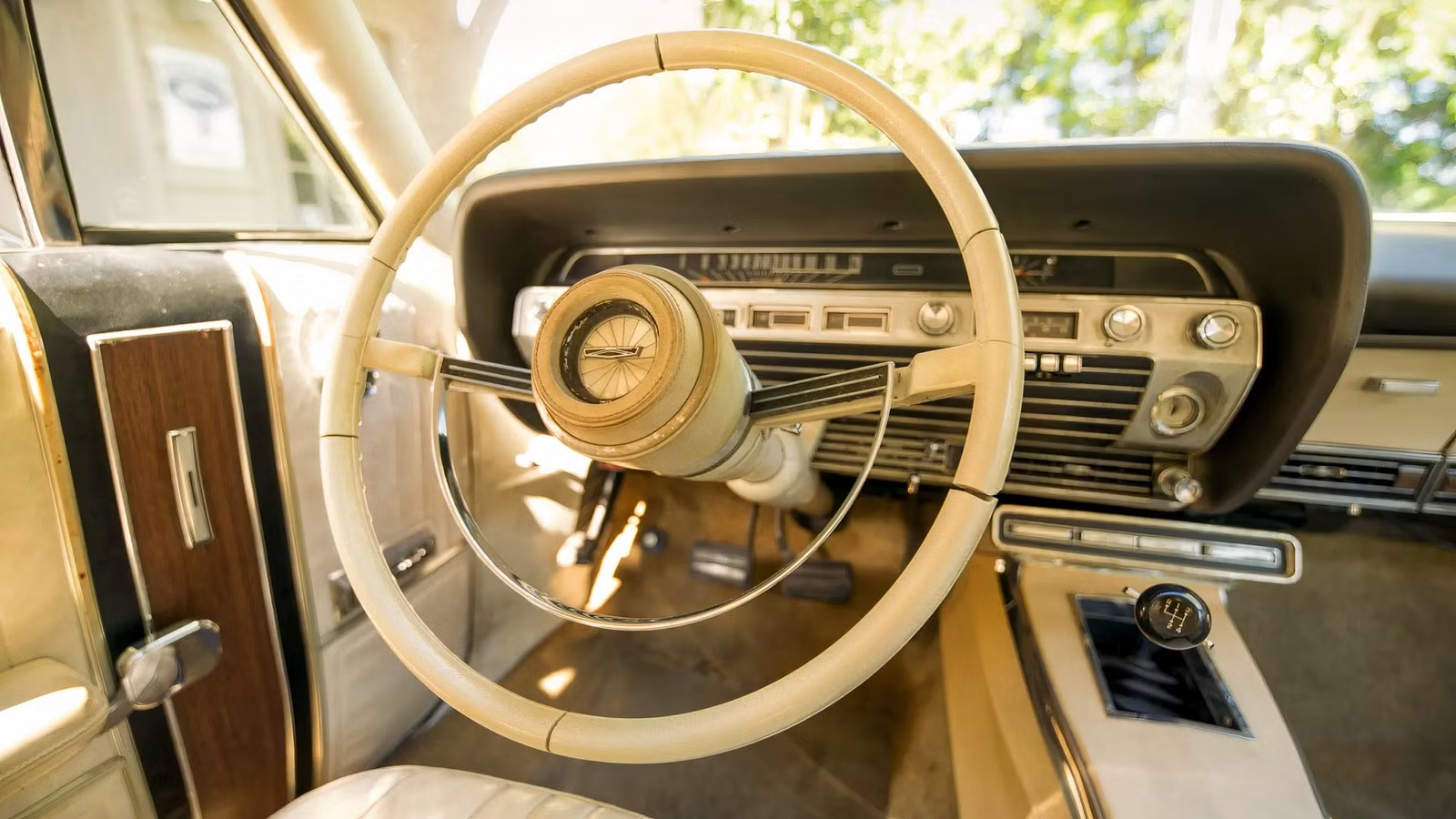
This is by no means a standard factory option. In fact, the only publicly known example — the one pictured above — surfaced on Bring a Trailer in 2020, where it sold for $47,750 with just under 28,000 miles on the odometer. According to the listing, it was a special-order example delivered in 1967 to its first owner, who reportedly wrote directly to Ford executive Lee Iacocca requesting a Q-code 428, a four-speed manual, bucket seats, and a center console — an absurd spec by any family-wagon standard. Since then, it changed hands a few times before landing with its current collector-owner, preserving a rare glimpse of Detroit’s muscle-era flexibility.

|
Engine |
Power |
Torque |
|---|---|---|
|
428ci Q-Code V8 |
*345 hp |
*462 lb-ft |
*Factory power ratings for the 428 Q-Code V8 in the 1967 Ford Thunderbird The presence of Ford’s 428 Thunderbird Special in a Country Squire wasn’t the result of a performance experiment or a marketing push. In all honesty, it was simply a glorious byproduct of how Ford structured its engine options in the late 1960s. The ordering system was a little wild back then, creating opportunities for gearheads in the know to build wonderful machines carrying far more power than anyone would ever need behind the wheel of a ’60s wagon. In a sense, Ford’s ordering system was a bit like saying, sure, we can get ice cream, just don’t tell your mother — except this time it wasn’t ice cream; it was dropping a big-block 428 V8 under the hood of the family car. Still, let’s be clear: the 1967 Ford Country Squire equipped with a 428 Thunderbird Special wasn’t common, and it was never advertised as a feature. It was a special-order engine approval that could be paired with a body style Ford still viewed primarily as simple transportation.
This 428 Country Squire Is A Proper Sleeper Wagon

While there’s no official performance data for the 428 Thunderbird Special-equipped Country Squires — simply because they’re so rare — under the hood of the 1967 Ford Thunderbird, the same Q-Code 428 V8 was rated at 345 hp and around 462 lb-ft of torque, enough to put it on par with serious muscle cars like the Pontiac GTO at least on paper. In reality, most publications report that 428-fitted T-Birds reached 60 mph in about 9 seconds and cleared the quarter mile in 16, topping out at around 135 mph. These were never meant to be drag cars — they were extremely capable luxury cruisers — and that’s exactly what this 428 Country Squire is, despite tipping the scales at over 5,000 lbs. The Thunderbird engine wasn’t there because the wagon needed it, or even wanted it. It was there simply because Ford left it on the table, and a handful of determined gearheads had enough fire in their bellies to go ahead and check the right boxes.
Why The 428 Thunderbird Was Overkill In A Family Wagon

Calling the 428 Thunderbird Special excessive in a Country Squire isn’t a value judgment so much as a mechanical reality — the engine was designed for luxury, and the wagon was built to be a family hauler. The 428 Thunderbird Special was engineered to sit in the bay of smooth, torque-focused vehicles like the Ford Thunderbird. The Country Squire, by contrast, was designed to move families, cargo, and trailers over long distances. The mismatch starts with the fact that the 1967 Country Squire was a large, heavy full-size wagon with a long wheelbase and body-on-frame construction tuned for ride comfort. Its suspension prioritized compliance over control, and its steering and brakes were engineered around ease of use.

The 428 Thunderbird Special also brought a level of output that went far beyond what was necessary for the wagon’s mission. Its abundant torque provided far more power than required for hauling passengers or cruising at highway speeds, particularly in normal day-to-day driving. And while the engine was well-suited to moving heavy vehicles, it was not designed with efficiency in mind — especially in a vehicle with significant weight and frontal area. For a family wagon buyer, the trade-off made little practical sense, offering minimal everyday benefit in exchange for higher operating costs.

But let’s not get it twisted. The combination wasn’t unsafe or poorly engineered. The engine simply existed outside the wagon’s original design logic. The Country Squire didn’t need a 428-cubic-inch big-block to do its job. That it could accept one at all is less a sign of intent than a byproduct of late-1960s Detroit flexibility — when power was plentiful and restraint was, well, optional, as this overpowered family hauler so perfectly proves.
Other Muscle-Era Family Cars That Tested Practical Limits

- Chevrolet Impala/Bel Air: Available with the 409 and later 427 big-blocks, delivering up to 425 hp.
- Pontiac Catalina and Bonneville: Equipped with 421-cubic-inch V8s, providing effortless torque for heavy-duty cruising.
- Buick Sport Wagon & Oldsmobile Vista Cruiser: Both could be optioned with a 365-hp 455 V8.
- Chrysler Dodge Polara & Plymouth Fury: 440 V8s in full-size sedans and wagons, packing up to 390 hp.
- 1969 AMC Ambassador Cross Country: Could be ordered with the 325-hp AMX 401 engine and a 4-speed manual.
As seasoned gearheads will remember, the 1960s muscle car scene was equal parts wacky and wonderful. There were some real beauties created during this era, along with some genuinely out-of-the-box ventures — like a Country Squire wagon pushing 345 ponies. But Ford wasn’t the only automaker to wander into excess during the muscle era. Across Detroit, the late 1960s produced several vehicles that had no real business existing, blurring the line between practical transportation and top-level performance. On the Chevy side, full-size sedans like the Impala could also be ordered with serious big-block power, including the 409 and later 427 V8s. These were four-door rides designed to carry families in comfort, yet they could house the same powerhouse engines that drove Chevrolet’s performance lineup. The result was family sedans capable of moving far quicker than their soft suspension, modest brakes, and conservative tires ever demanded.

Pontiac followed a similar path with the Catalina and Bonneville. The availability of high-output 421 engines in large, family-focused bodies gave buyers effortless torque and straight-line muscle, even though these cars were still tuned for relaxed highway cruising. Buick’s Sport Wagon and Oldsmobile’s Vista Cruiser wagons could also be optioned with large-displacement V8s, including 455-cubic-inch engines, by the early 1970s. Like the Country Squire, these wagons were engineered for passengers and cargo first, with long wheelbases and comfort-oriented suspensions that made their available power feel almost excessive for daily use. Even Chrysler joined in, with Dodge Polara and Plymouth Fury models available with 383 and 440 engines, delivering torque levels more commonly associated with muscle coupes. The power was real, but the platform never revolved around exploiting it. Taken together, these cars highlight a brief moment when Detroit’s ordering freedom outpaced restraint — a time when performance engines weren’t confined to performance cars. For those gearheads brave enough to navigate the right channels, these engines spilled into family vehicles simply because they could, creating a short-lived era where a family wagon and unbridled performance shared the same showroom floor.
Sources: Hagerty, Bring a Trailer, Hemmings.

Related posts
Latest Post


No Comments