
The 8,000-RPM ‘90s Honda Gen Z Is Sleeping On
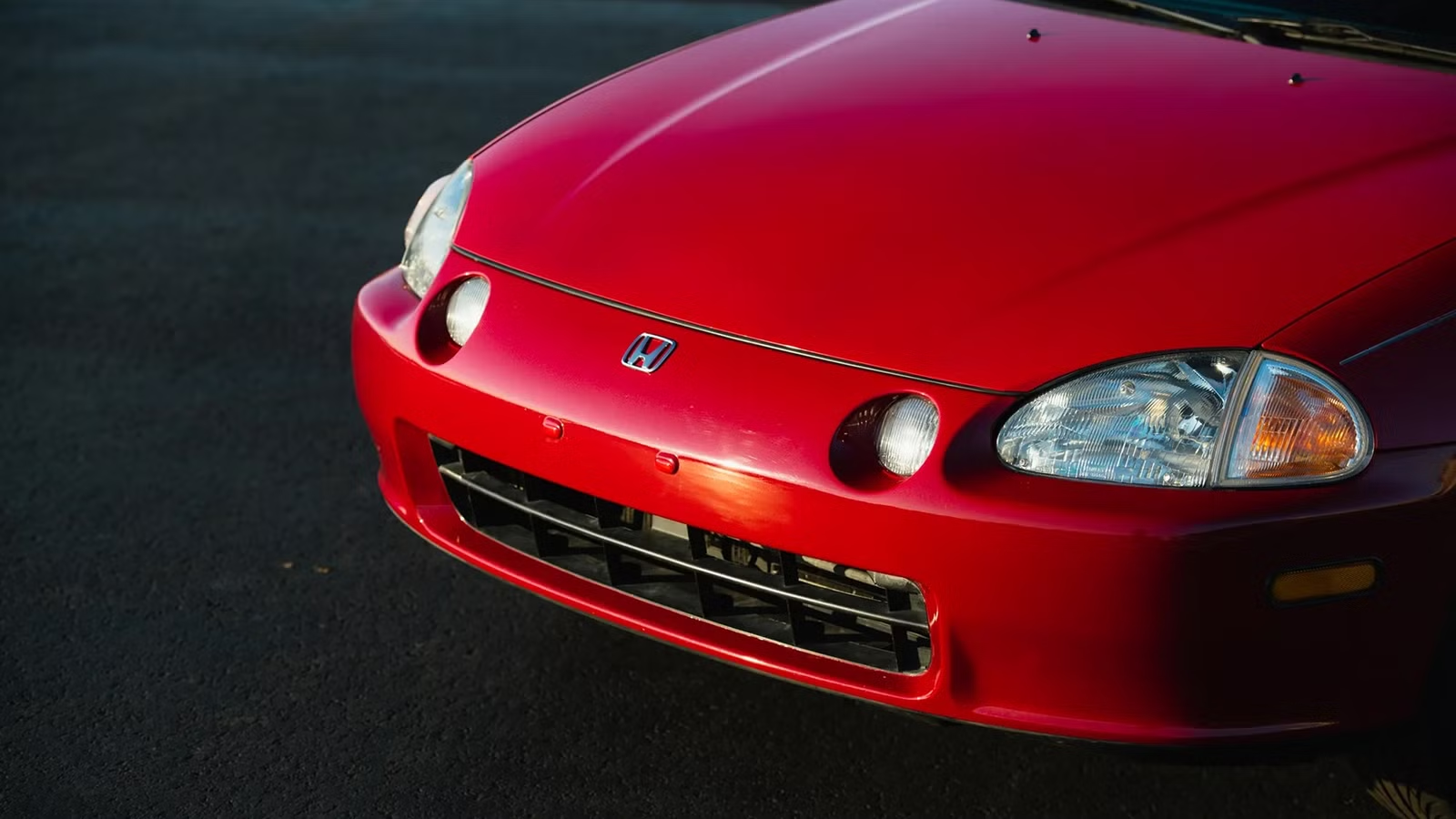
Gen Z enthusiasts face a brutal automotive reality: modern sports cars are financially out of reach, while budget-friendly options are often just commuter cars with fancy graphics. Cars today have gained speed but lost their feel. Classic JDM Icons like the Civic Si and Integra Type R have skyrocketed into overpriced territory, leaving young enthusiasts stuck between muted modern appliances and unreachable legends. Yet one JDM classic has been overlooked for years and might be the perfect gateway into high-revving, lightweight performance without breaking the bank.
The Performance Tradeoff of The Modern Era

Modern performance cars are marvels of efficiency, but they are emotionally hollow. The visceral sensation has been stripped in the search for thefastest 0 to 60 mph times. Hitting under four seconds today is no longer special. Just floor the gas pedal and the electronics do the rest. Drive-by-wire throttle and lightning-quick dual-clutch transmissions have replaced the real skill required for driving on the edge.
Gen Z is surrounded by cars with massive screens that control everything automatically; this has created cultural friction for young enthusiasts looking for a sports car with pure mechanical feedback, hydraulic steering, and a manual transmission packed into a lightweight chassis.
The new-car market is already overpriced for young enthusiasts; the “working class” icons of the past have become unaffordable. A 2000s Honda Civic Si, an accessible fun car when it launched, now goes for the cost of a slightly used or even a new base-spec commuter car. The Acura Integra Type R, in well-maintained condition today, can easily cross the six-figure barrier.

Honda’s Confidential ’90s Targa Experiment

In the 1990s, Honda was at its engineering peak. The road car division had unprecedented freedom to innovate around a single goal: bring high-revving, race-bred engineering to the streets. This era gave birth to Honda’s revolutionary Variable Valve Timing and Lift Electronic Control, aka VTEC. The enthusiast market leaned toward sports coupes during that era, and Honda was developing an ambitious experimental platform. It was to be the successor to the lightweight CR-X.
For this new project, engineers set out to achieve three distinct goals: an agile, front-engine, front-wheel-drive compact sports car; an open-cockpit design with structural rigidity, weatherproofing, and open-top freedom, like the lightweight European roadsters, without adding the drag or soft-top wear of a traditional convertible. Honda’s solution was a lightweight, 24-pound removable aluminum Targa panel, paired with the screaming redline of a naturally aspirated performance engine.
The Honda Del Sol: an 8,200-RPM VTEC Coupe

Honda’s forgotten masterpiece, the Civic Del Sol VTEC, launched in North America for the 1994 model year. The Del Sol had a high-revving 1.6-liter naturally aspirated engine, the B16A3, that made 160 horsepower at 7,600 rpm and pulled all the way to its high 8,200 rpm redline. The performance figures might not look that impressive.
To put it into perspective, Honda extracted 100.3 horsepower per liter from the 1.6-liter engine without any turbocharger or supercharger. This was supercar territory back in 1994, a feat shared with exotics like the Ferrari F355. The B16A3’s internals were built to take a beating: a high-silicon aluminum block, a micro-polished crankshaft, lightened connecting rods, and oil-squirt jets that targeted the undersides of the pistons to maintain thermal stability at high engine speeds.
The true magic lay in Honda’s dual-stage DOHC VTEC system. Below 5,700 rpm, the engine was calm, running on economy cam lobes that let it idle quietly and provide tame throttle response for around-town driving. Once past 5,700 rpm, hydraulic oil pressure engaged a locking pin that forced the valvetrain onto high-lift, long-duration cam lobes, instantly making the engine more aggressive and turning the intake tone from a docile hum into a metallic wail that unleashed all its power up to the 8,200 rpm redline.
How a Lightweight Chassis and Short-Ratio Manual Gearbox Transformed Driving

Paper specs do not do the driving experience justice. Tipping the scales at just 2,490 pounds, the Del Sol drives like a featherweight athlete that reacts instantly to the driver’s inputs, unlike modern cars that often use MacPherson struts or rear torsion beams. The Del Sol rode on an independent double-wishbone suspension system.
This sophisticated suspension kept the tire in constant contact with the pavement, even under extreme cornering loads, giving the driver razor-sharp front-end grip, neutral turn-in, and pure, unfiltered feedback from the hydraulic steering. Mated to a short-throw five-speed manual transmission that was engineered with close gear ratios, the B16A3 was kept in the sweet spot. The Del Sol was a targa, so when you unlatched the lightweight aluminum roof, you could hear the engine singing: no need for fake engine notes like today’s modern cars.
Early models suffered from leaky targa seals in heavy rain; Honda redesigned the weatherstripping by 1995, which fixed the problem entirely. Because the naturally aspirated power came high in the rev range rather than low like a turbo-equipped engine, enthusiasts could rev the engine to its max and still stay at reasonable speeds without breaking any speed limits.
The Last Undervalued JDM Gateway

The Del Sol spent decades being neglected by purists for its styling, as it looked too soft compared to the standard Civic, the Integra, and its contemporaries. But because of that, a dynamic, nimble, analog machine is available today for the younger enthusiast at an accessible price. As 1990s JDM icons continue to skyrocket into the stratosphere, the Del Sol remains the quiet option, with the same internals as its cousin, the Integra. It shares the same double-wishbone setup and high-revving engine, plus the addition of an open-top targa configuration that none of the other cars can replicate.
Recent auctions show the Honda Del Sol, with a clean title and in driver condition, selling for around $22,000, compared to its rival and cousin at the time, the Honda Civic Si; a clean, low-mileage example sold for a whopping $50,000, and it shares the same engine. And the Acura Integra Type R in low-driven, pristine condition sold for an eye-watering $112,000.
Modern cars keep getting heavier, more insulated, and more expensive. The Del Sol is no longer a quirky alternative but a viable option for the up-and-coming enthusiast who wants a car that does the basics right, a car that focuses on handling and driver engagement. The Del Sol is one of the market’s underrated 8,000 rpm options right now, and a smart purchase as the market wakes up to it.
Source: Bring a Trailer, Honda, Wiki.

Related posts
Latest Post


No Comments