
The Underrated Japanese Cruiser That Deserves More Respect
Motorcycles stand for rebellion in most people’s minds, especially cruiser motorcycles. However, in a great twist of irony, there are very few things that suffer from rigid conformity like the cruiser segment. A ‘proper’ cruiser needed to be American, have a pushrod, air-cooled V-twin engine, and sound a particular way. This gatekeeping meant that the cruiser segment did not allow mechanical innovation for a very long time. Riders that have bought into the cruiser segment have been willing to put up with what are frankly subpar products that sell more on nostalgia and the ‘right badge’ than anything else.
Japanese Metric Cruisers Deserve Recognition For Engineering Excellence

The cruiser segment is a very profitable one, so it’s little wonder that everybody wants a piece of the pie. When Japanese manufacturers entered this segment, traditional cruiser bias immediately dismissed them. They were called soulless metric copycats, and that attitude made them overlooked.
These products were some of the most dependable and refined motorcycles engineered, irrespective of the segment. They didn’t have harsh vibrations or oil leaks that could not be fixed. They followed the same obsession with quality and longevity that the Japanese have for any motorcycle they make. That polite competence ended up working against them because it was mistaken for a lack of character.
Honda Diversified The Cruiser Segment With Unmatched Powertrain Variety

True excellence stems from an obsession with quality, regardless of what the product is. Honda became the dominant two-wheeler manufacturer on the backs of tiny commuter motorcycles like the Super Cub. It is known as a manufacturer of small motorcycles like the Grom as well, but regardless of the size or price point, Honda made sure that its legendary engineering and quality were present.

It applied the same philosophy to the cruisers it made. Honda doesn’t do things in half measures; there was a point globally where Honda had cruisers powered by a V-twin, a flat-six, a V4, and an inline-four on sale at the same time. No other manufacturer has ever had the audacity or the capability to do something like this.
A Radical Factory Chopper Flipped Honda’s Conservative Image On Its Head

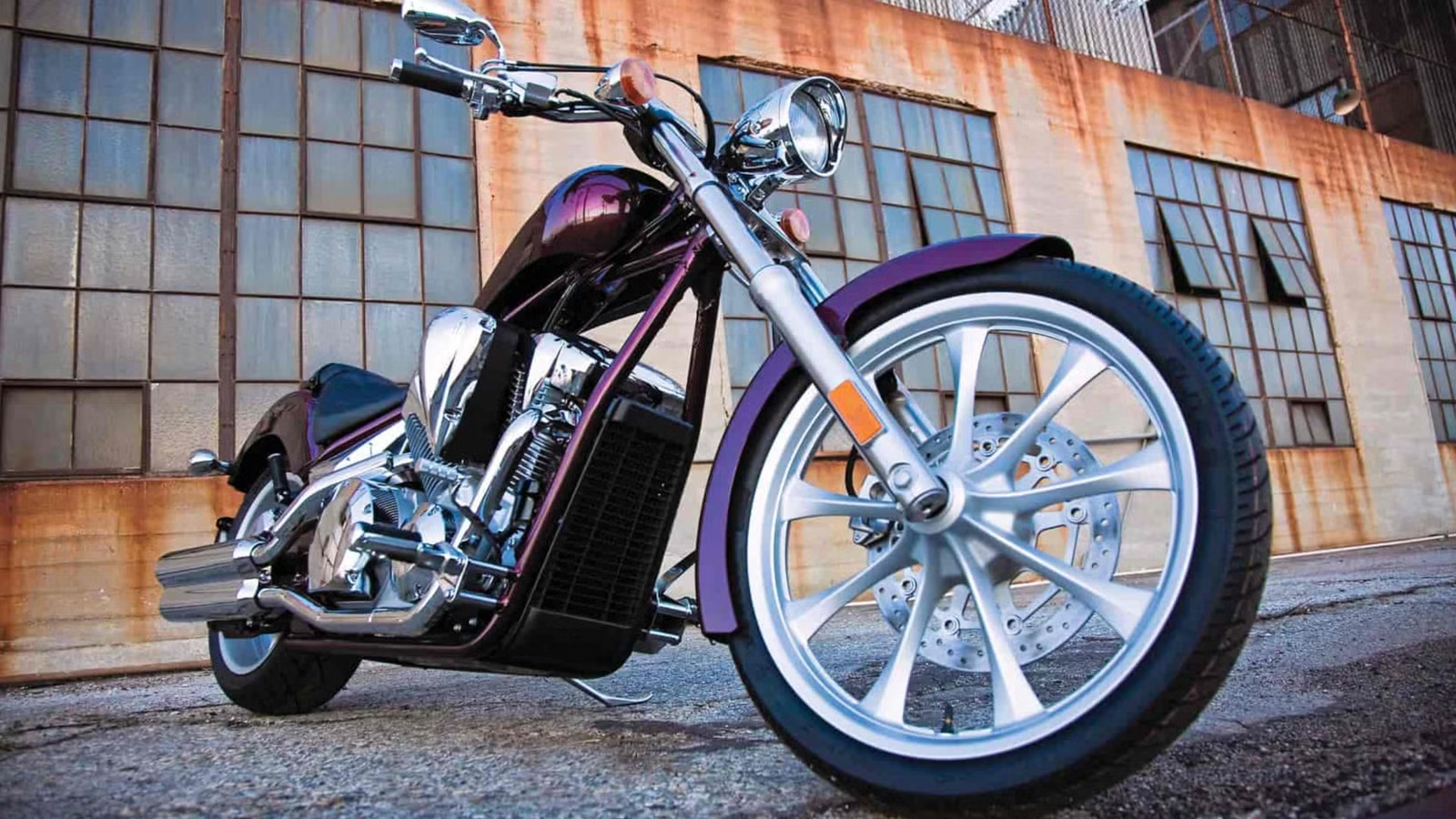
We know all about the Valkyrie Rune and how it established Honda’s credentials in the modern age as a cruiser manufacturer. But way before that, Honda took its engineering excellence to an extreme with a radical factory custom that flipped its conservative reputation on its head. This product has an audacious, raked-out front end, a massively wide rear tire, and minimalist bodywork that any custom builder would be proud of.
Underneath, however, it still had Honda’s immaculate attention to detail and obsessive quality control. It had a combination of killer looks and even better quality. What’s more, it is still going strong today, nearly two decades after its launch.
The Honda Fury Has Been Hiding In Plain Sight For 15 Years

Conventional wisdom has come to treat a custom motorcycle like a work of art – all it needs to do is look good, and everything else is secondary. Honda has challenged the status quo with the Fury, making a product that looks custom but is as reliable as any other product from its stable.
Choppers might have fallen out of favor with the public today, but the Fury’s small but extremely loyal following tells us that it is still one of the coolest V-twin motorcycles one can buy today. To the casual observer, it might come across as a slightly boring-to-ride, impractical cruiser, though that misses the point of the Fury. The fact that it survives to this day without changing one bit is deserving of way more respect than it gets. But the Fury’s survival isn’t just about looks — it’s what Honda hid under that chopper body that makes it genuinely special.
An Accessible $11,499 Base Price Packages Factory-Custom Appeal

The Fury brings big bike vibes on a budget. It costs a very reasonable $11,499, and it has a single variant in the US market now. This variant has Honda’s Combined ABS technology and is available in a single color, which helps keep the price down. As with all Hondas, the cost of owning and maintaining one is extremely reasonable, especially given how long it has been in production and unchanged. At such a value, you might expect corners to have been cut — but the powertrain Honda chose tells a different story.
A 1,312cc Liquid-Cooled V-Twin Delivers Effortless Low-End Torque

Honda has settled on a 1,312 cc displacement for the Fury’s 52-degree V-twin that captures the Harley spirit in a different way. It has liquid cooling, PGM-FI fuel injection, an SOHC head, and three valves per cylinder. Unlike most modern Honda engines, this is a long-stroke design with a low 9.2:1 compression ratio.
The result is a low-revving torque output of 57 horsepower at 4,250 RPM and 79 pound-feet at 2,250 RPM, which is then put through a five-speed, wide-ratio gearbox and a driveshaft to the wheel. The high torque figure at low revs and shaft drive mean that this is the kind of motorcycle you can ride in a high gear all day long, and there is no chain maintenance to be done, which simplifies the ownership experience.
Raked Front Forks And A Hidden Monoshock Create A Seamless Hardtail Silhouette

As with any motorcycle that wants to be a custom lookalike, the Fury has a traditional double-downtube cradle frame and a two-sided swingarm made out of aluminum. The front suspension is a raked-out 45 mm telescopic fork with 5.1 inches of travel. At the rear, a monoshock is hidden under the seat for a hardtail look and offers 3.7 inches of travel. The brakes consist of a large 336 mm disc at the front with a three-piston floating caliper and a 296 mm rear disc with a single-piston caliper.
The current Fury offers alloy wheels with a 21-inch front and an 18-inch rear, and they are shod with tubeless tires. The 200-mm width of the rear tire is notable; it is quite wide. At the front, the raked-out forks and large diameter front wheel also add to the visual drama. Thanks to its design choices, this is the most aggressive-looking Japanese V-twin cruiser available from a factory today.
A 32-Degree Rake And 71-Inch Wheelbase Maximize Highway Stability

The Fury is a long and low motorcycle whose design makes it the most aggressive looking Honda V-twin cruiser, and its standout dimension is its 32-degree rake and 3.6 inches of trail. Coupled with a massive 71-inch wheelbase, the Fury is going to be a very stable motorcycle.
Also commendable is the 26.7-inch seat height. For reference, the Rebel 1100 has a twin rear shock setup, unlike the Fury’s monoshock that is under the seat, and its seat is still higher at 27.9 inches. The fuel tank can hold 3.4 gallons, and it weighs 675 pounds wet, although it carries that weight down low.
Sparse Electronics And A Hidden ABS System Prioritize Style Over Convenience
The Fury is a minimalist motorcycle, and its features are accordingly sparse. The handlebar-mounted instrument cluster is of a unique pentagon shape. The dominant element is an analog speedometer, and there is an LCD display housed within it. You can cycle through the odometer, two trip meters, and a digital clock on it. The electronics are limited to dual-channel ABS, but unlike other systems, this is Honda’s unique C-ABS system. The front brake caliper has three pistons; the two outer ones are actuated by the front brake lever and the middle one by the rear brake lever.
A Modest Fuel Tank And Wide Turning Radius Limit Its Usability

In the quest to make the Fury a head-turner, Honda has given it a tiny fuel tank. When coupled with a 1,300 cc V-twin engine, it makes for a dismal tank range, and there isn’t a fuel gauge to mitigate the range anxiety. The ergonomics also mean that it will be good only on a smooth road and for a short period of time. One needs to experience how difficult it is to make a small U-turn on a Fury before deciding to get one. There is no way you can carry a pillion on a Fury comfortably either.
The engine’s modest power output coupled with the shaft drive means that the actual amount of power getting to the wheel is quite low, even accounting for Honda’s refinement and minimization of driveline losses. The lack of information in the instrumentation is another concern if you intend to use it as a daily driver. Then again, choppers aren’t meant to be practical, and the Fury is definitely a classic in the making.
Against The Vulcan, Suzuki M109R, And Harley Breakout, The Fury’s Value Case Gets Stronger

The factory-custom cruiser is a rare animal today, but there are a few options available besides the Fury. We’ll take them in order of price. The Kawasaki Vulcan 900 Custom retails for $9,999 and is the most aggressive looking Kawasaki V-twin cruiser. It has the same concept as the Fury, but it shares most of its chassis and all of its driveline with the Vulcan 900 cruiser.
This is a liquid-cooled, fuel-injected V-twin that employs a final belt drive. However, there are no modern conveniences like ABS, but it does have a much larger 5.3-gallon fuel tank. At 903 cc, it is very much a middleweight and not in the same league as the other examples here.

The Suzuki Boulevard M109R does not qualify as a chopper-style motorcycle, but it comes close. When it launched, it had the world’s widest rear tire on a production motorcycle, and it still has some of the biggest pistons known to two-wheelers.
It employs shaft drive and a hidden rear monoshock just like the Fury, but unlike the Fury, it does not have ABS. This is a big and heavy motorcycle that takes its performance seriously, with a digital tachometer mounted on the handlebar. It is still the most powerful cruiser in the segment at $15,799 and yet feels effortless to own.

If you want a wholly modern, chopper-styled cruiser, then you’ll have to shell out $22,999 for the Harley-Davidson Breakout that nails style, comfort, and dependability. Not only does it have the 117-cubic-inch Milwaukee-Eight powering it, it also has a six-speed gearbox, a by-wire throttle, and a six-axis IMU, which means it is the most modern product here by a country mile, but you do have to pay for the privilege.
Source: Honda Powersports

Related posts


Latest Post


No Comments