
A V10 Mustang On A Dyno Sounds Like Nothing Ford Has Ever Built, And The Video Proves It
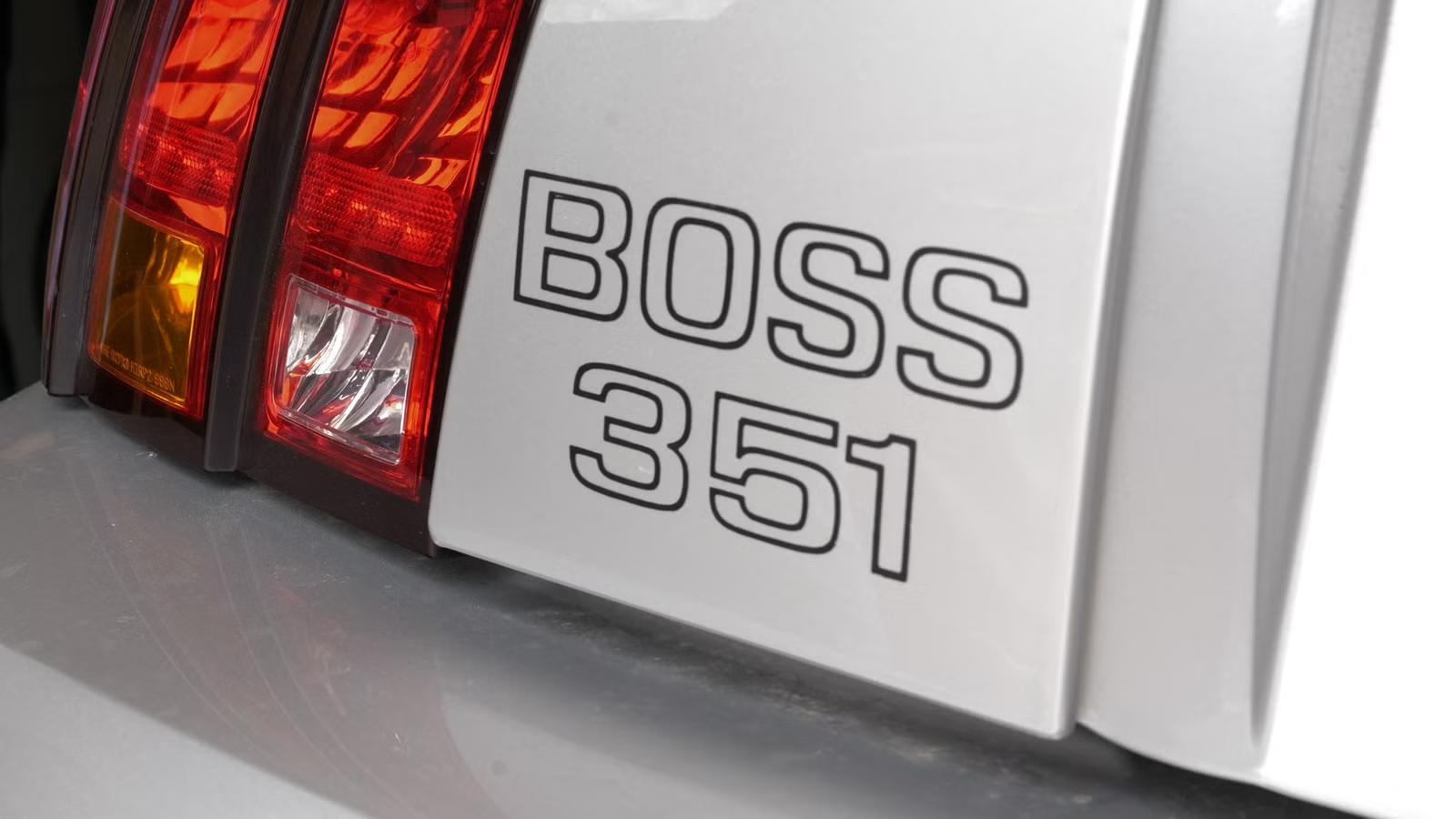
Ford Heritage just put the V-10 Boss 351 prototype on a dyno, and the footage released this week answers a question that never got a real answer in the mid-2000s: what does a 10-cylinder engine do to a Mustang? The short answer is 510 horsepower and a sound that shares almost nothing with the V-8 pony cars enthusiasts grew up with.

Fleet manager Matt Korczyk led the resurrection effort, working alongside the original development team to bring the New Edge prototype back to running condition — new electronics and all. The dyno clip that accompanied his blog post is brief, but it’s enough. The V-10 doesn’t growl the way a 4.6-liter modular does. It screams, with a higher-frequency, more layered exhaust note that sits somewhere between a NASCAR motor and a Viper at full chat. It’s a character the Mustang has never had in production form, and hearing it makes the road Ford didn’t take feel like a genuine loss.
510 Horsepower That Would Have Changed the Conversation
The 510-hp figure isn’t just impressive in isolation — it lands differently when you put it in context. The Mustang GT of the New Edge era was making 260 horsepower from its 4.6-liter V-8. A production V-10 Boss 351 would have nearly doubled that output and placed the Mustang directly in the same conversation as the C6 Corvette Z06 and the third-generation Dodge Viper, both of which were producing around 500 horsepower through the mid-2000s. For a pony car to arrive at that number — from the factory, wearing a Boss badge — would have been a seismic shift in how the segment was perceived.

For comparison, the modern Mustang GT makes 486 horsepower from its 5.0-liter Coyote V-8. The V-10 prototype, restored to its original spec, is already ahead of that. That’s not a knock on the Coyote — it’s a reminder of how serious Ford’s engineering team was about this project.
Why Ford Went Another Direction

The V-10 Boss 351 never reached production, and the reasons weren’t purely about engineering. Ford had two high-profile performance programs converging at roughly the same time. The Ford GT supercar, which arrived for the 2005 model year, produced 550 horsepower from a supercharged 5.4-liter V-8 and served as the company’s flagship performance statement. Then came the Shelby GT500, which hit the 500-horsepower mark for the first time in 2007 using a supercharged 5.4-liter of its own.
Both cars are celebrated today, and both made sense as business decisions. The GT was a halo car with a Le Mans lineage to honor. The GT500 gave Shelby’s name back to the Mustang lineup and delivered supercar-adjacent power at a price point buyers could actually reach. A V-10 Mustang would have occupied awkward territory between them — more exotic than the GT500, less prestigious than the GT, and considerably more expensive to develop and produce than either. Ford made the pragmatic call. Whether it was the right one is a different argument.
The sound is the story here, and it’s worth being specific about why. A V-8 Mustang — any V-8 Mustang — produces its signature character from a firing order and exhaust pulse that enthusiasts have internalized over decades. The cross-plane crankshaft, the 90-degree bank angle, the burble at idle and the bark at wide-open throttle: that’s the Mustang’s sonic identity.
A V-10 changes all of that. Ten cylinders firing in sequence produce a higher-frequency note with more overlapping pulses, giving the engine a smoother but more intense sound — closer to a Formula 1 car of that era or a Lamborghini Gallardo than anything wearing a pony badge. The dyno clip makes that difference visceral rather than theoretical. You’re not hearing a louder Mustang. You’re hearing a fundamentally different machine that happens to wear Mustang sheetmetal.

That distinction is what makes the prototype worth revisiting in 2026. It’s not a nostalgia piece. It’s a demonstration of a performance philosophy Ford considered and set aside — one where the Mustang competed on cylinder count and sonic drama rather than supercharger boost.
The V-10 Boss 351 will stay in the Heritage fleet, which means it’ll keep running rather than sitting behind glass. Gearheads who’ve spent years wondering what a 10-cylinder Mustang would have felt like now at least have the dyno footage to answer the sonic half of that question. Let’s hope Ford Heritage keeps putting it on the rollers.

Related posts



Latest Post


No Comments