
The Japanese Tourer That Does Everything Well
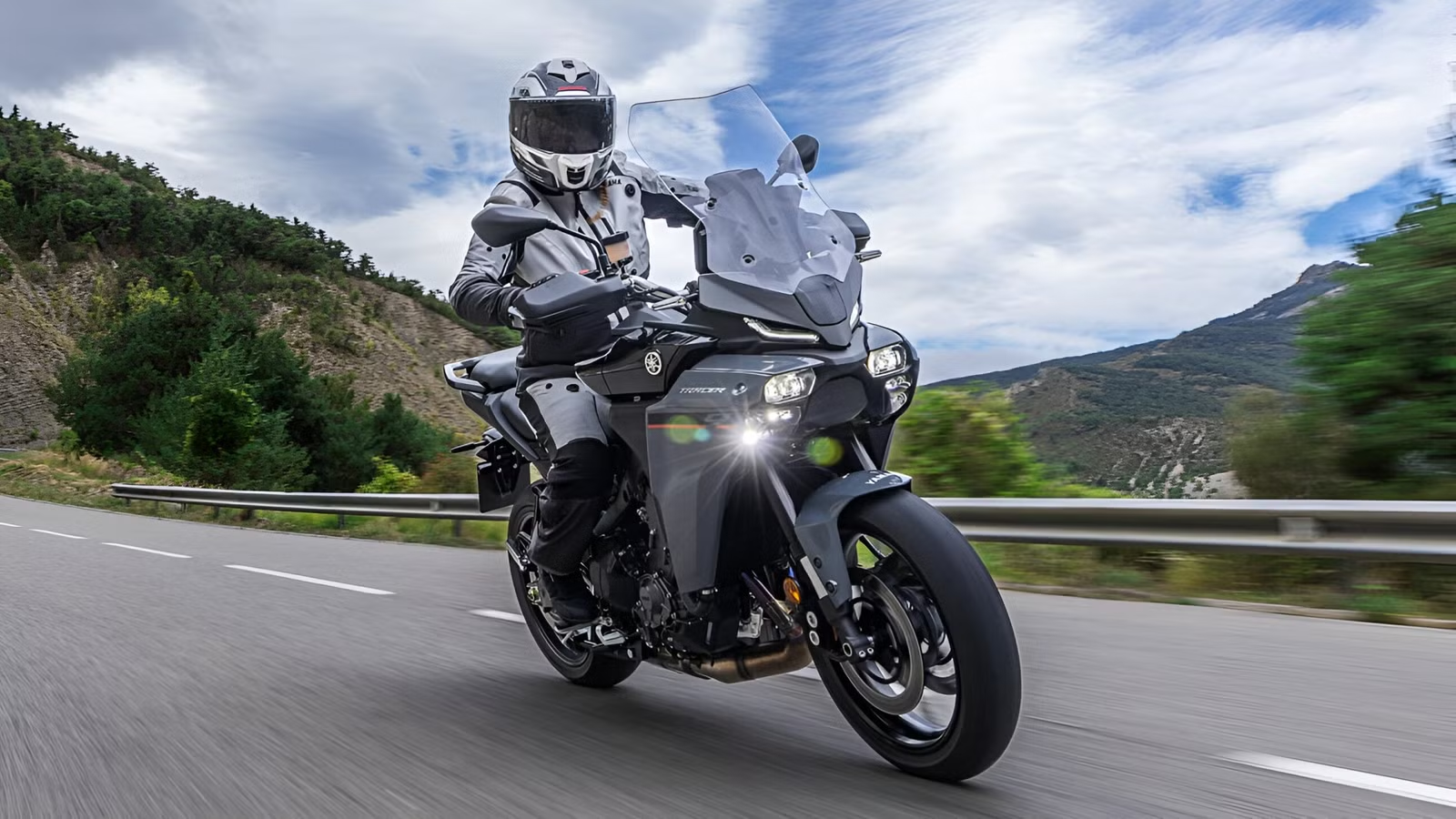
When we think of touring motorcycles, the image of low-slung, luxurious land yachts pops to mind. Prime examples include the Honda Gold Wing and the Harley-Davidson Road Glide Limited. However, the touring segment has expanded far beyond the traditional bunch today, with adventure tourers and sport tourers taking the lead with versatility.

While ADV tourers do have an extra edge with off-roading finesse, sport tourers tickle the senses of those who want a supremely versatile and fun tarmac motorcycle. In fact, the subsegment of crossover sport tourers offers enough ground clearance for light trails, too. Hence, sport tourers are actually a lot more capable than they seem to be. The most popular and sought-after sport tourer today is a seasoned middleweight Yamaha “Street ADV” that even has the brawn to make the flagships sweat.
The Appeal Of Do-It-All Touring Bikes
Versatility is key here, as a do-it-all touring motorcycle helps riders transition seamlessly between commuting, long-distance touring, and spirited canyon runs. They excel at mile-munching duties. But some sub-segments go beyond the norm by offering comfort, relaxed ergonomics, utility, and even superior fuel efficiency to help strengthen a tourer’s do-it-all appeal.


Adventure tourers are the best when it comes to all-round appeal because they blend on-road comfort with off-road stability. However, the number of prospective riders who actively utilize ADVs’ off-roading capabilities is rather limited. Hence, practically speaking, sport tourers are the better options when it comes to more usable do-it-all tourers for the masses.
Sport Tourers Score High Where It Matters

Sport touring bikes are more desirable for most riders because they excel on the tarmac with better high-speed stability and effective wind protection (for highway runs), more agile cornering (for fun mountain runs), and a slimmer, lighter construction (for breezy urban runs). They also offer relatively low seat heights, and passenger comfort is not compromised much despite their slimmer, more compact design compared to traditional options and even certain adventure tourers.

At the heart sits a versatile engine that is mostly shared with sportbikes or naked streetfighters. This helps it achieve a spirited on-road character that puts a grin on the rider’s face. Hence, a sport tourer can shift seamlessly between adrenaline-pumping performance, cozy mile-munching, and daily riding duties. The crossover bunch can even sprinkle in some trail-going capabilities without compromising on its on-road finesse.
Japanese Sport Tourers Are Wholesome

Compared to American counterparts, Japanese touring bikes have an edge in reliability ratings. The big-twin alternatives, despite replicating the old-school American formula, edge out with superior refinement. Furthermore, they have an advantage in their more durable internals, which improves longevity, especially in rugged adventure tourers.

The big four Japanese motorcycle makers collectively offer a comprehensive range of sport tourers. These are divided into two broad categories. One focuses more on the sporty side. Examples include the Suzuki GSX-S1000GT+, the Kawasaki Ninja H2 SX, and the Honda NT1100 DCT.

The other bunch offers a sportier take on tall-riding touring bikes, deriving its stance from adventure tourers. The major differences here include smaller road-biased wheels and tires, stiffer yet relatively long-travel suspension, and a slimmer profile. Notable examples include the Suzuki GSX-S1000GX+, the Kawasaki Versys 1100, and the much-anticipated Honda CB1000GT. However, the Japanese sport tourer that has consistently punched above its weight is the middleweight Yamaha Tracer 9.
10 Sport Tourers That Nail The Sweet Spot Between Speed And Comfort
All these sport tourers mix go-fast fun with long-haul comfort.
The Yamaha Tracer 9 Does Everything Well
Price: $12,599

The Yamaha Tracer 9’s do-it-all character stems from its well-calculated crossover design. It has an ADV-like stance that offers upright, relaxed ergonomics for the rider, ideal for superior touring duties. Its touring potential is further dialed up with standard luggage solutions and a solid electronics suite. There is ample wind protection with the fuel tank and the unique lower fairings angled to deflect wind away from the rider.
It Makes Owning Multiple Bikes Unnecessary
Its engine has a sporty character while also being flexible enough for daily rideability. This is courtesy of its versatile construction. The tall riding stance might not look confidence-inspiring for corners, but Yamaha has tuned the springs to offer the best of plushness and stability on straights and through corners, respectively. Tarmac-focused wheels and tires further complement it. For a starting price of $12,599, the 2026 Yamaha Tracer 9 is a bang-for-buck motorcycle.
Powered By A Versatile Inline-Three Engine

The Yamaha Tracer 9 packs the tried-and-tested CP3 inline-three engine. This 890 cc mill produces 117 horsepower at 10,000 RPM and 68.6 pound-feet of torque at 7,000 RPM. Power is sent to the rear wheel via a six-speed manual gearbox and a final chain drive.

Its versatility makes it an excellent choice. This is well showcased by Yamaha, which uses the same mill (albeit in different states of tune) on the MT-09 streetfighter, the XSR900 retro roadster, and the new R9 sportbike. On the Tracer 9, the engine is tuned for meaty mid-range torque, a linear power curve, and more emphasis on fuel efficiency. Thanks to Cycle World reports, we know that the Tracer 9’s engine makes about 70 percent of its peak torque at just 3,000 RPM, helping with breezy urban runs and cozy highway rides.
Furthermore, the power curve is linear from 2,000 RPM to 10,000 RPM. It also helps make the Tracer 9 welcoming to new riders. The mill’s softer character helps it return a commendable 48 MPG fuel efficiency rating. Coupled with its sizable five-gallon fuel tank, the Tracer 9 can travel up to 240 miles between gas stops.
Complemented Further By Underpinnings That Make It Curve-Happy

A lightweight aluminum diamond main frame underpins the Tracer 9. It is attached to a bolt-on sub-frame designed to support the load of a full-sized pillion and loaded panniers. Balancing rigidity and weight, the setup is completed with an aluminum swingarm.
The chassis is suspended on 41 mm KYB inverted front forks with 5.1 inches of travel. These offer adjustability for preload and rebound damping. The rear gets a preload and rebound-adjustable monoshock with 5.2 inches of travel. The provision to adjust the springs helps the Tracer 9 be tuned perfectly for confidence-inspiring leans on winding mountain roads and even on racetracks.

Braking duties are handled by dual 298 mm discs coupled to radially mounted four-piston fixed calipers up front. The rear gets a 267 mm disc coupled to a single-piston floating caliper. Lightweight 17-inch wheels with tarmac-spec tires help keep unsprung mass low and improve nimbleness and quick direction changes.
The Affordable Tourer That Feels Made For 500-Mile Days
This Honda stands out in the touring market with its value pricing and impressive feature set, making it a top choice for long highway days.
Slim Dimensions Make The Tracer 9 Urban-Friendly

The Tracer 9’s compactness greatly helps make it an accessible touring bike despite its upper-middle-class construction. It has a wheelbase of 59.1 inches and a factory-adjustable seat height ranging from 33.3 to 33.9 inches. Also, despite offering many standard touring-ready features, including weatherproof side cases, the Tracer 9 weighs 483 pounds.
The side cases are quick-release, which can improve maneuverability and convenience in tight urban settings. The rider triangle is relaxed with an upright torso and neutrally positioned legs. The seat is wide and long to help accommodate riders of varying sizes too. All of these features help the Tracer 9 be a versatile riding machine.
Loaded With Impressive Technology Features

The cockpit features a sizable 7-inch TFT display with smartphone connectivity via the Yamaha MyRide app. The riding experience is enhanced by features such as five ride modes (Sport, Street, Rain, and two user-defined options), ride-by-wire throttle, and a variable speed limiter. For superior riding assistance and safety, a six-axis IMU seamlessly integrates with features such as ABS and lean-sensitive traction control. The Tracer 9 further highlights its sporty side with MotoGP-derived technology such as a slide control system, a slip regulator, and even wheelie control. Things can be spiced up further with features like a bi-directional quickshifter and heated gloves, adding versatility.
13 Bikes That Are Perfect For Riders Downsizing From Big Tourers
These 13 touring motorcycles are perfect for riders looking to downsize from heavyweights, offering comfort, performance, and affordability.
The Yamaha Tracer 9 Is A Touring Bike That Checks All Boxes

The Yamaha Tracer 9 perfectly balances comfort, power, and value. Its tall-riding stance helps a lot with practical riding conditions. Yamaha also strives to balance grin-worthy sportiness with mile-munching comfort and convenience.
This is courtesy of a sportbike-derived engine, lightweight underpinnings, a compact form factor, and a solid suite of electronics to stitch all of these together. Its versatility underscores the Tracer 9’s practical nature, which not only helps it check all the boxes for a touring motorcycle but also makes it a formidable daily riding companion. Its rivals are still playing catch-up. However, the all-new Honda CB1000GT has the potential to be the Tracer 9’s arch-rival.
Source: Yamaha Motorsports

Related posts




Latest Post


No Comments