
GR Corolla: Toyota’s Hot Hatch Answer To Civic Type R
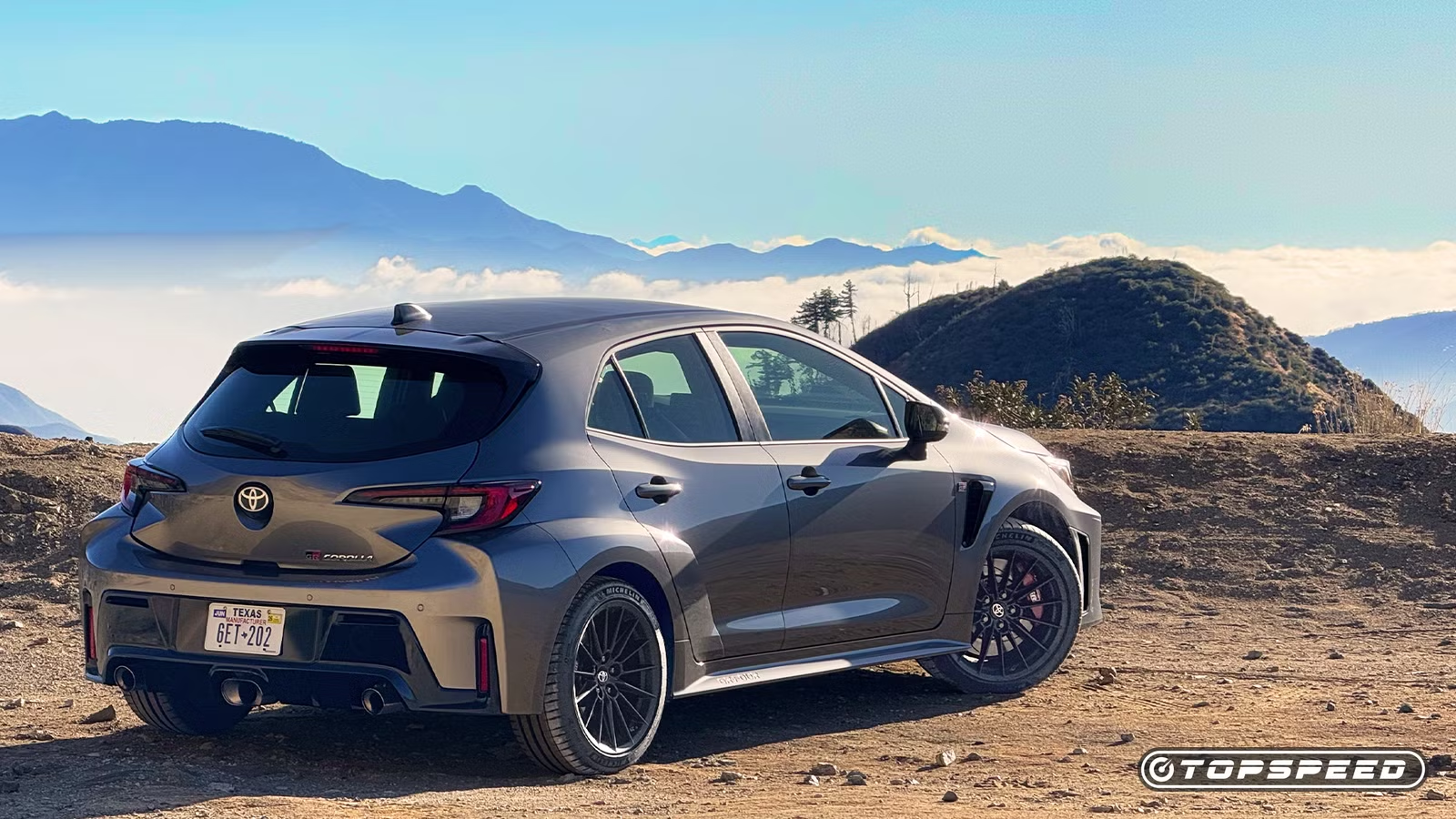
Toyota spent years building sensible cars while Honda and Volkswagen turned practical hatchbacks into enthusiast icons. The GR Corolla changes that script with 300 horsepower, a manual transmission, and a rally-inspired AWD system. Despite this, the Civic Type R remains formidable on a racetrack, while the Golf R delivers greater refinement and effortless acceleration. That leaves the GR Corolla fighting from the middle with a very different personality. The question is not whether Toyota built a legitimate hot hatch. It did. What matters is whether the GR Corolla’s explosive engine, adjustable AWD system, and lower starting price make it the right one for you.
The Three-Cylinder Engine Punches Above Its Displacement
300 Horsepower From 1.6 Liters

The GR Corolla’s turbocharged 1.6-liter engine has only three cylinders, yet it produces 300 horsepower and 295 lb-ft of torque. That equals 187.5 horsepower per liter, giving the engine one of the highest specific outputs in an attainable production car.
Toyota uses direct and port fuel injection, an oil-cooled turbocharger, and a compact exhaust design intended to reduce back pressure and improve response. This is not a standard Corolla engine with a larger turbo attached. It originated in the smaller GR Yaris, which Toyota developed around its World Rally Championship experience.
The engine’s character matters more than its peak output. Below the boost range, the GR Corolla can feel relatively ordinary. Get the tachometer moving, and it develops an urgent midrange punch accompanied by an uneven three-cylinder growl.
Boost Makes The GR Corolla Feel Busy And Engaging


The GR Corolla demands more participation than the Golf R. You must keep the engine in its strongest operating range, plan downshifts, and accept some turbo lag. That extra work becomes part of the appeal if you want a hot hatch that feels mechanical and engaging.
The six-speed manual complements that personality. Its throws are short enough for quick shifts, while Toyota’s intelligent manual transmission system can automatically match engine speed during downshifts.
Toyota added an eight-speed automatic for 2025. It makes stop-and-go driving easier but does not automatically improve GR Corolla performance. Car and Driver recorded a 5.0-second GR Corolla 0-60 run with the automatic, compared with as little as 4.2 seconds from its quickest manual test. MotorTrend produced different results, recording 5.1 seconds with the automatic and 5.4 seconds with an earlier manual car.
Those variations demonstrate how launch technique, tires, track surfaces, and model-year changes affect acceleration testing. The automatic adds convenience, but the manual remains the better match for the engine’s energetic personality.
The GR Corolla AWD System Changes Its Character
GR-FOUR Varies Torque Between The Axles

The GR Corolla AWD system separates Toyota’s hot hatch from the FWD Civic Type R. GR-FOUR uses a mechanical connection between the axles and an electronically controlled multi-plate clutch to manage front-to-rear torque distribution. It does not use separate electric motors.
Toyota provides selectable settings with nominal distributions of 60:40, 50:50, and 30:70. The 60:40 setting suits everyday driving, while 50:50 prioritizes stability and traction. Selecting 30:70 gives the chassis a more rear-biased personality. These are control targets rather than permanently locked ratios, as the system can adjust torque distribution as conditions change.
Front and rear Torsen limited-slip differentials add side-to-side control. GR-FOUR manages the relationship between the two axles, while the differentials help direct power to the tires that can use it.
Calling this “torque vectoring” can be misleading because the system does not independently drive each wheel, unlike an electric or active-clutch-based setup. Nevertheless, it reduces inside-wheel spin, improves corner exits, and allows you to influence the car’s attitude with the throttle.
AWD Adds Grip Without Eliminating Understeer

The GR Corolla can deploy its power earlier than the Civic Type R on a wet road or tight corner exit. The rear-biased setting does not transform it into a drift car, but it makes the chassis more willing to rotate. AWD does not eliminate understeer. Enter a corner too quickly, and the front tires will still push. The system works best when you settle the car under braking, establish your direction, and then use all four tires to accelerate away.
The Civic Type R takes the opposite approach. Its dual-axis front suspension, limited-slip differential, and wide front tires manage 315 horsepower through the front wheels. It requires restraint when accelerating on slick pavement, but its front end is exceptionally precise in dry conditions.
MotorTrend measured 1.03 g of lateral grip from the Civic Type R and 0.96 g from a GR Corolla Circuit Edition. The Honda also completed the publication’s figure-eight test in 24.5 seconds, compared with 24.9 seconds for the Toyota. AWD gives the Corolla stronger launch and poor-weather traction, but it does not automatically make it faster through corners.
Morizo And Circuit Editions Serve Different Buyers
The Circuit Edition Preserved Everyday Practicality

The GR Corolla Circuit Edition was offered for 2023 and 2024. It combined a five-seat cabin with front and rear Torsen differentials, a forged carbon-fiber roof, a vented hood, a larger spoiler, and upgraded trim. The 2024 version also received lightweight forged BBS wheels.
That combination makes the GR Corolla Circuit Edition appealing on the used market. It retains the practicality expected from a hatchback while adding equipment that improves cooling, reduces weight, or strengthens its rally-car appearance.
The 2023-only Morizo Edition took things to a whole new level. Toyota deleted the rear seat, rear speakers, and rear window regulators. It also increased structural rigidity, widened the tires, shortened the transmission’s differential gearing, raised torque to 295 lb-ft from 273, and fitted Michelin Pilot Sport Cup 2 tires.
The original price gap exceeded $5,000. Toyota priced the 2023 Circuit Edition at $42,900 before destination, while the Morizo started at $49,900. That $7,000 difference created a more focused car while removing much of the practicality that defines a hot hatch.
The Morizo Is A Specialized Track Car

If you regularly carry passengers, commute over rough pavement, or need one car to handle every job, the Circuit Edition is the more rational purchase. It delivers desirable performance equipment without turning every grocery run into a track-day rehearsal.
The GR Corolla Morizo makes sense when rarity and track performance outweigh rear-seat usefulness. Its shorter gearing keeps the engine on boost, while its reduced weight, stickier tires, and additional body rigidity sharpen its responses under stress.
Used buyers should inspect either model carefully. Track use is not automatically abuse, but it accelerates wear on tires, brakes, clutch components, and fluids. Uneven tire wear, heat-discolored brake hardware, non-original modifications, and incomplete service records deserve attention.
For 2026, Toyota lists the standard GR Corolla at $40,520 and the Premium Plus at $46,565. Premium Plus includes the carbon roof, vented hood, and additional equipment that make it the closest successor to the Circuit Edition. The limited-production $64,360 GRMN Corolla now occupies the track-focused position previously held by the Morizo.
Tested Performance Reveals Important Trade-Offs
The GR Corolla Wins The Launch More Often Than The Lap

A GR Corolla 0-60 time requires context. Car and Driver has recorded manual times ranging from approximately 4.2 to 4.9 seconds, while MotorTrend needed 5.4 seconds with its early test car. The manual’s gearing can require another shift near 60 mph, and a hesitant launch wastes the traction provided by AWD.
In a three-car comparison, Car and Driver’s GR Corolla Circuit Edition completed the quarter-mile in 13.3 seconds. The Toyota reached the line first but lost ground to its larger-engined rivals at higher speeds. GR-FOUR helps it launch aggressively, but the 1.6-liter engine cannot sustain the same upper-speed pull as the Honda and Volkswagen.
Track results further complicate the comparison. At Virginia International Raceway, Car and Driver recorded a 2:59.6 lap in the Morizo Edition. The Civic Type R completed the same course in 2:58.8. Both cars used Michelin Pilot Sport Cup 2 tires, making the result a meaningful comparison. An eight-tenths advantage is small, but it confirms that the FWD Honda can beat Toyota’s lightest and most track-focused GR Corolla under controlled conditions.
Each Rival Prioritizes A Different Kind Of Performance

The 2026 Civic Type R produces 315 horsepower and 310 lb-ft of torque from a turbocharged 2.0-liter four-cylinder engine, which is sent through a manual transmission to the front wheels. At $46,895 before destination, it costs over $6,000 more than the entry GR Corolla, but its larger cabin, exceptional shifter, and proven track pace help justify the premium.
The 2026 Golf R produces 328 horsepower and 295 lb-ft of torque from a turbocharged 2.0-liter four-cylinder. Standard AWD and a seven-speed dual-clutch transmission make its speed easier to access. It starts at $49,455 before destination and delivers more cabin refinement. Unfortunately, Volkswagen no longer offers a manual transmission in the U.S., which means a loss of engagement for drivers who prefer to shift themselves.
The Toyota occupies the wildest corner of this triangle. It is not as polished as the Volkswagen or as surgically precise as the Honda. Its cabin also feels too similar to a basic Corolla for a car that can approach $50,000. Those compromises give the Toyota character. The three-cylinder engine sounds unusual, the manual demands attention, and GR-FOUR lets you adjust how the chassis delivers its power.
Ownership Reality Determines The Best Hot Hatch
Performance Hardware Raises Running Costs

A small engine does not make the GR Corolla an economy car. Toyota estimates 21 city/28 hwy mpg, and 24 mpg combined with the manual. The automatic drops to 19 city/27 hwy mpg, and 22 mpg combined. Premium fuel, performance tires, large brakes, and higher insurance premiums add to ownership costs.
The GR Corolla includes Toyota’s three-year/36,000-mile basic warranty and five-year/60,000-mile powertrain coverage. ToyotaCare covers scheduled maintenance for two years or 25,000 miles under normal program terms.
Long-term reliability data remains limited because the GR Corolla only reached the United States in 2023. Toyota’s broader reputation is encouraging, but it cannot replace model-specific evidence accumulated over time. Cars used for track days, autocross, or repeated short trips may require more frequent maintenance.
Buyers should also check NHTSA records by VIN. One recall involving some 2023–2024 GR Corollas concerned inaccurate load-capacity labels installed on vehicles with certain Gulf States Toyota accessories. It was not an engine or AWD recall, but every used performance car still deserves a recall check.
The Right Choice Depends On How You Drive
The GR Corolla vs Civic Type R decision cannot be settled by declaring one universally better. Choose the Type R if you value steering precision, track pace, passenger space, and one of the best manual transmissions available. Its FWD layout is not a serious weakness on dry pavement.
Choose the Golf R if you want effortless acceleration, greater comfort, a more mature interior, and AWD security without having to work for every shift. It is the easiest of the three to live with, although its price and automatic-only configuration may push enthusiasts elsewhere.
The GR Corolla is for you if grip, involvement, compact dimensions, and mechanical personality matter more than cabin refinement. The standard model offers the strongest value, while Premium Plus supplies upgrades associated with the discontinued Circuit Edition. A used Morizo should be viewed as a specialized two-seat collectible rather than an automatic step up.
Toyota did not beat Honda by copying the Civic Type R. It built a different answer shaped by boost, AWD traction, and rally-inspired aggression. The Civic remains the sharper track instrument, and the Golf R remains the more polished all-weather missile. The GR Corolla earns its place by making an ordinary road feel like a rally stage.
Sources: Toyota, Honda, Volkswagen, NHTSA

Related posts
Latest Post


No Comments