For twenty years, the automotive industry ran on a quiet agreement. An SUV could be fast. It just couldn’t be fast, full stop, no qualifiers, no forgiving nod to its curb weight. “Quick for something this size” was the ceiling, and everyone from the buyers writing six-figure checks to the journalists testing the things had made peace with it. A performance SUV was a party trick, not a threat. That agreement is dead. Nobody signed anything. It just stopped being true.
The cracks showed up early. Lamborghini’s Urus, a 641-horsepower V8 SUV that looks like it was styled to intimidate school drop-off lines, will do 0-62 mph in 3.6 seconds in base form, and the track-tuned Performante trim shaves that down further while lapping Lamborghini’s own handling circuit three seconds quicker than the standard car on identical tires.
Porsche’s answer was even more unhinged. The 2022 Cayenne Turbo GT packed a 631-horsepower twin-turbo V8 into a body that had just lapped the Nürburgring Nordschleife in 7 minutes and 38.9 seconds, the fastest lap ever recorded by a production SUV. Its party trick: 0-60 mph in 3.1 seconds, a full tenth quicker than the naturally aspirated 911 GT3 Porsche was selling that same year. A family hauler with a trailer hitch was already outrunning Porsche’s own halo sports car. Nobody quite knew what to do with that fact, so mostly everyone just filed it under “remarkable, but an outlier.”
Electric Motors Are About To Make Those Numbers Look Slow
2025 Porsche Taycan Turbo GT from the front three-quarter anglePorsche
It was not an outlier. It was a preview. Twin-turbo V8s were always going to hit a wall eventually, limited by turbo lag, gearing, and the simple mechanical reality of igniting fuel thousands of times a minute. Electric motors don’t have that problem. They deliver peak torque from a dead stop, no spooling required, no waiting for revs to climb into the power band. The moment automakers started dropping serious battery packs into SUV platforms, the three-second club stopped being the finish line and started looking like the on-ramp.
Porsche’s own EV lineup had already hinted at what was coming. The Taycan Turbo GT can hit 62 MPH in well under 2.4 seconds, a figure that would embarrass most of the supercar establishment on its own. The only question left was when that kind of violence would show up in something with a tow hitch and three rows of cupholders. The answer arrived in 2026.
The Cayenne Turbo Electric Makes 1,139 Horsepower With Launch Control
2026 Porsche Cayenne Turbo Electric front 3:4th cinematic shotPorsche
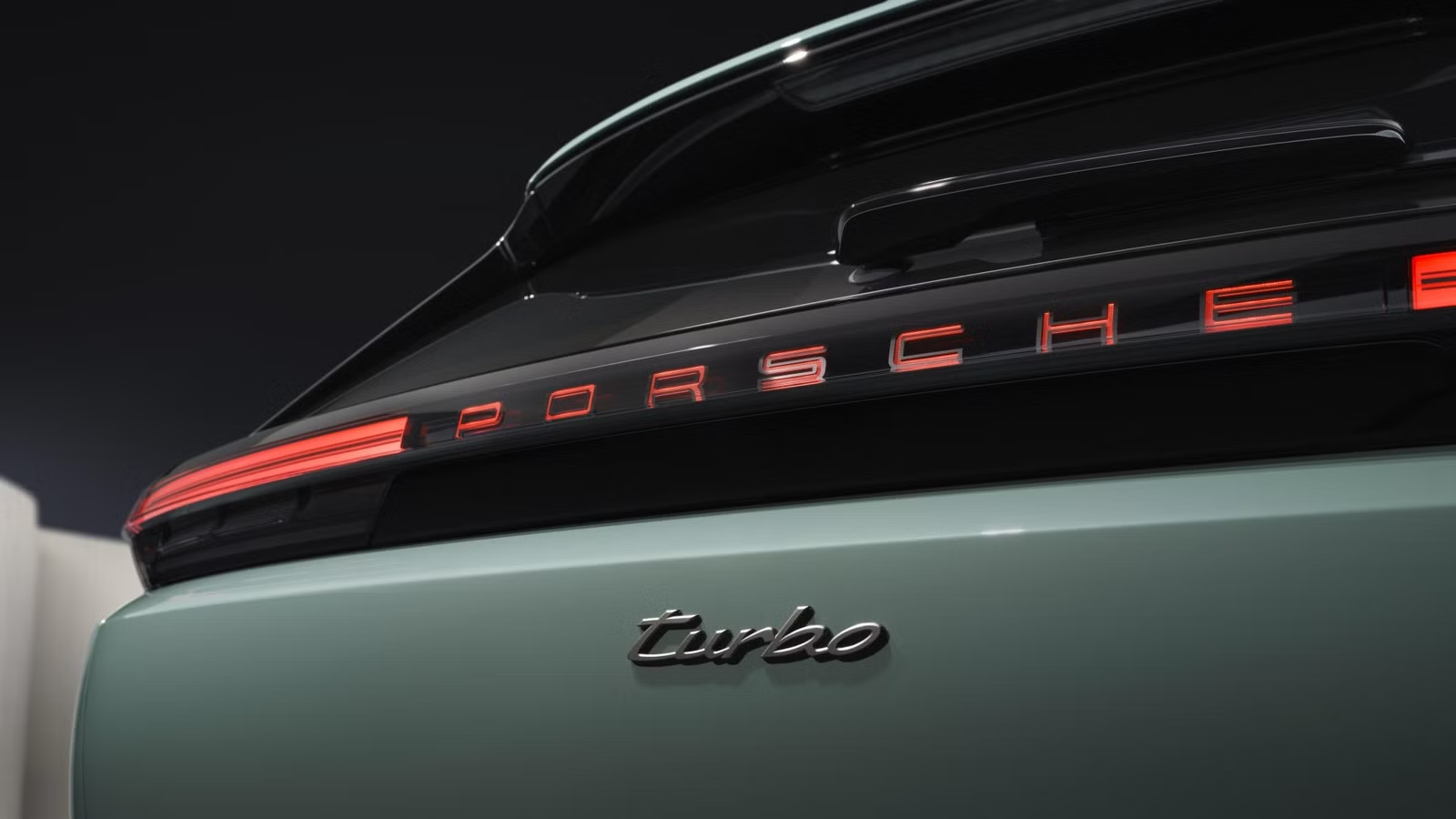
Meet the 2026 Porsche Cayenne Turbo Electric, the car that finally makes the Turbo GT look quaint. Porsche’s own numbers, straight from the newsroom announcement, put peak output at 1,156 PS (850 kilowatts, or 1,139 horsepower) and 1,500 Newton-meters (1,106 pound-feet) of torque with Launch Control engaged. That power comes from two permanent-magnet motors, one per axle, running on an 800-volt architecture and a 113-kilowatt-hour battery pack mounted low in the floor. The rear motor gets direct oil cooling, a trick borrowed straight from Porsche’s motorsport program, so the car can string together repeated launch runs without the power tapering off the way it does in lesser EVs.
In everyday driving the SUV settles for a still-absurd 844 horsepower. Arm Launch Control and stand on the pedal, and the full 1,139 arrives all at once, launching a three-ton SUV to 62 mph in a claimed 2.4 seconds on the way to a 162 mph top speed. Independent testers who’ve driven it have clocked an even quicker 2.1-second sprint to 60 mph and a quarter mile in 9.5 seconds. That’s quicker than the Turbo GT. It’s quicker than every combustion Cayenne Porsche has ever sold. By Porsche’s own description, it’s the most powerful production Porsche the company has ever built, full stop, no asterisk.
7,716 Pounds Of Towing Capacity Says This Is Still A Cayenne
2026 Porsche Cayenne Turbo Electric side profilePorsche
Here’s the part that should be impossible: none of that speed cost the Cayenne its Cayenne-ness. Towing capacity holds at 7,716 pounds (3.5 metric tons), identical to the combustion-engined Cayenne and enough to haul a loaded horse trailer or a mid-size boat without breaking a sweat. Cargo space runs to 26.4 cubic feet with the rear seats up, there’s a 3.2-cubic-foot frunk up front, and Porsche rates WLTP range at up to 624 kilometers, roughly 387 miles. Five seats, real ground clearance, a real hitch. Nothing about the family-SUV mission got compromised to build a car this fast. That’s the actual headline, buried under the horsepower number.
This SUV Is Quicker Than Most Of Porsche’s Own Sports Car Lineup
2026 Porsche Cayenne Turbo Electric drifting shotPorsche
Exterior of the 2023 Porsche 911 GT3Porsche
Put the Cayenne Turbo Electric next to Porsche’s own sports car range and the numbers stop being impressive and start being a little embarrassing. The current 911 GT3, a 502-horsepower, naturally aspirated track weapon that exists for no reason other than lap times, needs 3.2 seconds to hit 60 mph with the PDK gearbox, per Kelley Blue Book’s tested figures. A three-ton SUV with a frunk and a tow package gets there seven-tenths of a second sooner. Somewhere, a GT3 owner is quietly recalculating what they actually paid for.
Only the 911 Turbo S, at roughly 2.2 seconds to 60 mph by Car and Driver’s measurements, still holds the line for Porsche’s sports car range, which is exactly why a used GT3 remains such a compelling budget alternative if outright pace against Porsche’s own SUV is the point of the exercise. Everywhere else in the two-door lineup, the family car is now the quicker car, and Porsche built it that way on purpose.
McLaren, Ferrari, And Lamborghini Are In The Same Fight
2024 McLaren 750S front, left exterior photoMcLaren Press Room
It doesn’t stop at Zuffenhausen’s own badge, either. McLaren’s 720S, a 710-horsepower carbon-tub supercar that Bloomberg clocked at 2.8 seconds to 60 mph when it launched, is now slower off the line than a Cayenne with a full tank of horses and a Labrador in the back. Lamborghini’s Huracán, in Tecnica and EVO trim, makes 631 to 610 horsepower and lands in roughly the same 3.2-second window as the GT3, per KBB’s figures, which means Sant’Agata’s screaming V10 and Porsche’s family SUV are now, at best, evenly matched to 60.
Only Ferrari’s 296 GTB still wins outright, and it earns that win. Car and Driver tested Maranello’s 819-horsepower plug-in hybrid, the quickest rear-wheel-drive car the magazine has ever measured, at 2.4 seconds to 60 and 9.7 through the quarter mile, a tenth quicker than the Cayenne’s claimed run. Fine. Ferrari keeps its crown for now. But when the closest thing to a beat-down a $350,000 Italian hybrid can manage over a Porsche family SUV is one-tenth of one second, the entire supercar hierarchy has quietly rearranged itself.
How A Three-Ton SUV Out-Accelerates Cars Half Its Weight
2026 Porsche Cayenne Turbo Electric chargingPorsche
None of this happens by accident, and none of it happens without serious engineering underneath the spec sheet. The Cayenne Turbo Electric’s 800-volt architecture isn’t just a charging-speed trick; it’s what lets the motors dump enormous current without the voltage sag that chokes lesser EV powertrains under sustained hard acceleration. Layer in that motorsport-derived direct oil cooling on the rear motor, and the car is built to do something a lot of high-powered EVs still struggle with: launch repeatedly, back to back, without the power curve wilting by the third or fourth run. Porsche didn’t just chase a single headline number. It built the plumbing to sustain it.
Instant Torque Beats Curb Weight Every Time
2026 Porsche Cayenne Turbo Electric front 3:4th tracking shotPorsche
The other half of the equation is simpler and more brutal: torque doesn’t care how much the car weighs, and neither does an electric motor’s power delivery. A twin-turbo V8 has to spool before it hits peak boost. A naturally aspirated flat-six has to climb through the rev range to find its power band. An electric motor is already at maximum torque the instant current flows, which is why a 5,860-pound SUV with 1,106 pound-feet of torque on tap can out-launch a 3,100-pound supercar that’s still waiting on its turbos to wake up. Weight matters everywhere else: in braking distances, in cornering loads, in how a car changes direction. In a straight line off the line, it barely matters at all anymore.
The Cayenne Turbo Electric Doesn’t Need To Be A Sports Car
2026 Porsche Cayenne Turbo Electric rear 3:4th static shotPorsche
None of this makes the Cayenne Turbo Electric an actual replacement for a 911 or a 296 GTB, and Porsche isn’t pretending otherwise. At roughly 5,860 pounds, it’s more than 2,700-pounds heavier than a GT3, and no amount of torque vectoring turns three tons of SUV into a scalpel through a canyon road. The Taycan, Porsche’s own sedan, still beats it on range and feels sharper the instant the road stops being straight. Pricing for the Cayenne Turbo Electric starts north of $160,000 before options, which puts it well into territory where a used GT3 or a lightly specced 296 GTB starts to look tempting on paper rather than just impressive on a spec sheet.
But that was never really the fight this car was built for. The buyer cross-shopping a Cayenne Turbo Electric isn’t choosing between it and a two-seat coupe; they’re choosing between it and a BMW X5 M or an Aston Martin DBX707, cars that don’t tow 3.5 tons, don’t seat five in comfort, and definitely don’t embarrass a Ferrari to 60 mph while doing it.
2026 Porsche Cayenne Turbo Electric rear 3:4th tracking shotPorsche
Porsche has spent two decades proving the Cayenne name doesn’t have to mean a compromise, and the same brutal depreciation curve that befalls many high-dollar performance cars doesn’t apply the same way here, either, since this is a car built to be driven daily, loaded up, and hitched to a trailer, not parked in a garage waiting for a track day that never comes. It doesn’t need to be a sports car. It just needs to keep being the family SUV that happens to beat one, and right now, it’s beating almost all of them.










No Comments