
The Ultra-Rare Chevrolet Muscle Car Collectors Have Been Hunting For Decades
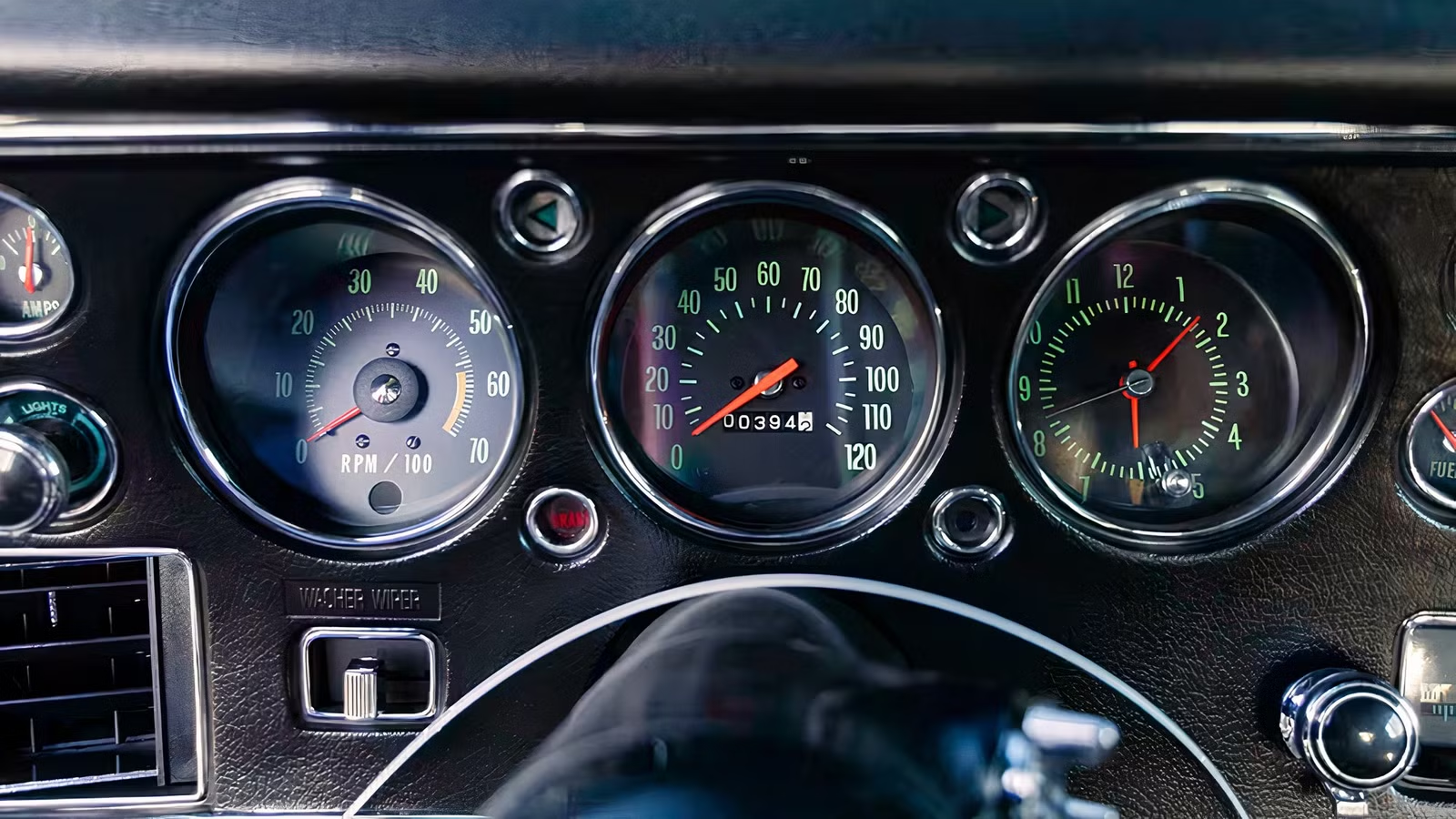
The muscle car era gave us plenty of household names. Cars everyone recognizes, posters everyone’s had on their wall, and spec sheets that have been memorized for decades. But it also produced a few machines that slipped quietly through the cracks, not because they lacked performance, but because timing, paperwork, and production overlap worked against them. These are the cars that didn’t get celebrated right away, even though they probably should have.

This one revolves around one of those near-mythical machines. It wasn’t planned as a limited edition, never marketed as a halo car, and wasn’t meant to be rare at all. Yet decades later, it’s become one of the most elusive factory-built muscle cars Chevrolet ever produced. Today, when one of these cars surfaces at auction, it triggers debates across collectors, historians, and auction houses trying to answer a question that still hasn’t been fully settled: How many actually exist?
The Chevelle SS 454 LS6 Convertible Was Never Meant To Be This Rare
The moment the 1970 Chevrolet Chevelle SS 454 LS6 Convertible enters the conversation, the entire definition of ‘rare muscle car’ starts to shift. What’s kept this Chevelle in constant conversation is just how few were built, but more than that, it’s how difficult it is to prove one today. And unlike other blue-chip muscle cars with clean production records, the LS6 convertible exists in a gray area where estimates, partial paperwork, and period-correct components do most of the talking. That uncertainty has turned every surviving example into a rolling investigation, where history matters as much as horsepower.

In 1970, the Chevelle SS lineup already sat at the center of Chevrolet’s muscle car universe. It was the brand’s most versatile performance platform, capable of accommodating everything from mild street setups to full-blown big-block brutality. But the LS6 package pushed it to an entirely different level.
The LS6 represented the absolute peak of Chevrolet’s big-block muscle car program. This was the most aggressive factory big-block the company ever put into a production passenger car, designed during a brief window when emissions regulations were still loose and insurance companies hadn’t fully cracked down.
Convertibles were already a niche choice by 1970. Hardtops dominated muscle car sales because they were cheaper, stiffer, and better suited to straight-line abuse. Convertibles added weight, reduced structural rigidity, and didn’t exactly scream drag strip credibility. Most buyers who wanted maximum performance skipped the soft top entirely.
Combining the LS6 with a convertible body created an almost accidental unicorn. The option sheet technically allowed it, but almost nobody checked both boxes. Estimates today place production at fewer than 20 examples, with no official General Motors number ever published. That lack of documentation is part of what’s kept this car shrouded in mystery for decades.
Chevrolet Chevelle Generations (All Years): Engines, Trims, Specs, & Value
It was the meanest Chevrolet muscle car, period, still ranking among the greatest of all time. Here’s your guide to the might Chevrolet Chevelle.
How The LS6 Package Changed Everything

|
Engine |
Power |
Torque |
|
7.4-liter LS6 V8 |
450 hp |
500 lb-ft |
To understand why this particular Chevelle matters so much, you have to understand what separated the LS6 from the more common LS5. On paper, both were 454 cubic inch big-blocks. In reality, they were very different animals.
The LS6 was engineered with a very singular aim. It featured higher compression, a more aggressive camshaft, better flowing cylinder heads, and a fuel system designed to feed serious airflow. Chevrolet wasn’t chasing smoothness or daily drivability here. The factory intent was clear. This was a street-legal engine built to sit right at the edge of what was acceptable in 1970. And at the time, this level of performance put the LS6 Chevelle in direct competition with the fastest cars on the road, including the Plymouth Hemi ’Cuda and Ford Mustang Boss 429. But unlike those cars, this one was never meant to become a headline.
And that mattered because this was the final moment when manufacturers could openly sell engines like this without worrying about looming regulations. Chevy knew the window was closing, and the LS6 was the company taking full advantage of it. The fact that it was available at all in a convertible body style feels almost like a loophole that slipped through before anyone thought to close it.
A Muscle Car Built For Impact

Pairing this engine with a convertible made little practical sense. The chassis flex, added weight, and reduced torsional rigidity all worked against what the rare big block LS6 was meant to do best. From a performance standpoint, the hardtop was the obvious choice.
That’s why buyers who ordered this combination were already outliers. They were customers who wanted the craziest engine Chevy offered and still wanted the top down. Whether that decision came from confidence, ego, or simply not caring about convention, it resulted in one of the rarest muscle car configurations ever assembled.
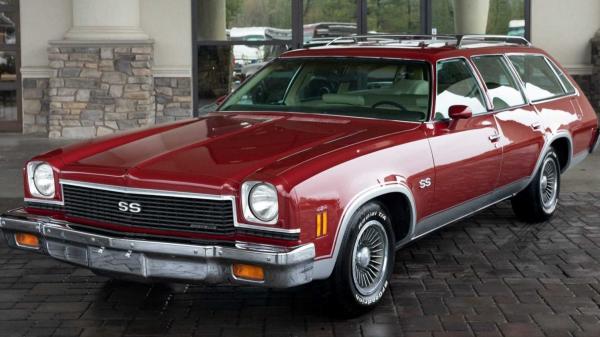
The Story Behind The Rare 1973 Chevrolet Chevelle SS Wagon And Its Massive 7.4-Liter V8
In 1973, Chevrolet made the 454 V8 available for the Chevelle SS Malibu Wagon, creating a rare muscle wagon with just around 71 examples produced.
Production Chaos Turned This Chevelle Into A Ghost

What makes this Chevelle especially difficult to track is that ordering an LS6 convertible was technically possible, but never encouraged. The option sheet allowed it, even if it wasn’t promoted. Dealers could submit the order, but few customers ever requested it, and even fewer dealers likely suggested it. This wasn’t a planned rarity. It was the result of ordering behavior, low demand for convertibles, and a system that wasn’t designed to track anomalies. In other words, it became rare by accident.
This was also a time when production processes weren’t built around future collectors. Chevrolet wasn’t documenting rarity with the expectation that people would still be arguing about it 50 years later. Cars were built, shipped, sold, and driven. If a configuration didn’t move in volume, it simply faded into the background.
Documentation Is The Real Battleground

Today, proving authenticity is far harder than finding horsepower. Build sheets, VINs, engine stampings, and original paperwork are everything. Without them, even the most convincing car is treated with skepticism.
This is where clone cars complicate the market. Because the LS6 Chevelle is already legendary, recreations are inevitable. Add the convertible body style into the mix and things get even murkier. Genuine cars are separated from replicas not by appearance, but by paperwork. And that paperwork is often missing, incomplete, or hotly debated.
Survivors, Clones, And The Ones That Disappeared

Another reason so few examples remain comes down to how these cars lived their early lives. Convertibles were often driven hard and modified without much concern for originality. Engines got swapped, bodies were raced, and some cars simply didn’t survive the decade.
The LS6 engine itself was valuable even back then. Pulling it for use in another car wasn’t uncommon, especially once the muscle car era cooled off and values dropped. Many original cars were dismantled long before anyone realized what they were losing.
The Clone Problem
LS6 convertibles are among the most cloned Chevelles for a reason. The combination is legendary, and the visual differences between an authentic car and a recreation can be subtle. What separates real cars from recreations usually lives on paper, not in sheet metal.
Why Rarity Alone Doesn’t Tell The Full Story

While the Chevelle SS 454 LS6 Convertible is often defined by its ultra-low production numbers, rarity alone doesn’t fully explain its reputation among collectors. Plenty of low-production muscle cars exist, but very few generate the same level of debate, skepticism, and fascination as this one. What sets the LS6 convertible apart is the combination of rarity and uncertainty.
Unlike limited-production cars that were intentionally documented and marketed as special editions, the LS6 convertible exists in a gray area. There was no official announcement, no production breakdown, and no clear effort from Chevrolet to preserve its legacy. As a result, its story has been pieced together over decades by historians, collectors, and enthusiasts trying to verify what was actually built.
This lack of clarity has created a unique dynamic in the collector world. Instead of simply chasing ownership, buyers are often chasing validation. Owning one of these cars isn’t just about having a rare muscle car — it’s about proving that it’s real. That added layer of scrutiny has elevated the LS6 convertible beyond a typical collector vehicle and into something closer to an automotive mystery.
In many ways, this uncertainty has become part of its appeal. The questions surrounding production numbers, surviving examples, and authenticity have kept the conversation alive for decades. It’s not just a car people want to own — it’s a story they want to solve.
The 1970 Chevrolet Chevelle SS 454 LS6 Was Not The Most Powerful Muscle Car Of The ’70s
There was actually another, more powerful road-legal muscle car that boasted over 500 hp on tap.
What The Chevelle SS 454 LS6 Convertible Is Worth Today

When a verified example does surface, it lives in a completely different price bracket than standard Chevelles. According to Classic.com, valuation trends show these cars commanding prices well into six figures when documentation is solid and originality is preserved. Sales data is sparse because so few trade publicly. Many of these cars are supposedly locked away in long-term collections, and when one does change hands, it often happens quietly. That lack of visibility only fuels the mystique and drives demand even higher. However, we found several recently auctioned examples that show just how valuable these cars currently are.
For example, one clean Chevelle LS6 Convertible changed hands at a 2022 Barrett-Jackson Scottsdale auction for a whopping $572,000. Before that, another blue convertible fetched $225,500 at a Mecum auction in 2015. More recently, in August 2024, Bonhams auctioned off a restored LS6 convertible in red for an impressive $206,080.
Condition And Documentation Matter More Than Mileage

With a car this rare, paperwork outweighs cosmetics. Original components, matching numbers, and factory documentation dramatically affect value. A well-preserved car with ironclad history will always outperform a restored example with gaps in its story. Mileage becomes almost irrelevant at this level. Buyers are looking for certainty. And in a market filled with clones and questions, certainty is priceless.
Most muscle cars are remembered because they were celebrated when they were new. The LS6 convertible is remembered because it wasn’t. And decades later, that mistake is exactly what turned it into one of the most fascinating cars Chevrolet ever built.
Sources: Bonhams, Barret-Jackson, Hagerty, Hemmings, Mecum, Classic.

Related posts


Latest Post



No Comments