
The Forgotten Race Car That Got A 300-Horsepower Hemi V8 Three Years Before Any Chrysler
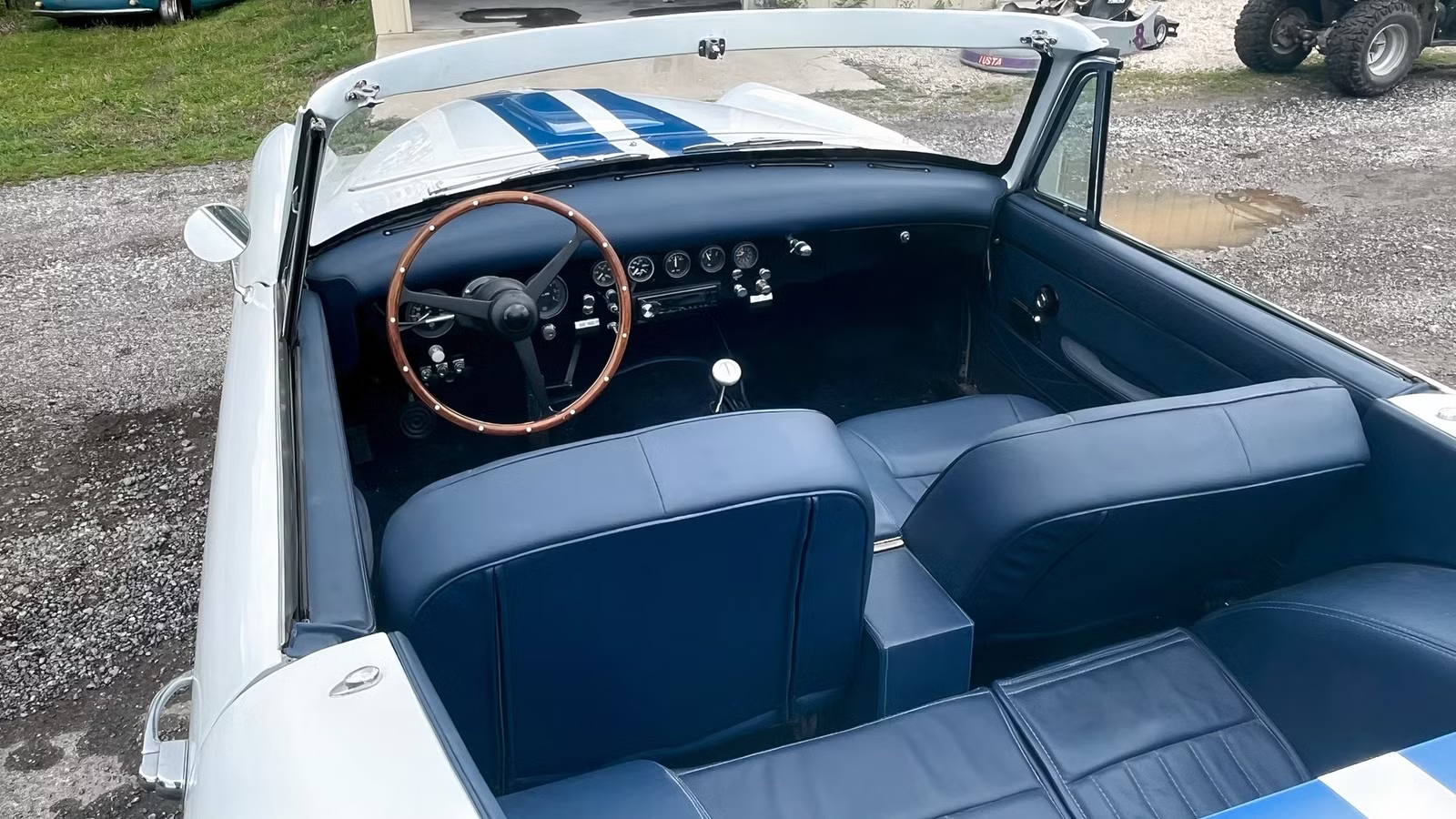
You can hardly discuss the history of motorsports without discussing Mopar’s Hemi V8s. But things weren’t always this way. Chrysler experimented with hemispherical combustion chambers in a fighter-plane engine before offering this exclusive technology in refined personal luxury cars. It was a small, scrappy racing team that first proved what a Hemi could do on a track. It hot-rodded the V8 in its custom-built fast cars to go toe-to-toe with Ferrari and Jaguar. Detroit took notice, and the rest is history.
Chrysler Brought Battle-Ready Technology To The Horsepower Wars

They say necessity is the mother of invention. And with WWII raging overseas, Chrysler engineers built an inverted V16 engine prototype intended for a fighter plane which pioneered some incredible innovations. Its cylinder heads incorporated Chrysler’s first hemispherical combustion chambers. The concept was simple: a round shape would allow the air-fuel mixture to spread evenly around the chamber and would facilitate a more efficient combustion process as more of the mixture had time to ignite. More importantly, this cylinder shape made room for larger overhead intake and exhaust valves, because they were installed at an angle instead of parallel to the piston. An easy-breathing engine can make a ton more power.
When Chrysler needed a new V8 for its cars of the 1950s, it dusted off its old hemispherical combustion chamber concept. The 331-cubic-inch “FirePower” V8 debuted in 1951 Chryslers, including the New Yorker, Saratoga, and Imperial. It came with a 180-horsepower rating.

In 1952, DeSoto got its 276-cubic-inch, 160-horsepower version. And just in case buyers forgot the Hemi technology it packed under the hood, DeSoto named this V8 the “Firedome.” Finally, the 241-cubic-inch “Red Ram” V8, which made 140 horsepower, launched in Dodge’s 1953 lineup.

If you’re sensing a pattern here, you aren’t wrong. In the 1950s, the horsepower wars were spearheaded by powerful personal luxury cars. With the debut of cost-effective muscle cars a decade away, entry-level vehicles from Dodge had to make do with lower-output, inexpensive versions of Chrysler engines. Chrysler would accelerate the horsepower wars with its famed 300-horsepower tune of the FirePower. But not until a small racing team proved what the first-gen Hemi could do, without any factory support.
How The Le Mans Grid Got A Detroit-Sized Contender

Endurance racing, and its most famous race, the 24 Hours of Le Mans, often showcases a variety of technologies. By 1950, American V8s were racing wheel-to-wheel with the best European technology. Sydney Allard was a British constructor and driver who assembled lightweight sports cars around American engines, such as the Cadillac 331 OHV V8. His cars were a major force at Le Mans in the late 1940s and early 1950s. In 1950, he placed third with his Cadillac-powered car.
Briggs Cunningham, born in Ohio, dreamed of winning Le Mans with an all-American version of Allard’s car. He was a triple threat: driver, team owner, and car constructor. His team arrived at the 1950 24 Hours of Le Mans with two modified Cadillac Series 61 racers. One was a coupe and one wore a custom roadster body. But both had tuned versions of Cadillac’s 331 V8, which made 160 horsepower in stock trim. His cars finished 10th and 11th overall, but Cunningham was hungry for more.

These early V8s offered torque and the reliability of a mass-produced engine. But they weren’t yet a match for the best European powerplants. Between 1951 and 1953, Jaguar entered a C-Type with a 3.4-liter inline-six rated at 200–220 horsepower. By 1953, Ferrari’s 4.5-liter Colombo V12 churned out an impressive 340 horsepower. The likes of Allard and Cunningham would have to dial up the competition to stand a fighting chance.
The 1952 Cunningham C-4R Put A 300-HP Hemi Into A Race Car

Briggs also established the B.S. Cunningham Company to sell road-going cars. His C-1 prototype featured the familiar Cadillac V8. But for the C-2R, Cunningham swapped to a Chrysler’s FirePower V8. The car competed at Le Mans in 1951, but Cunningham built only three. To qualify for the manufacturer class, he’d need to sell at least 25. So for the C-3 production car, he upped the ante, adding four Zenith downdraft carburetors and producing 310 horsepower. Sources put the number sold between 25 and 27, qualifying the company for the manufacturer class. But Cunningham knew his next race car would need even more power.
Cunningham’s next race cars were the C-4R roadsters and C-4RK coupe. He improved the engine’s induction, tuned the cam, improved airflow, and used four downdraft carburetors. The result was more than 300 horsepower; Cunningham’s own archive lists 325. An American team was finally building a car that could put Ferrari on notice.

Cunningham built two C-4R roadsters and a single C-4RK coupe to debut at Le Mans in 1952. For 1953, he built the one-off C-5R around another 331 FirePower Hemi still making more than 300 horsepower. French fans nicknamed his open-grille roadster “The Smiling Shark” (Le Requin Souriant). By 1955, Cunningham’s Le Mans team had pivoted away from the Chrysler V8 to experiment with an Offenhauser four-cylinder. This “C-6R” had to retire after 18 hours of racing.
Cunningham proved that reliable American V8s could keep up with the best powerplants Europe had to offer. And in a grueling endurance race no less. As importantly, it had proved that Chrysler’s first-gen Hemi could reliably produce 300-plus horsepower.
The Chrysler C-300 Brought Le Mans Power Home To Main Street

Fast-forward to the 1955 model year and Chrysler was announcing an all-new tune of its 331-cubic-inch FirePower V8. The first-gen Hemi hit showrooms with a factory rating of 300 horsepower, making it the first American production car to reach the 300-horsepower mark. Chrysler was understandably proud of the accomplishment, even naming the C-300 after that output figure, a model name that would resurface for decades.
Chrysler’s record-breaking V8 used a familiar formula. It had a high-performance solid-lifter camshaft, improved breathing, a larger low-restriction dual exhaust, and two Carter four-barrel carburetors. Just like the Cunningham race cars, Chrysler was using familiar hot-rodding tricks to move more air and fuel through the same 331-cubic-inch architecture.

Before you assume that Cunningham sold trade secrets to Chrysler, or that the automaker ripped off his race car’s engineering, think again. The Cunningham cars simply used the hot-rodding best practices at the time. The C-300’s high-output V8 re-engineered the same best practices. There’s no evidence one engine led directly to the other. And it’s entirely plausible the two 300-horsepower engine tunes are the product of parallel evolutions.
Cunningham Taught The Motorsports World To Fear The Hemi

The C-300’s FirePower V8 changed motorsports forever. Carl Kiekhaefer’s independent C-300 team dominated NASCAR in 1955: Tim Flock won 18 races and the Grand National championship, while Fonty Flock added three more wins. The V8 really showed the world what it could do at the 1955 Daytona Beach speed trials, averaging 127.58 mph across the Flying Mile. The “Smiling Shark” would have been proud of its spiritual successor.
Fans of endurance racing may not have been especially surprised by the FirePower’s dominance of NASCAR in 1955. It had been winning endurance races for years. The Cunningham C-4R finished fourth overall at the 24 Hours of Le Mans in 1952. After this narrow podium miss, the car went on to finish first at the 12 Hours of Sebring. The one-off C-5R debuted at the 1953 24 Hours of Le Mans, finally earning Cunningham a podium with a third-place finish. It also recorded the fastest kilometer of the race at 154.81 mph. Jaguar’s new Dunlop disc brakes helped the C-Types finish first, second, and fourth, with the C-5R preventing a sweep. The same year, a C-4R roadster nabbed seventh overall, while the C-4RK coupe finished tenth. A decade before the Ford GT went to war with Ferrari, Cunningham’s Hemi-powered cars were already finishing ahead of Ferrari machinery at Le Mans.

Racing fans are all familiar with the second-generation Hemi. The 426 debuted in NASCAR in 1964, when Hemi Plymouths swept the Daytona 500 podium and Richard Petty went on to win the Grand National championship. NASCAR excluded the non-production Race Hemi for 1965, prompting Chrysler to boycott much of the season until the engine could be homologated for street production. Mopar also doubled down on NHRA drag racing and dominated a second sport with the same V8 architecture. In fact, the 426 Hemi remained competitive in NHRA Super Stock for more than six decades, with Hemi Darts and Barracudas still racing today.
No discussion of motorsports is complete without mentioning the Hemi. But its high-output auto racing legacy began when a privateer team took a Chrysler V8 to France.
Sources: The Revs Institute (via BriggsCunningham.com), The Smithsonian Institute, The Allard Register, Chrysler 300 Club International, and NHRA

Related posts

Latest Post


No Comments