
The Most Beginner-Friendly Adventure Motorcycle
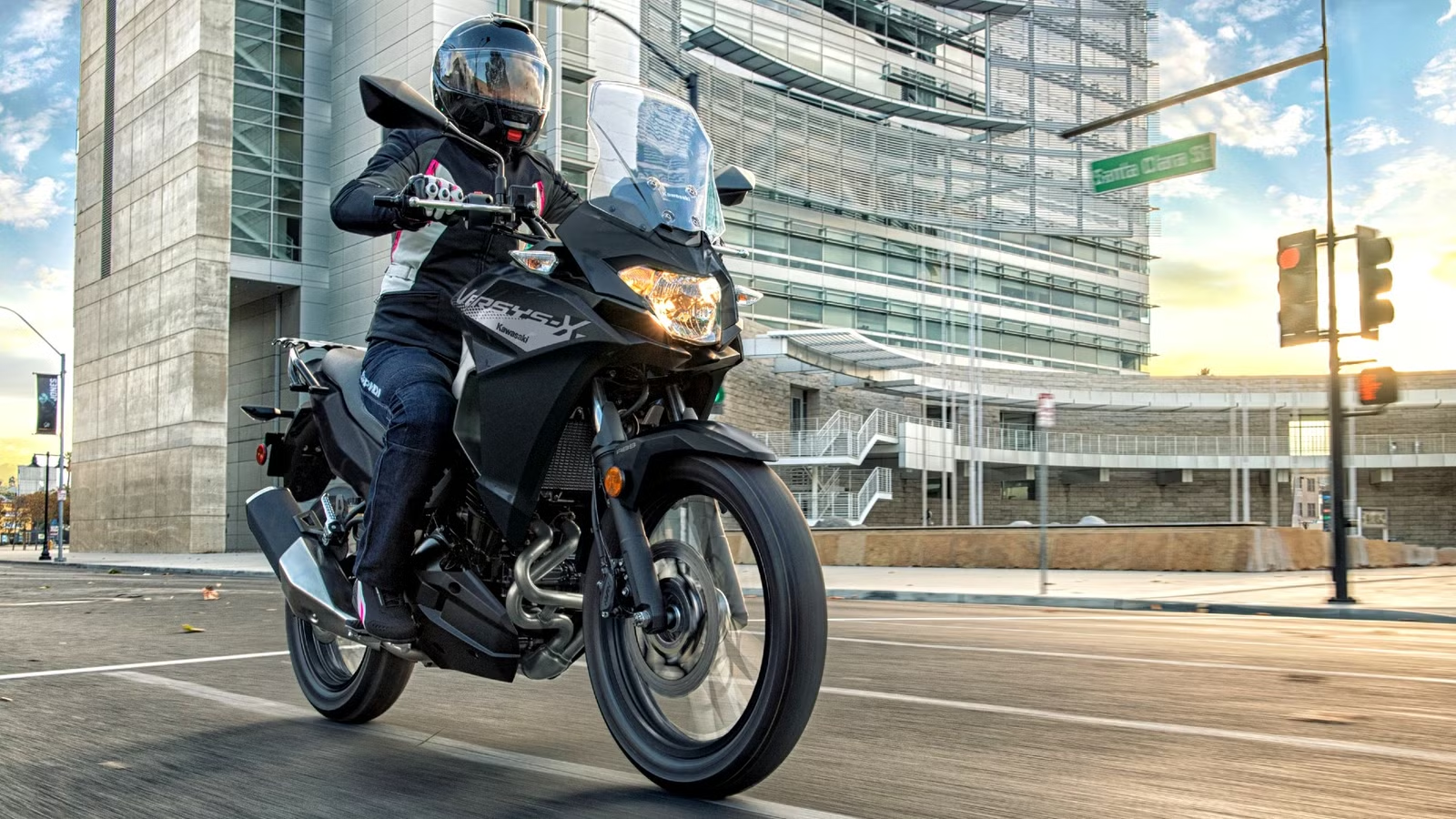
Given the exponential rise in popularity of adventure bikes, it’s fair for new riders to want one. The decision makes sense on paper, too, considering ADVs are highly versatile. The right ones will do commuting, weekend runs, freeway touring, and occasional exploring. Emphasis here is on the ‘right one’, as requirements for beginners are different from experienced riders. Things like seat height, fuel efficiency, cheap spares, and predictable performance come into the picture, all of which change the narrative. Lucky for you, there is one Japanese ADV that fits the bill just right today.
The Prerequisites For A Beginner-Friendly Adventure Motorcycle

If you’re a beginner looking for an ADV, there are certain things you’d need for a smooth experience. Chief among these is ease of riding. This depends on factors like saddle height and weight. Ideally, anything under 32.2 inches is good enough for most of us to plant our feet on the ground.
This can be a lifesaver in slow-speed maneuvers, particularly if you’re going on small, rough tarmac. As for weight, we think 370–400 pounds is a good range. Of course, how a bike masks its weight while riding matters, too. But if an ADV is heavy, it will certainly show its weight somewhere or the other. And if it does that during a hairy situation, this can result in serious damage.

Then there’s performance. Since this is for beginners, we wouldn’t stress too much about this. Anything between 35 and 45 horsepower is a good number that will keep you entertained for a few years. The range also ensures you can easily kick the dirt by just twisting the wrist or sit on the freeway occasionally without too much stress. Oh, and the less stressed the engine, the easier it will be on gas consumption.


Finally, reliability holds a lot of importance. An engine that keeps running without costing a bomb or days in the service center can make a beginner’s riding experience. The opposite of this–an unreliable package that needs regular service center visits–can break the ownership experience. This is even more prevalent in ADVs, as you’d want to do some exploration on these bikes.
The Kawasaki Versys-X 300 Has Everything Beginners Need For Their Adventures

Take all that into account, and the Kawasaki Versys X-300 comes out as an ideal pick. A bit surprising, considering how competitive the ADV space is right now, but the balance is what none of its sub-450cc rivals can match. The weight is perhaps the USP, measuring just 385 pounds fully fueled. Most of its rivals don’t even breach the 400-pound mark. Add the low 32.1-inch seat height, and you’re looking at one of the more easy-to-live-with machines in this space.
Then, there’s the reliability. Being an old ADV on sale for around a decade, this has proven its mettle over the years. Not just in the engine department, but also in how unbreakable the rest of the package is. A driving reason for that is the overall simplicity of things. There are no fancy electronics or complex mechanicals that could be a pain to fix during exploration. Oh, and that also means cheaper spares should you break things.
The Versys-X300 Justifies Its Under $6,000 MSRP Well Today

The simplicity and age also help Kawasaki keep the prices low. The 2026 Versys X-300 is priced at $5,799, making it the cheapest parallel-twin adventure bike money can buy. More importantly, this price also undercuts newer single-cylinder rivals–KTM 390 Adventure X and Royal Enfield Himalayan 450–by a fair margin. To make matters sweeter, Team Green is also offering discounts on the MY25 Versys-X 300, which can bring down the MSRP to under $5,500. It’s simply a no-brainer at this price, given the equipment. Speaking of which, let’s dive into the nitty-gritty.
Powered By A Proven And Efficient Parallel-Twin Engine

First things first is the engine. The Versys-X 300 boasts Kawasaki’s ultra-reputed 296cc parallel-twin engine. We’ve seen the mill in the Ninja 300 earlier, and it’s proven to be highly reliable with varying degrees of abuse. That even includes club racing. Coming to numbers, the engine is good for 39 horsepower and 19.2 pound-feet. Both of these are high up in the RPM range for a smooth and linear power delivery, while being sent to the wheel via a six-speed transmission.
At the same time, the fuel efficiency is said to be 57 MPG, equating to a theoretical range of over 250 miles. Impressively, the MPG is in the ballpark of single-cylinder rivals, despite an extra cylinder on the Versys. Also, the compression ratio here is under 11:1, meaning the engine isn’t exactly too stressed.
Simple Chassis And Suspension Elevate The Versatility

Like the engine, the baby Versys’ underpinnings are simple. They’re built with dependability in mind, rather than chasing performance or high-end specs. So there’s a steel diamond chassis as the centerpiece, paired with telescopic forks and a rear monoshock. There’s 5.1 inches of travel up top and almost 6 inches of travel at the rear, both of which help promise a ground clearance of over 7 inches.
Topping things off is a set of 19/17-inch wheels. That isn’t as exploration-friendly as a 21/18-inch setup, but it’s far more versatile for usage across pavements. Considering a beginner would try to do all kinds of riding on his/her first ADV, this is a subtle plus rather than a con. We do think the brakes are a bit inferior, though. A single 290 mm front and a single 220 mm rear disc make up the setup, which is simply too small by 2026 standards.
All these also help keep the dimensions in check. They measure:
- Wheelbase: 57.1 inches
- Height: 54.7 inches
- Length: 85.4 inches
- Tank capacity: 4.5 gallons
Standard ABS Is A Plus

Being an entry-level machine from the previous decade, the Versys-X is understandably vanilla in the feature department. The instrument cluster is semi-digital with no option for phone connectivity, and you don’t even get LED lights. However, the basics are all there. That includes spoke wheels, dual-channel ABS, and engine protectors on the sides. For anything else, you’ll need to resort to the aftermarket, which we’re happy to report is quite vast.
Source: Kawasaki

Related posts
Latest Post


No Comments