
The Honda Motorcycle That Makes Reliability Feel Exciting
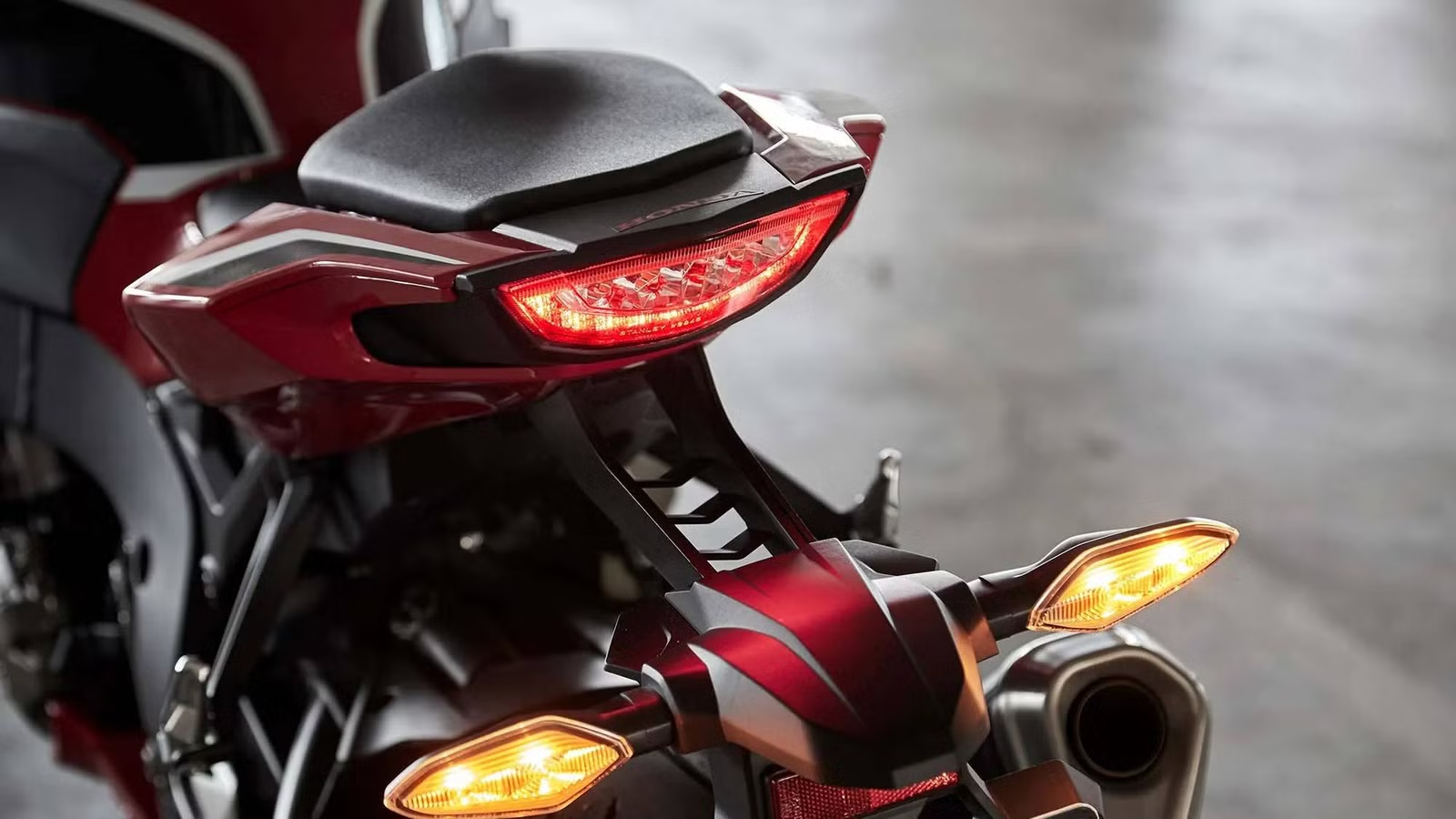
Speed and precision are easy to fall in love with — it’s the fine print that tends to sting. High-performance motorcycles have long come bundled with trade-offs: punishing ergonomics, sky-high maintenance bills, and the nagging sense that you’re one missed service interval away from an expensive lesson. For most riders, that bargain has always felt a little lopsided.

Modern engineering is quietly rewriting those terms. Advances in manufacturing, electronics, and engine design have produced a new generation of sports bikes that deliver genuine thrills without demanding a pit crew. Unsurprisingly, one of the finest examples comes from Honda.
Why Reliability Matters In Performance Motorcycling
When you have a dedicated track bike, you’re looking for parts and components that give you outright performance at the cost of durability, and that’s understandable — those parts are built to survive a session or two, not a lifetime. But when it comes to street performance bikes, longevity matters just as much as lap times. For decades, this is exactly what Japanese motorcycle manufacturers have built their reputations on, proving that high-performance machines could also be reliable enough for everyday use.


Of course, this reputation was not built overnight. It was earned through countless miles of real-world testing, conservative engineering philosophies, and an unrelenting focus on manufacturing quality. Riders from across the world trust these Japanese stars because they start every morning, handle long journeys without complaining, and rarely require extensive repairs — provided you stick to a regular maintenance schedule.
Yes, riders have come to expect sophisticated electronics and predictable handling, but dependability and reliability rank just as high on the list of requirements. In the Japanese motorcycling world, one of the Big 4 has exactly the kind of bike we are looking for. It’s a liter-class sport bike that has power in reserve, even when blazing trails on the mountainside, and it comes out of Honda’s stable.
The CBR1000RR Is A Honda That Makes Reliability Feel Exciting

We chose the Honda CBR1000RR because it perfectly illustrates the concept of reliability made exciting. While many liter-class sport bikes chase maximum performance figures above all else, the Honda superbike focuses on delivering a more complete package — extraordinary speed and capability paired with the refinement and durability that have become synonymous with the name. The CBR1000RR traces its lineage back to Honda’s racing programs and benefits from decades of development in its labs, yet it remains remarkably approachable for riders who want more than the occasional track-day thrill. It is equally capable of delivering exhilarating performance on circuit while still being able to pile on highway miles without complaint.
Features A High-Revving Inline-Four Powerplant

At the heart of the bike sits a 1,000 cc liquid-cooled inline-four engine producing around 190 horsepower and approximately 82.6 pound-feet of torque. The architecture draws heavily from Honda’s racing expertise while retaining the smoothness you expect from a modern Honda. Technologies refined through years of competition have shaped many aspects of this powertrain, benefiting both performance and long-term reliability. One of the engine’s defining characteristics is its eagerness to rev.
Power builds progressively throughout the rev range, rewarding riders who explore the upper reaches of the band. Honda’s engine design features advanced internal components engineered to reduce friction and improve efficiency. By optimizing airflow and combustion, the motor delivers the performance it does while still maintaining a sensible approach to durability.
|
Engine |
1,000 cc, inline-four, liquid-cooled, four-stroke |
|
Compression Ratio |
13.0:1 |
|
Power |
176 HP |
|
Torque |
82.6 LB-FT |
|
Transmission |
6-speed, chain-drive |
Its Chassis Is Built For Confidence

Of course, performance motorcycles depend as much on their chassis as they do on their engines. Honda has engineered the CBR1000RR around a lightweight aluminum twin-spar frame that strikes a balance between rigidity and feedback. It allows for rapid changes of direction while maintaining stability even at high speeds. In terms of geometry, you get a 23-degree rake and 3.8 inches of trail.
Combine that with a curb weight of 432 pounds and you have a fairly nimble motorcycle once it’s moving. That manageable weight also reduces the workload on the suspension, which consists of a 43 mm inverted Showa SFF-BP fork with 4.7 inches of travel up front and a Unit Pro-Link single shock with 5.4 inches of travel at the rear. Stopping power comes from a dual 320 mm disc and radial four-piston caliper setup at the front, backed by a 220 mm single disc at the rear.
|
Rake x Trail |
23 degrees x 3.8 inches |
|
Suspension |
43 mm inverted Showa front fork; 4.7 inches of travel Unit Pro-Link HMAS single shock; 5.4 inches of travel |
|
Brakes |
Dual 320 mm discs; radial-mounted four-piston calipers Single 220 mm rear disc |
|
Tires |
120/70ZR-17 Front 190/50Z-17 Rear |
|
Wheelbase |
55.3 inches |
|
Seat Height |
32.8 inches |
|
Curb Weight |
432 LBs |
This Flagship CBR Is More Than Just Performance Numbers

If you’re wondering whether people will notice you on this bike, they will. The CBR1000RR is aggressive enough to turn heads, but the styling isn’t purely cosmetic. Every surface has been designed to optimize airflow, particularly when you’re tucked in behind the screen. On the technology front, the CBR1000RR packs an impressive electronics suite, especially considering the platform’s age.
Multiple riding modes govern power delivery, traction control, and ABS to suit your riding style. Honda’s Selectable Torque Control lets you fine-tune traction individually, while an electronic steering damper dynamically adjusts damping based on deflection velocity and wheel speed. A TFT screen ties it all together, putting the essential information in front of you at a glance.
User-Friendliness In Heaps For A Superbike

One of this Honda’s greatest strengths is how user-friendly it is. You get the CBR1000RR-R Fireblade SP that’s meant for the track, but this CBR is a lot more street-friendly. The controls are intuitive, and the engine is smooth even at low speeds. On the ownership side of things, maintenance remains reasonable, at least for a bike in this category. Honda has an extensive dealer network, and parts are affordable, too.
A preliminary search online suggests that annual maintenance costs can range anywhere from $500 to $1,500, depending on mileage and how aggressively you ride. Valve clearance checks and adjustments are required every 16,000 miles, while the chain and sprockets typically need replacing every 15,000–20,000 miles. That’s a solid service schedule for a superbike, particularly when you stack it up against comparable European machinery.
Prices start at $17,099

The Honda CBR1000RR is not a cheap bike to purchase, and the base price is only the beginning. ABS costs extra, and the quickshifter — which arguably should come standard — adds to the bill as well. That said, on the accessories front, those are really the only meaningful add-ons most riders will need. Everything from the bike’s high-performance inline-four engine and sophisticated chassis to its advanced electronics and aerodynamic design has been thoughtfully engineered. The CBR1000RR stands out not because it is the fastest machine on the track, but because it sustains a standard of reliability that few rivals can match.
Splurge For The Triple-R SP For Track-Focused Performance And Dependability

The Honda CBR1000RR isn’t the only Honda motorcycle that makes reliability feel exciting. Honda offers a more focused sibling in the CBR1000RR-R Fireblade SP, which brings a track-oriented personality with the same Honda reliability baked in. The reason we haven’t chosen the SP over the standard Fireblade — despite it being more powerful, more advanced, and more current — comes down to price. Starting at around $28,999, the CBR1000RR-R Fireblade SP is a significant investment, and that substantial price gap is enough to put it out of reach for most motorcyclists.
Genuine Track-Ready Performance Out Of The Box

For the extra outlay, the Fireblade SP is a track-oriented, near-MotoGP-derived race replica. Powered by an updated version of the same liter-class engine, the SP delivers a substantial 217 horsepower compared to the standard Fireblade’s 189 — a figure that places it firmly in the top tier of the superbike class. It pairs that performance with high-end semi-active Öhlins Smart EC suspension and Brembo Stylema R brake calipers, along with competition-derived aerodynamic winglets. Put simply, this is a serious track weapon that often draws comparison to the Ducati Panigale V4 in terms of performance and handling.

Despite its race-bred personality, the CBR1000RR-R Fireblade SP is praised for its outstanding mechanical reliability. While it requires strict adherence to factory-recommended service intervals, it avoids many of the catastrophic mechanical failures that can plague other high-strung liter-class superbikes. That’s not to say the Triple-R SP will be cheap to own, though. The higher sticker price is followed by expensive consumables — tires and brake pads in particular — which the over-200-horsepower performance will chew through considerably faster than on the standard Fireblade.
The CBR1000RR-R Fireblade SP Is Not For Everyone

So, which one is right for you? If you’re an experienced motorcyclist looking for a serious, dependable superbike that delivers more than enough performance for real-world riding, the CBR1000RR is the smart pick. The money saved over the Fireblade SP is better spent on track days, riding gear, and consumables. Unless you’re at the very top of your game and unwilling to compromise on either performance or technology — in which case, there’s hardly a better option than the CBR1000RR-R Fireblade SP.
Source: Honda Powersports

Related posts

Latest Post


No Comments