
The 6.2-Liter V8 Was GM’s Best Truck Engine, But Now It’s A Liability
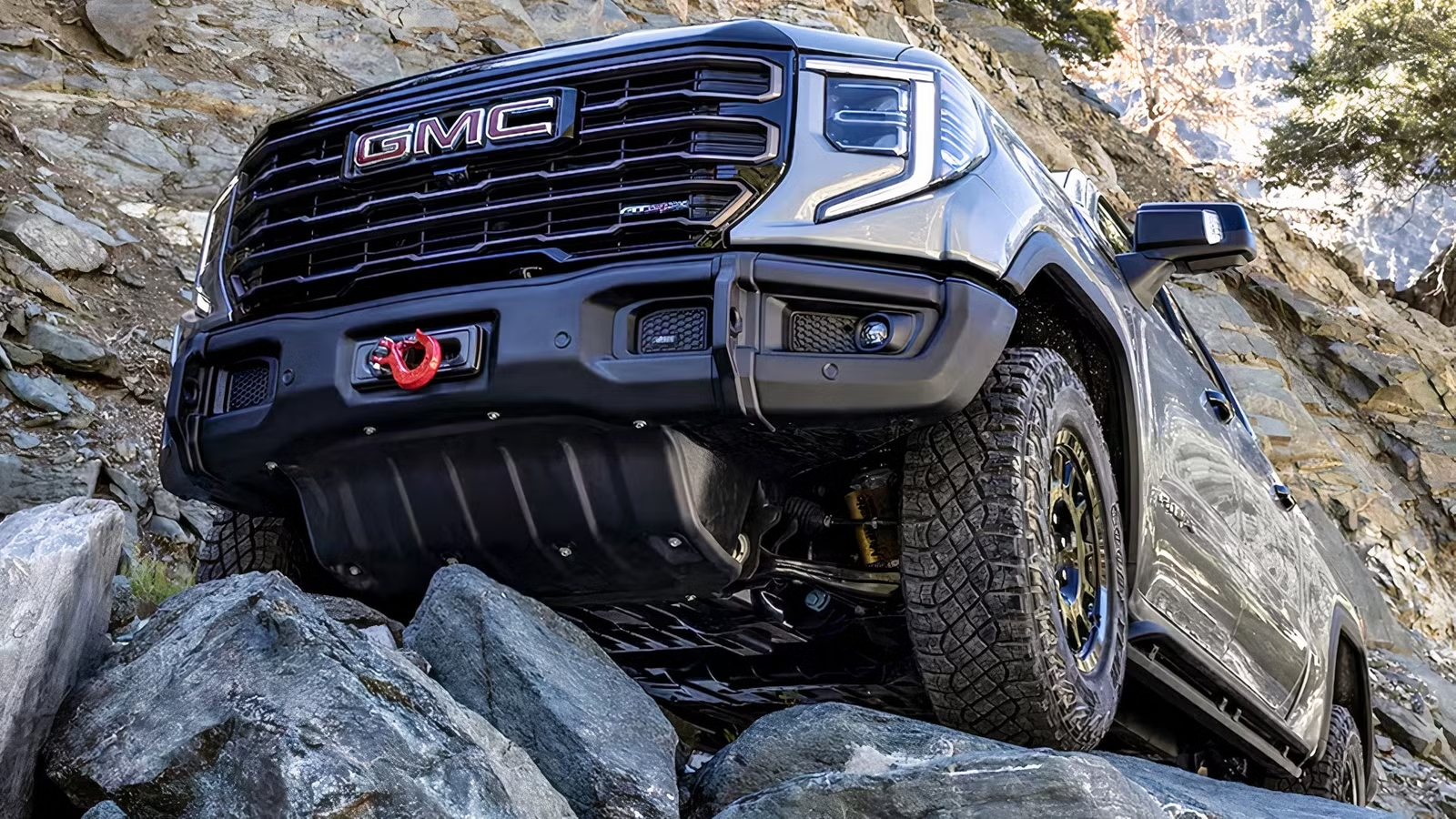
GM’s recall of nearly 600,000 L87 6.2-liter V8 engines was supposed to close the book on a serious crankshaft and bearing failure problem. Instead, it may have opened a new chapter. The National Highway Traffic Safety Administration opened Engineering Analysis EA26005 on August 20, 2026, after hundreds of owners reported engine failures in vehicles that had already gone through the official recall repair — a rare escalation that signals federal regulators are no longer confident the fix worked.

The investigation now covers 997,743 vehicles spanning the 2021 through 2026 model years. That includes the Chevrolet Silverado 1500, Tahoe, and Suburban; the GMC Sierra 1500, Yukon, and Yukon XL; and the Cadillac Escalade and Escalade ESV — essentially every major GM full-size truck and SUV powered by the L87 V8 during that production window.
What the Original Recall Covered and How the Fix Was Supposed to Work
GM voluntarily recalled 597,630 U.S. vehicles in April 2025 under Recall 25V-274, targeting L87 engines manufactured between March 1, 2021, and May 31, 2024. The defect traced to manufacturing problems in the engine’s rotating assembly: rod-bearing damage caused by machining sediment left inside connecting rods and crankshaft oil galleries, plus crankshaft dimensions and surface finishes that fell outside required specifications. GM attributed the failures to supplier quality shortcomings rather than a fundamental design flaw.

Dealers were instructed to scan each engine for diagnostic trouble code P0016, which flags crankshaft or camshaft misalignment. Engines that failed the test received a full replacement. Engines that passed got a lighter-touch remedy: a switch from the factory 0W-20 oil to heavier 0W-40, a new oil filler cap stamped with the updated spec, a new oil filter, and a revised owner’s manual insert. The theory was that higher-viscosity oil would provide enough additional protection to prevent further bearing damage from any remaining manufacturing irregularities. GM also established a special coverage program — 10 years or 150,000 miles from the original in-service date — for engines that passed inspection.
The Numbers That Prompted NHTSA to Act

The failure reports kept coming after dealers completed the work. NHTSA has received 499 complaints of engine failure in vehicles that had already undergone the recall remedy. Of those, 473 involved engines that received the oil viscosity change — the lighter fix — and 26 involved engines that had received a full replacement. That last figure is particularly hard to explain away: replacement engines were built after the May 2024 production cutoff and should not have been subject to the same manufacturing defects the recall identified.
GM’s own records tell an even starker story. The automaker logged 6,953 post-remedy engine failure complaints from its own customers — more than 10 percent of the originally recalled fleet. On top of that, NHTSA received 191 additional failure reports from L87 engines built after the original recall’s production window, suggesting the problem may extend beyond the vehicles the 2025 recall addressed. Combined, those 690 new failure reports are what pushed NHTSA to formally escalate.
Owners have described sudden power loss, severe engine knock, and complete engine shutdown while driving — what NHTSA characterizes as “loss of motive power due to engine failure.” At least one crash and one injury connected to sudden power loss have been recorded in the current investigation file.
What an Engineering Analysis Means for Affected Owners

An Engineering Analysis is a formal technical evaluation by NHTSA’s Office of Defects Investigation — and it is typically the agency’s final step before it can require a manufacturer to issue an expanded recall or a more comprehensive repair. Regulators will examine components, test protocols, and supplier manufacturing controls to determine whether GM’s original remedy was adequate and whether the failure population extends beyond the 2021–2024 production window originally covered.
If NHTSA concludes the oil viscosity change is insufficient, GM could be compelled to issue a secondary recall covering close to one million trucks and SUVs — potentially requiring full engine replacements or deeper hardware overhauls. No new recall has been ordered yet. Some owners have already filed suit against GM; the automaker has asked a federal court to dismiss the case, arguing the existing recall campaign already provides the remedy plaintiffs are seeking.
GM spokesman Bill Grotz stated that “the safety and satisfaction of our customers are the highest priorities for the entire GM team,” and that the company continues to cooperate with NHTSA’s evaluation. GM has not modified the existing recall scope, which remains limited to the original 597,630 vehicles from model years 2021 through 2024.
For owners of an L87-equipped vehicle right now, the practical guidance is straightforward: keep detailed records of all recall-related service and oil changes, and report any warning lights, unusual engine noise, or power hesitation to both your dealer and NHTSA. The 10-year/150,000-mile special coverage program GM put in place remains active — use it. And note that 2027 model year trucks move to a new 6.6-liter V8, which sidesteps the L87 question going forward, though it does nothing for the nearly one million owners currently caught in the middle.

Related posts





Latest Post



No Comments