
Lincoln Used To Build American Dreams — Now It’s Importing Them From China
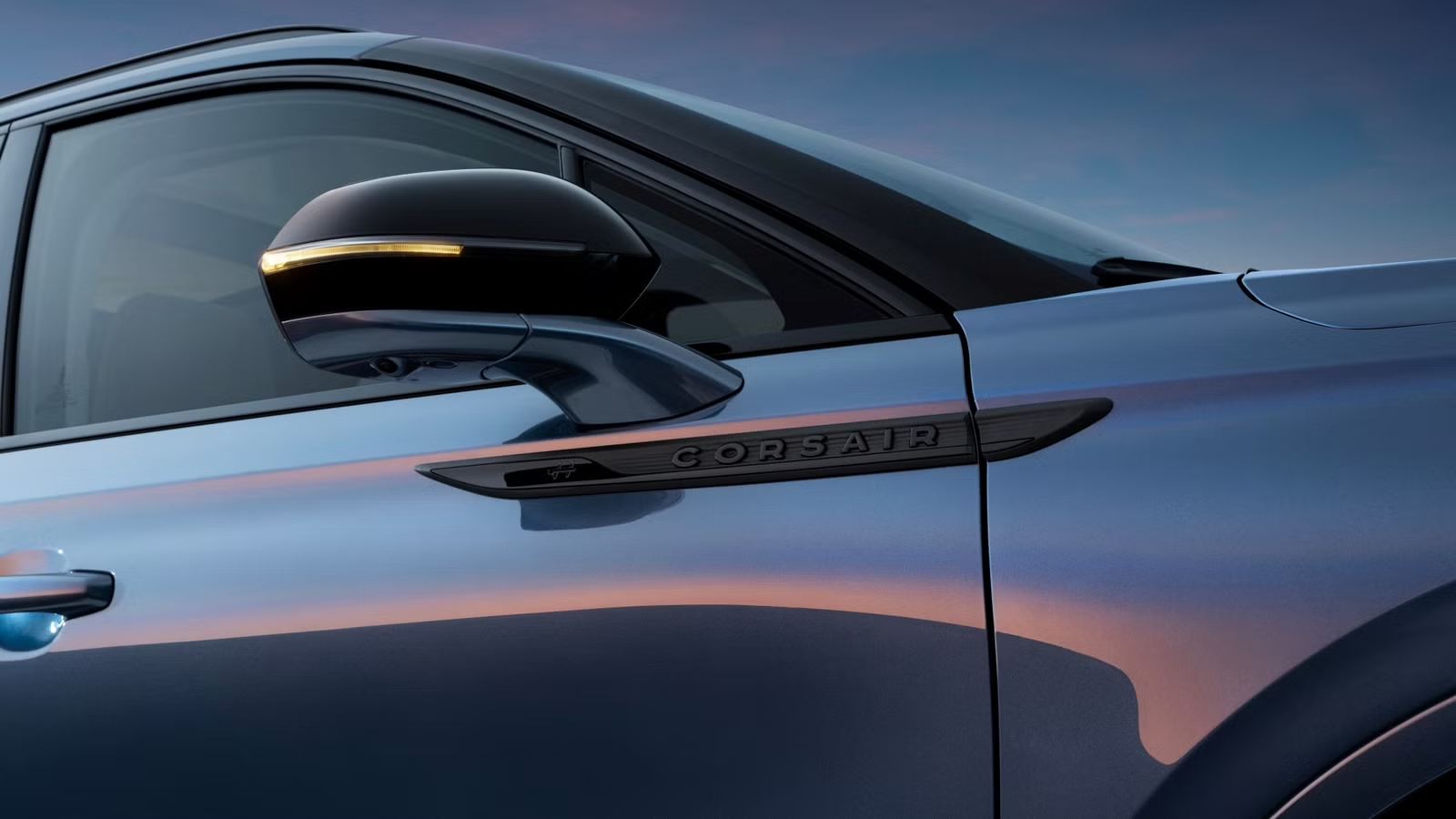
Lincoln officially announced the return of the Corsair on August 25, 2026, and the compact luxury SUV is coming back with a significant asterisk: it will be built at Ford’s Chongqing plant in China and shipped across the Pacific to U.S. dealerships. The 2027 Corsair Hybrid joins the Nautilus as the second China-manufactured Lincoln in American showrooms, arriving early next year with a starting price of $48,790 — a $7,310 jump from the last Corsair on sale.

The price increase reflects a hybrid powertrain upgrade and newly standard all-wheel drive, but it also lands in a market where 52.5% tariffs apply to Chinese-built vehicles. Lincoln’s own spokesperson confirmed the Corsair will face a tariff rate similar to what the Nautilus already carries — a number that shapes every line of the Corsair’s value proposition for buyers cross-shopping German and Japanese alternatives.
What China Production Means for the Corsair’s Price Tag
The 52.5% tariff on Chinese-built vehicles is the unavoidable backdrop to the Corsair’s pricing story. Lincoln spokesperson Kelly Wysocki told the Detroit News that the price increase has more to do with added standard content than tariff pass-through — and there’s something to that argument. The 2027 model bundles in AWD, a hybrid powertrain, BlueCruise 1.5 hands-free highway driving, and four years of connectivity services that the old base Corsair didn’t include. But those additions don’t fully insulate buyers from the tariff math.

For context, the Nautilus has operated under the same tariff structure since Lincoln began importing it from China in 2024, and the Corsair is expected to follow the same model. Ford hasn’t broken out exactly how much of the tariff cost is absorbed versus passed to buyers, but MotorTrend noted that a chunk of the price hike is “likely due to the tariffs Lincoln will now pay.” Buyers should treat the $48,790 starting price as a tariff-inclusive figure, not a pre-tariff one.
There’s also a longer-term signal embedded in the announcement: Ford confirmed earlier in August that it plans to move Chinese-based Lincoln production back to the U.S. by 2030. The company cited tariffs as the primary driver. That timeline suggests the Corsair’s China-built era is a bridge, not a permanent strategy — but it also means buyers purchasing a 2027 or 2028 model are buying into a production arrangement that carries real geopolitical and cost risk.
How the Corsair’s Hybrid Specs Stack Up Against the Competition

The 2027 Corsair’s powertrain is the clearest upgrade in the package. A turbocharged 2.0-liter four-cylinder works alongside two motor generators through a continuously variable transmission, producing 305 combined horsepower with standard AWD. That’s up from 266 hp in the outgoing plug-in hybrid Grand Touring, and notably the Corsair’s version of this hybrid system makes 20 more horsepower than the same basic setup in the larger, heavier Nautilus.
The tradeoff versus the old plug-in hybrid is real, though. The 2026 Grand Touring offered 27 miles of electric-only range; the 2027 drops the larger battery and goes conventional hybrid. Buyers who wanted a commuter with meaningful EV range will need to look elsewhere.
On the competitive grid, the Corsair’s pricing creates friction. The BMW X1 starts roughly $4,240 below the Corsair’s $48,790 base. The Audi Q3 comes in cheaper still, and the Lexus NX — which offers its own hybrid powertrain — undercuts the Corsair by about $1,570. The Lexus comparison is particularly pointed: the NX 350h delivers a proven hybrid system with a brand reputation for long-term reliability, and it costs less. Lincoln is asking buyers to pay a premium over those alternatives for 305 horsepower, BlueCruise, and a nameplate that is, by its own admission, trying to serve as many shoppers’ “first introduction” to the brand.
Warranty, Service, and the China-Built Question for Luxury Buyers

For luxury shoppers, the country of manufacture raises practical questions beyond tariffs. Lincoln covers the 2027 Corsair under Ford’s standard warranty structure — the same coverage that applies to the Nautilus, which has been China-built since 2024. That means warranty claims are handled through Lincoln’s U.S. dealer network regardless of where the vehicle was assembled, which limits the direct service exposure for most buyers.
The more nuanced concern is parts sourcing and long-term support if the geopolitical environment around Chinese imports shifts further. Ford’s stated 2030 target for U.S.-based Lincoln production is a hedge against exactly that scenario, but it’s four model years away. Buyers signing a 60- or 72-month loan on a 2027 Corsair will own a China-built vehicle for the duration of that financing term, and potentially beyond it.
The 2030 Reshoring Plan and What It Signals Now
Ford’s announcement earlier in August — that it intends to bring Lincoln’s Chinese production back to U.S. soil by 2030 — arrived less than two weeks before the Corsair reveal. The timing is awkward, and Lincoln’s own spokesperson acknowledged it directly: the Corsair’s China sourcing was always part of the cycle plan, filling the gap left when the Louisville Assembly Plant was retooled for the Ford Fathom electric truck.
The Chongqing plant producing the Corsair operates under Ford’s joint venture with Chang’an Automobile Group — a different facility from where the Nautilus is built. Ford hasn’t specified where U.S. Lincoln production will land after 2030, only that it expects to create thousands of direct and indirect jobs. A Bronco platform-based Lincoln model is also expected to join the lineup.
For buyers weighing the 2027 Corsair today, the reshoring timeline is a mixed signal. It confirms Lincoln sees long-term value in the segment — the Corsair was the brand’s second best-selling model last year — but it also underscores that the current China-built arrangement is a cost-management workaround, not a strategic preference. The 52.5% tariff burden is the reason Ford wants out of it by decade’s end.
The 2027 Lincoln Corsair goes on sale early next year with dealer orders open now. For luxury crossover shoppers, the decision comes down to whether 305 hybrid horsepower, standard AWD, and four years of BlueCruise justify a price that clears the BMW X1 and Lexus NX by a meaningful margin — with a China-built supply chain factored in.

Related posts


Latest Post



No Comments