
The Jesko Absolut’s 190 MPH Trap Speed Just Made Every Hybrid Hypercar Look Overcomplicated
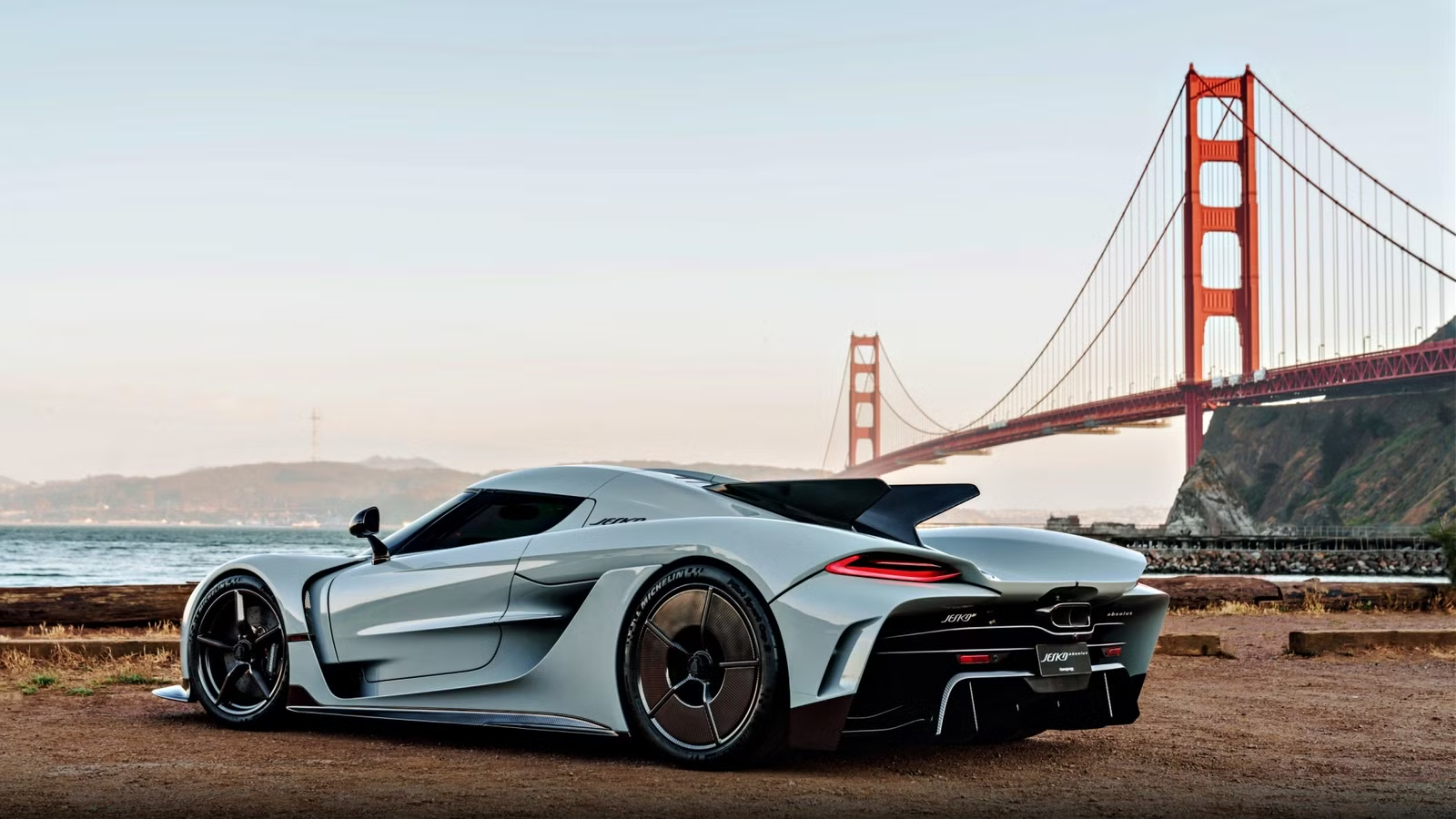
Koenigsegg just confirmed what combustion purists have been arguing for years. The Jesko Absolut ran the quarter-mile in 8.54 seconds and crossed the traps at 190 mph — no electric motors, no all-wheel-drive system, no prepared surface, no asterisks. It is, by those numbers, the quickest and fastest production car ever recorded through the quarter-mile.

The timing matters. For the better part of a decade, the hypercar conversation has been dominated by hybrid torque-fill and multi-motor AWD traction. Rimac, Ferrari, and Porsche have all made compelling cases that electrification is the only credible path to the front of the performance envelope. The Jesko Absolut just showed up with a twin-turbocharged V8, a rear-drive layout, and a nine-speed multi-clutch transmission—and buried all of them.
What 8.54 Seconds Actually Means Against the Hybrid Field
The numbers that matter most here aren’t Koenigsegg’s in isolation—they’re Koenigsegg’s relative to the machines that were supposed to have made this kind of run impossible without electrification.

The Ferrari SF90 Stradale, Ferrari’s 986-horsepower plug-in hybrid flagship, runs the quarter-mile in approximately 9.4 seconds. It uses three electric motors and all-wheel drive to get there. The Porsche 918 Spyder — still one of the benchmark hybrid hypercars — clocked around 9.8 seconds in independent testing. The Rimac Nevera, a purpose-built all-electric hypercar with four motors and over 1,900 horsepower, has recorded quarter-mile times in the 8.6-second range. Every one of those figures sits behind the Jesko Absolut’s 8.54, and none of them matched its 190 mph trap speed.
Trap speed is arguably the more revealing number. It reflects sustained power delivery across the full quarter-mile distance, not just launch grip. Crossing at 190 mph means the Jesko Absolut was still pulling hard at the stripe—a direct function of its engine’s top-end output, not electric torque at zero rpm.
The Powertrain Philosophy Behind the Record

The Jesko Absolut is built around a 5.0-liter twin-turbocharged V8 that Koenigsegg rates at 1,600 horsepower on E85 fuel. Power reaches the rear wheels through the company’s proprietary Light Speed Transmission—a nine-speed unit with seven clutch packs that can execute gear changes in under a millisecond, eliminating the torque interruption that plagues conventional automatics and dual-clutch gearboxes.

There is no front axle motor to fill torque gaps at launch. There is no battery pack adding weight or complexity. The entire performance case rests on the engine’s output, the transmission’s mechanical efficiency, and rear-wheel traction management. That Koenigsegg extracted an 8.54 at 190 mph from that configuration—on what Motor1 described as a standard surface, not a prepped drag strip—makes the achievement harder to dismiss as a controlled-conditions outlier.
Koenigsegg also confirmed the run separately from any manufacturer-controlled testing environment, which adds credibility to the figures in a segment where claimed numbers and independently verified numbers don’t always match.
What This Doesn’t Mean—And What It Does

The Jesko Absolut’s record doesn’t invalidate hybrid hypercar engineering. The SF90 Stradale is a usable road car that can charge on a plug and run silently through city centers. The 918 Spyder helped establish that hybrid systems could enhance rather than dilute driving character. The Rimac Nevera demonstrated that an all-electric powertrain can be genuinely terrifying in a straight line. These are real achievements.

What the Jesko Absolut does challenge is the assumption that electrification and AWD complexity are *necessary* conditions for reaching the front of the production-car performance hierarchy. Koenigsegg’s approach—obsessive weight reduction, mechanical transmission innovation, and an engine tuned for sustained high-rpm output—produced a result that the hybrid consensus said shouldn’t be possible from a rear-drive, combustion-only platform.
With production limited to 125 units and deliveries already underway, the Jesko Absolut won’t redefine the market. But it has redefined the benchmark. For anyone tracking where production-car performance actually stands right now, the number to beat is 8.54.
Sources: Koenigsegg

Related posts


Latest Post


No Comments