
The Roadster That Deserves More Attention Than Its Sales Numbers Suggest
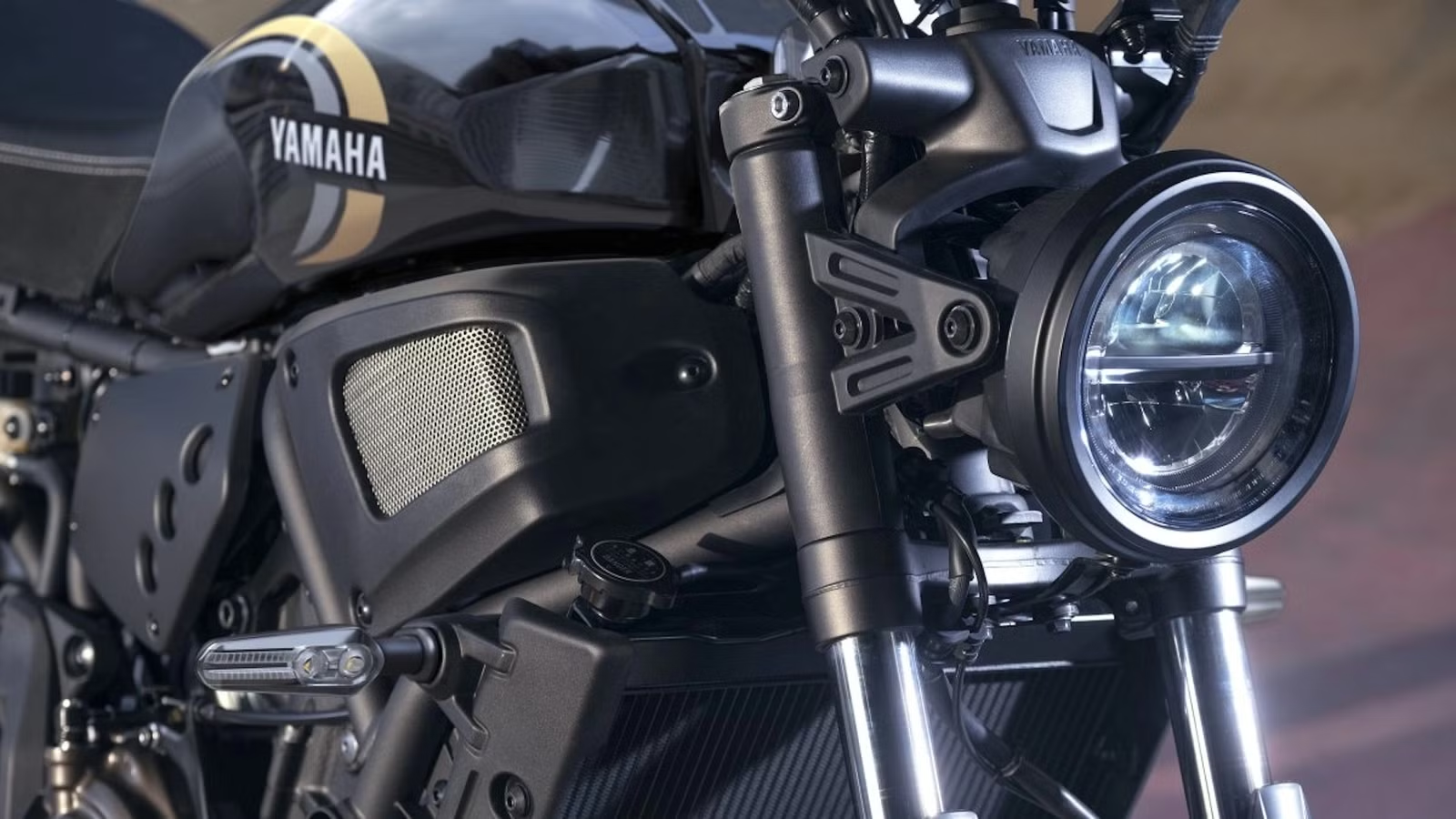
Some motorcycles almost market themselves. They’re the fastest, cheapest, newest, or stuffed with enough electronics to make the spec sheet read like a smartphone launch. Others have a harder time because nothing about them screams for attention. They just work. One middleweight roadster has spent years in that awkward position, combining a hugely popular engine, manageable weight, everyday comfort, and genuinely handsome styling while somehow remaining easier to overlook than motorcycles that aren’t necessarily more enjoyable.
Middleweight Roadsters Have Become Surprisingly Tech-Loaded

Middleweight motorcycles used to be where riders went when they wanted to escape the excesses of bigger machines. That’s changed dramatically. Ride modes, traction control, TFT displays, smartphone connectivity, quickshifters, electronically controlled throttles, and increasingly elaborate rider aids have trickled downward. Some middleweights now offer technology that would’ve looked genuinely exotic on a liter bike barely a decade ago, and horsepower figures have climbed right along with the equipment lists.
There’s nothing inherently wrong with that progress. Better electronics can make motorcycles safer, more versatile, and easier to live with. But they’ve also changed expectations. A bike that doesn’t offer multiple riding modes or a massive full-color dashboard can suddenly look outdated even if the fundamentals underneath it remain excellent. Complexity has become something buyers expect to see, and manufacturers inevitably have to charge for at least some of it.
More Riders Are Beginning To Appreciate The Less-Is-More Philosophy


The problem is that motorcycles built around that philosophy don’t always shine in showroom comparisons. A machine can be excellent in isolation while looking less convincing once it’s parked beside something newer, faster, or more technologically impressive. Things get particularly awkward when that competition comes from the same manufacturer, because suddenly buyers aren’t comparing different brands or philosophies. They’re looking at two or three versions of roughly the same idea separated by surprisingly small amounts of money.
A perfect example is Yamaha’s current US lineup. One of its best-known middleweight naked bikes starts at $8,599 for 2026, while a larger heritage roadster with considerably more power, sophisticated suspension, cruise control, a TFT display, and extensive electronics costs $10,599. When you’re shopping by price and specifications, the motorcycle occupying the narrow space between those two propositions becomes remarkably easy to skip over.
The Yamaha XSR700’s Greatest Strength Is How Little Effort It Takes To Enjoy

That motorcycle is the Yamaha XSR700, and its US MSRP is $8,599, plus a $675 destination charge. It’s powered by Yamaha’s iconic 689cc liquid-cooled, DOHC, four-valve-per-cylinder parallel twin, with an 80mm bore, 68.6mm stroke, and 11.5:1 compression ratio. Fuel injection feeds the CP2 engine, while power reaches the rear wheel through a six-speed transmission, multiplate wet clutch, and chain final drive.
The defining ingredient is Yamaha’s 270-degree Crossplane Concept crankshaft, which gives the twin its uneven firing character and strong low- and midrange delivery. The XSR700 isn’t chasing huge peak horsepower or trying to imitate a supersport. Its appeal comes from having useful performance available without needing to wring the engine’s neck everywhere. That makes it entertaining at ordinary road speeds, whether you’re commuting through town or working through a good stretch of corners on a weekend.

The rest of the numbers reinforce that accessibility. Wet weight is just 410 pounds, wheelbase measures 55.3 inches, and the seat sits 32.9 inches from the ground. Overall dimensions are 81.7 inches long, 32.3 inches wide, and 44.5 inches tall, while rake is 25 degrees with 3.5 inches of trail. Ground clearance measures 5.5 inches. The fuel tank holds 3.7 gallons, and Yamaha estimates fuel economy at an impressive 58 mpg.
Its Chassis Is Basic, But The Important Hardware Is Already There

The XSR700 uses a diamond-type steel frame with a conventional 41mm telescopic fork providing 5.1 inches of travel. At the rear is a single shock with adjustable preload and the same 5.1 inches of travel. Neither end is especially exotic, and riders looking for extensive damping adjustment won’t find it here. But the setup matches the bike’s broader mission: straightforward road performance, reasonable comfort, and handling that doesn’t demand racetrack-level commitment to enjoy.
It rolls on lightweight 10-spoke cast-aluminum 17-inch wheels wearing Michelin Road 5 rubber, sized 120/70ZR17 up front and 180/55ZR17 at the rear. Braking comes from dual 282mm hydraulic front discs with ABS and a 245mm hydraulic rear disc, also backed by ABS. Yamaha additionally equips the bike with four-piston front calipers, giving the braking system more substance than the XSR700’s retro appearance might initially suggest.
Being Old-School Is Both The XSR700’s Weakness And Its Best Argument

There’s no hiding where the XSR700 gives ground. Its round LCD instrument panel looks decidedly old-school next to the TFT displays spreading across the middleweight class, and there are no elaborate riding modes or layers of electronic intervention to explore. The suspension is conventional, the clutch lacks the assist-and-slipper setup found on the latest MT-07, and the bike doesn’t make much effort to overwhelm you with technology.
That comparison becomes even tougher because the 2026 MT-07 costs the same $8,599. It now gets a 41mm inverted KYB fork, radially mounted front calipers, lightweight SpinForged wheels, YCC-T electronic throttle control, and an assist-and-slipper clutch while weighing seven pounds less at 403 pounds. Anyone buying purely on equipment-per-dollar has a very legitimate reason to look across the showroom.

But the XSR700 isn’t trying to be the MT-07 with a round headlight. Its appeal comes from traditional roadster proportions, exposed aluminum details, retro bodywork, a stitched seat, round LED lighting, compact LED turn signals, and styling designed around customization. It’s a motorcycle you can leave alone or gradually make your own, and its relatively uncomplicated mechanical package may actually become more appealing the longer you intend to keep it.
The XSR700 Makes More Sense The Longer You Stop Comparing Numbers
The XSR700 isn’t overlooked because Yamaha buried some fatal flaw in the small print. It simply exists between motorcycles that are easier to justify with numbers. The MT-07 gives you the same displacement, newer hardware, and more technology for identical money. Spend another $2,000 and the $10,599 XSR900 brings an 890cc CP3 triple, adjustable inverted suspension, cruise control, smartphone-connected TFT instrumentation, and considerably more sophisticated electronics.
Yet that’s also what makes the smaller XSR interesting. It sits in a shrinking space between beginner-bike friendliness and middleweight performance escalation. It’s light enough to manage easily, quick enough to keep experienced riders entertained, economical enough to commute on, and comfortable enough to use regularly. Yamaha even backs it with a one-year limited factory warranty, completing a package that isn’t especially complicated because it never needed to be.

Look at the XSR700 exclusively as a collection of specifications, and there are newer motorcycles that’ll beat it by a long shot. Look at it as something you’d actually own, ride, maintain, modify, and possibly keep for years, and the argument becomes considerably stronger. Its apparent lack of progress may be precisely what preserves its appeal. In a market increasingly determined to put more technology between rider and motorcycle, the XSR700 still trusts the person holding the handlebars to provide most of the entertainment.
Source: Yamaha

Related posts




Latest Post


No Comments