
Paul Newman Stuffed A Buick V8 Into A Volvo Wagon And Started A Badass Sleeper Dynasty
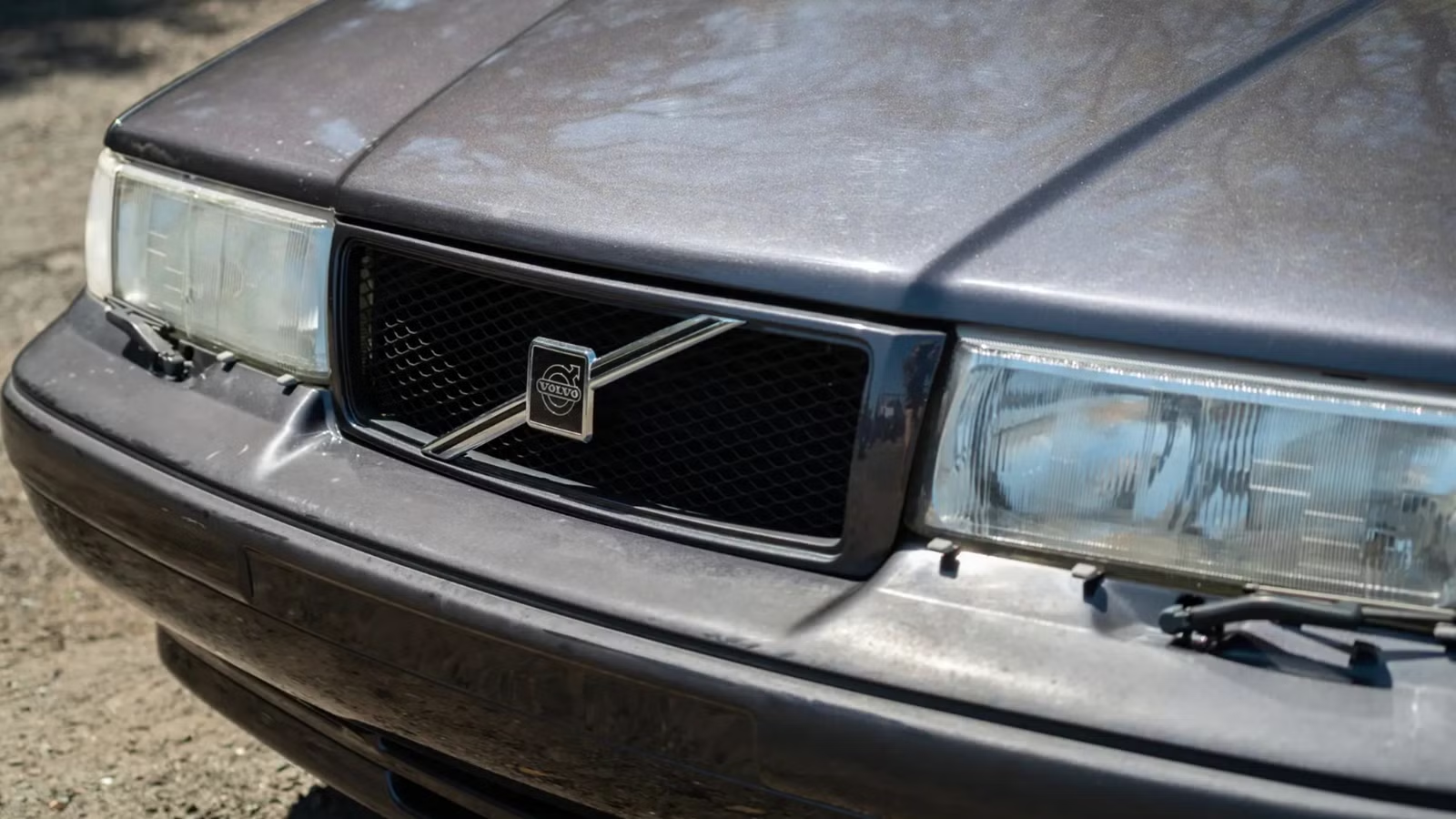
Paul Newman spent his working life being one of the most recognizable men in America, then spent his road life in the most anonymous box Sweden ever built. The anonymity was deliberate, and he wanted the paint, panels, and badges left exactly as Volvo shipped them, because the joke only worked if nobody noticed.

Over roughly two decades, three of his wagons received American muscle-car powertrains, each one angrier than the last. The car that started it ran a turbocharged V6, not a V8 — and that boosted six is what set off a dynasty of V8 heart transplants.
How Paul Newman Found His True Calling Later In Life
Newman was 43 when he took the lead role in the 1969 film Winning and enrolled at the Watkins Glen Racing School so he would look convincing on camera. He turned out to be genuinely quick. He later called it “the first thing that I ever found I had any grace in.” He entered his first professional race at 47, an age when most drivers are thinking about what comes after. This was the spark that started a 35-year second career.

Four SCCA National Championships followed, along with a second-place finish at the 1979 24 Hours of Le Mans in a Barbour Porsche 935. He won his class at the 1995 24 Hours of Daytona at 70, ran the Baja 1000 after that, and came back to Daytona in 2005 at 80. The SCCA put him in its Hall of Fame in 2009, and in 2022 Lime Rock Park renamed its No Name Straight after him. He also spent more than three decades as a team owner, which gave him permanent access to a shop full of people who could build engines, fabricate mounts, and solve problems that would defeat a normal customer.
None of that appetite for speed translated into showing off. He was a man who enjoyed flying under the radar but could not leave his lead foot at the track, so he built street cars quick enough to entertain him on the back roads near his Connecticut home. And he had a particular liking for Volvo wagons dynasty.
A 1988 Volvo 740 Turbo Wagon With A Buick Grand National Heart

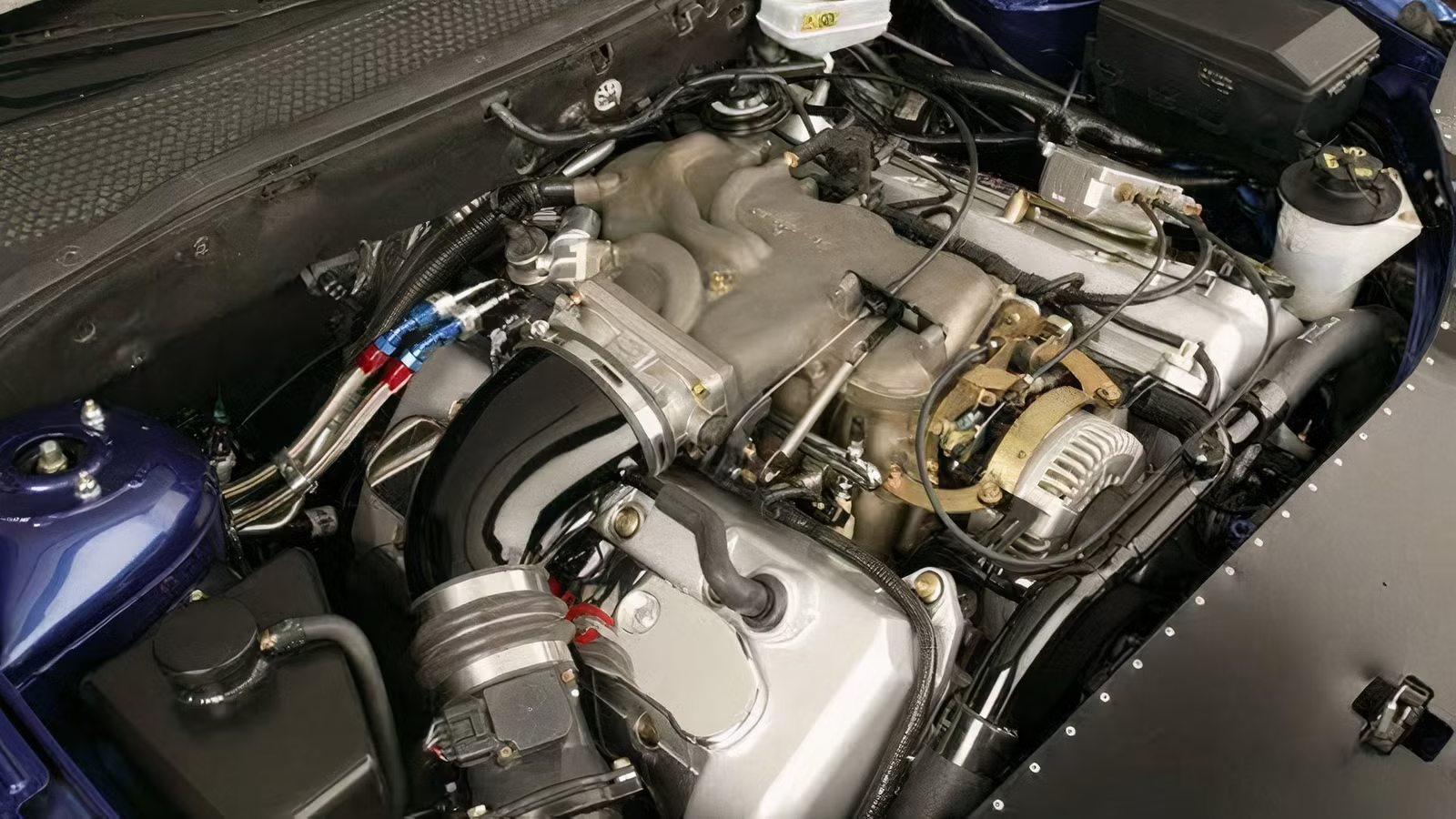
The wagon that started all of this was a 1988 Volvo 740 Turbo, and the engine under its hood came from Flint, Michigan, not Gothenburg. Newman sent the car to HESCO Engineering in Birmingham, Alabama, which pulled the 2.3-liter four-cylinder and dropped in the turbocharged 3.8-liter V6 from a Buick Grand National. Behind it went a Borg-Warner five-speed manual sourced from a Pontiac Firebird.
HESCO was no ordinary speed shop. Lee Hurley ran the place, and he built engines for Bobby Allison, Darrell Waltrip, and Neil Bonnett, which is an unusual résumé for a business that agreed to re-engine a Swedish grocery hauler.

The original transmission and differential came out along with the four-cylinder, and a limited-slip diff went in to make the extra torque usable. Bilstein struts and shocks were fitted at all four corners, together with IPD lowering springs and thicker sway bars. The car rides on 16-inch Gemini alloys wrapped in BFGoodrich g-Force Comp-2 A/S tires, and Newman added a Volvo Aero-style body kit that reads as a factory trim option rather than a modification.
He kept fiddling after delivery, adding a tune for the V6, a custom exhaust, and cooling upgrades to handle the heat a boosted six generates in a tightly packed bay.

Nobody has published a dyno sheet, and the numbers drift depending on who is telling the story. The finished car is rated roughly 300 horsepower against the 154 hp it left the factory with, which is believable for a Grand National engine rated at 245 hp and 355 lb-ft in stock form.
The turbo housing carries the only real giveaway, stamped “Volvo V6 Turbo” for the benefit of anyone who ever opened the hood. Everything else stayed as Volvo built it, including the stowable third-row seat, air conditioning, heated front seats, and the power sunroof.
The Ford-Powered 960 Newman Talked David Letterman Into One

Newman’s second wagon arrived in 1995, a Volvo 960 carrying a supercharged 5.0-liter Ford V8 and a Mustang T-5 manual. Hagerty reports he specifically asked for a more aggressive suspension setup this time around.
Converse Engineering handled the build, fitting Edelbrock aluminum heads and a Kenne Bell supercharger to the Ford small-block. Some claim it made 380 hp, though Letterman remembered Newman quoting him 400.
Newman phoned David Letterman during the build and offered him a matching car, a conversation Letterman retold in a 1995 interview with Jon Stewart. Newman explained that he wanted to stuff a Ford 302 into a Volvo wagon, that the engine was roughly the size of a small piano, and that the firewall would have to be pushed back to make room.

Letterman called Volvo wagons about as ugly as homemade shoes, then ordered one anyway and spent years raving about it. His car was red, Newman’s was gray, and a third went to a Manhattan businessman named Ian Warburg in blue.
It was as quick as a mid-1990s Mustang Cobra, which is the closest thing to hard proof the sleeper concept ever got. Nothing on the outside gave the game away. Letterman still had his car decades later and drove it around with Jerry Seinfeld for an episode of Comedians in Cars Getting Coffee, complaining about its reliability the whole way.
Newman’s 740 sat in a Connecticut driveway for years, while a talk show host with a nightly audience turned the Ford-powered 960 into automotive folklore.
The 400-HP Corvette V8 Newman Never Asked For

Newman’s third and final hot-rodded Volvo was not his idea. RM Sotheby’s catalog is explicit about it: unlike the other two, this car was conceived and built by his race team as a surprise gift in 2007. The dates cause most of the confusion in existing coverage. The car is a 1998 Volvo V90, but the build happened in 2007, nine years after it left the factory.
Under the hood sits a Chevrolet LS2 crate engine, the same 6.0-liter V8 used in the C6 Corvette, mated to a GM four-speed automatic. It makes 400 hp, roughly double what the V90’s factory inline-six managed. As a result, it earned the nickname the “Volvette.”

The V90’s rear-wheel-drive layout made the job easier than it sounds. Beyond shortening the driveshaft and adjusting the shifter linkage, so the lever sat properly in the center console, no major fabrication was needed, and an electrical specialist reworked the wiring.
The rear suspension remained in stock configuration, while the front end was reportedly modified with components borrowed from a Porsche 911. The exterior was left completely alone, because Newman preferred his Swedish wagons to look like Swedish wagons.
The team signed its work with a plaque on the dashboard that read “To PLM [Paul Leonard Newman], This Should Get You To The Grid On Time, From The Team” and a custom “V06” badge on the tailgate.
Newman died in 2008, not long after the car was finished, which makes the Volvette the only one of the three wagons he did not commission and the only one he barely got to drive. The car later sold with its original Volvo inline-six, transmission, and factory manuals still included.
Buyers Paid $23,000 More For The Slower Wagon

The 740 sold on Bring a Trailer in March 2023 for $80,740, roughly $20,000 more than a brand-new Volvo wagon cost at the time. The Volvette went to RM Sotheby’s three months later in the High Speed: Paul Newman’s Racing Legacy sale, carrying a $20,000 to $25,000 estimate. It sold for $57,200, more than double the top of that range.
No verified public auction result exists for the Ford-powered 960, but a Craigslist listing of a Volvo 900 series wagon with a supercharged Ford Windsor was seen in 2020. It has changed hands quietly over the years, and no one really knows its true value at the moment.
Buyers paid more for the slower wagon Newman ordered himself than for the faster one his team handed him. That sale also showed how deep the Newman market runs, with championship rings, medals, artwork, and racing memorabilia crossing the block alongside the wagon.
Twenty years before LS swaps became a genre, a 63-year-old actor in Westport was already three cars deep into hiding American muscle inside Swedish wagons.
Sources: Bring A Trailer, RM Sotheby’s, Hagerty

Related posts


Latest Post


No Comments