
The ’90s Honda Engine That Routinely Hits 300,000 Miles On Basic Maintenance
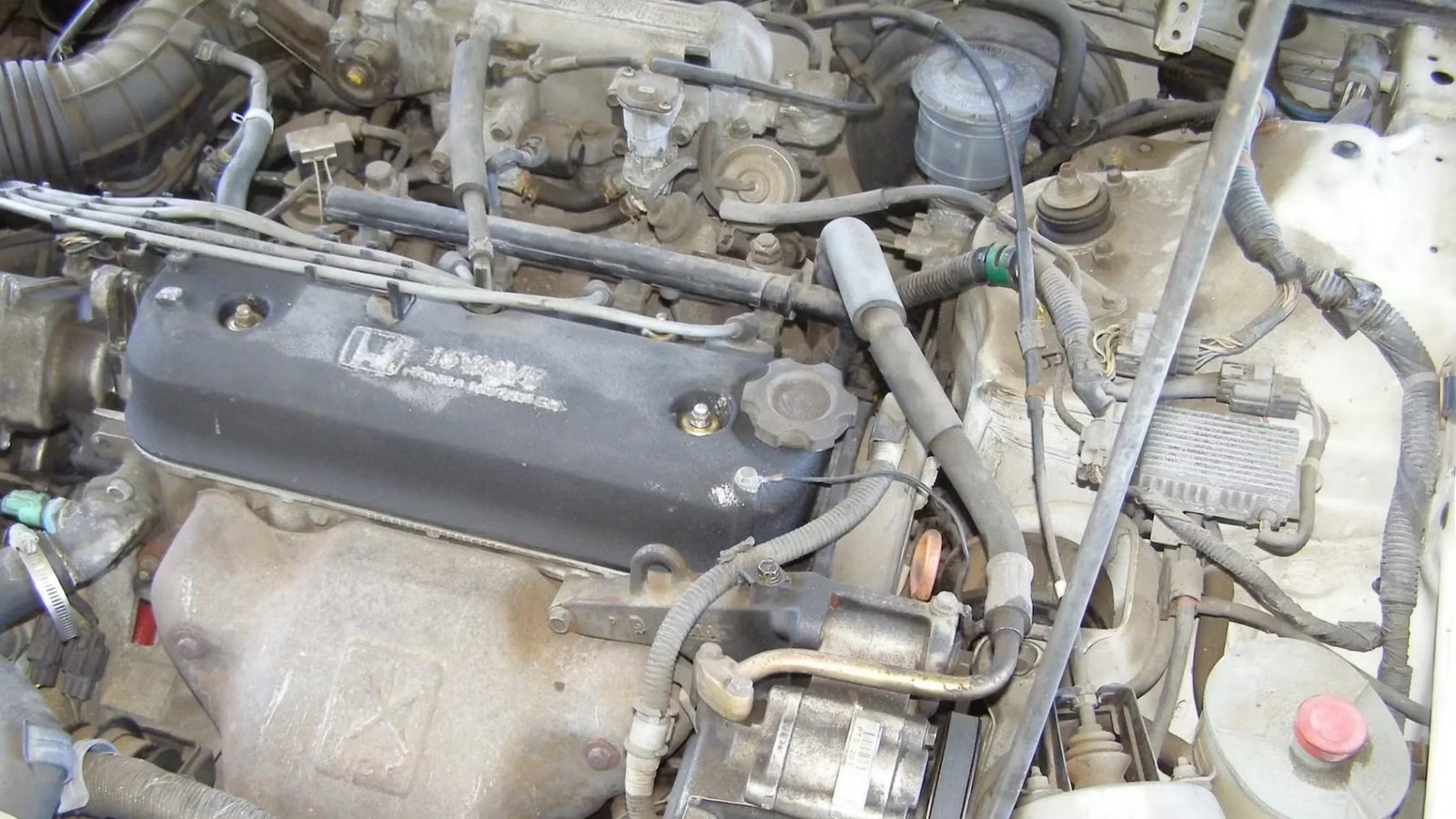
Ask any independent mechanic which engines they’d trust to run past 300,000 miles with nothing more than oil changes and basic upkeep, and the Honda F22A comes up almost every time. Found in 1990-1993 Accords, this 2.2-liter SOHC four-cylinder wasn’t fast, wasn’t flashy, and made a modest 125 to 150 horsepower depending on the year. But it became one of the most durable mass-produced engines of its era, on one condition. Miss that condition, and the same engine that shrugs off neglected oil changes can destroy itself in seconds.
The One Cheap Maintenance Job That Decides Whether It Lives Or Dies

There’s a single service item that separates an F22A with 300,000 trouble-free miles from one sitting in a scrapyard at 110,000, and that’s the timing belt. Everything else about this engine is remarkably forgiving. Owners have run it low on coolant, stretched oil change intervals, and ignored minor leaks, and the engine kept turning over. The timing belt is different. It doesn’t degrade gracefully or give a warning rattle before it fails; rubber and reinforcing cords simply reach the end of their fatigue life and let go, often without drama, usually without warning.
When that happens in the F22A, the consequence isn’t a stalled car and a tow truck bill. It’s a dead engine. The pistons and valves in this design share the same airspace at different points in the rotation, timed precisely by that belt. Snap it, and the valves stay open exactly when a piston is arriving at the top of its stroke.

The result is bent valves at minimum, and often a cracked piston or damaged head on top of that. A completely healthy, low-mileage engine can be turned into an expensive paperweight by a five-year-old rubber belt that nobody thought to check. This is the paradox mechanics keep circling back to. The same engineering simplicity that makes the F22A nearly indestructible against ordinary abuse is exactly what makes it merciless about this one component.

Why The Honda F22A Became The Blueprint For Bulletproof Commuter Engines

The engine responsible for this reputation is Honda’s F22A, a 2.2-liter single-overhead-cam four-cylinder that powered the fourth-generation Accord throughout the early-to-mid 1990s. It wasn’t engineered to impress anyone on a spec sheet. Output ranged from 125 horsepower in the earliest, lowest-state-of-tune versions up to 150 horsepower in the later F22A7 variant found in EX trims, modest numbers even by the standards of its own decade.
How The F22A Uses Restraint To Outlast Everyone Else

Honda built the F22A around a cast aluminum block, a single overhead cam actuating a straightforward valvetrain, and an output level far below what the architecture could theoretically handle. Every internal component—the bearings, the rings, the head gasket, the timing components other than the belt itself—operated well within its stress tolerance for the engine’s entire service life. Nothing was working close to its limit, which meant ordinary wear happened slowly and predictably instead of compounding into cascading failures.
This is why the early-’90s Accord became the default answer for anyone who needed cheap, reliable transportation: students buying their first car, commuters racking up highway miles, and small businesses running fleet vehicles into the ground. The car around the engine rusted, the interiors wore out, the transmissions occasionally needed attention, but the F22A itself kept running.

Independent mechanics interviewed about long-lasting engines consistently point to it as a benchmark, with routine examples clearing 250,000 to 310,000 miles on nothing more than oil changes, coolant service, and the timing belt done on schedule. Documented outliers have pushed past a million miles, though those cases typically involve owners who treated every maintenance interval as a hard deadline rather than a suggestion.
The Simple Engineering Choices That Helped This 2.2-Liter Four Reach 300,000 Miles And Beyond


Longevity like this doesn’t happen by accident, and it isn’t really about the Honda badge; it’s about specific decisions made when the engine was designed. The F22A’s displacement, 2,156cc, comes from an 85.0mm bore paired with a 95.0mm stroke, a configuration that favors low-end torque over high-rpm power. Engines tuned this way don’t need to rev hard to make usable power, which keeps piston speeds and internal loads lower across the engine’s typical operating range. An engine that spends its life turning at moderate rpm wears its bearings and rings far more slowly than one that’s routinely pushed toward redline.
The single-overhead-cam layout matters too, and not just because it’s simpler to build. Fewer moving parts in the valvetrain mean fewer things that can wear unevenly, fewer clearances that drift out of spec, and fewer failure points overall compared to more complex dual-cam or variable-valve-timing systems from the same era.
The cast aluminum block, meanwhile, handled heat more consistently than the iron blocks still common in domestic competitors of the period, reducing the thermal cycling stress that eventually cracked heads and warped blocks in less well-cooled designs. None of these choices were exotic or expensive. They were conservative, almost boring engineering decisions—the kind that don’t show up on a brochure but show up two decades later in an odometer reading.
The Timing Belt Myth That Still Misleads Honda Owners Today

Here’s where a lot of well-meaning advice online gets dangerous. The F22A is frequently and incorrectly described as a non-interference engine, one where a broken timing belt simply stops the car without damaging anything internally. That’s false, and it’s the single most consequential piece of misinformation still circulating about this engine. The F22A is an interference design. If the belt breaks or jumps time, the valves and pistons collide, and the resulting damage typically means a full head rebuild or a replacement engine.
On intervals, there are two figures worth knowing, and they’re not actually in conflict; they answer two different questions. Honda’s original service manual lists the OEM interval at 105,000 miles or seven years, whichever comes first, based on the belt’s expected fatigue life under normal conditions when the engine was new. But most independent mechanics today recommend replacing it closer to 60,000 miles, and that’s not overcaution for its own sake.

These belts are now three decades old at minimum, the rubber compounds degrade with age regardless of mileage, and the cost of being wrong is a destroyed engine rather than a stranded car. Treat 105,000 miles as the manufacturer’s baseline under ideal, new-parts conditions, and 60,000 miles as the realistic, conservative interval for an engine this age. Either way, “it’ll just stop running” is the myth that gets people stranded and their engines destroyed. Plan around interference, not around wishful thinking.
What Modern Turbo Engines Gained In Power, But Lost In Long-Term Durability

Compare the F22A’s approach to a modern turbocharged, direct-injection four-cylinder, and the trade-off becomes obvious. Today’s small-displacement turbo engines routinely make 250 to 300-plus horsepower from less displacement than the F22A’s 2.2 liters, using higher compression ratios, higher cylinder pressures, and turbochargers spinning at speeds that generate far more heat and mechanical stress than anything in a 1990s naturally aspirated engine ever saw. That power comes from running much closer to the material limits of the internals, all of the time.
The maintenance profile reflects that difference. Direct-injection systems are prone to carbon buildup on intake valves, which naturally aspirated port-injection engines like the F22A never dealt with. Turbochargers add oil-return lines, wastegates, and intercooler plumbing, more components, more seals, more potential failure points. Timing chains have largely replaced belts in modern engines specifically to eliminate the interference-belt failure mode, but chain tensioners and guides on some modern direct-injection engines have become their own well-documented, expensive failure point.

None of this makes modern engines bad; they’re dramatically more efficient and vastly more powerful per liter than anything from the F22A’s era. But that performance was bought with complexity, and complexity is precisely what the F22A’s designers deliberately avoided. A 30-year-old F22A with a timing belt on schedule remains a realistic daily driver today. Whether today’s turbocharged fours will still be doing that in 2056 is a question nobody can answer yet, and that uncertainty is the real cost of the horsepower gains.
Sources: Honda, Dagens.com, Engineguide.net, iSeeCars

Related posts





Latest Post


No Comments