
Honda Prologue: Inside the Honda-Rebadged Blazer EV
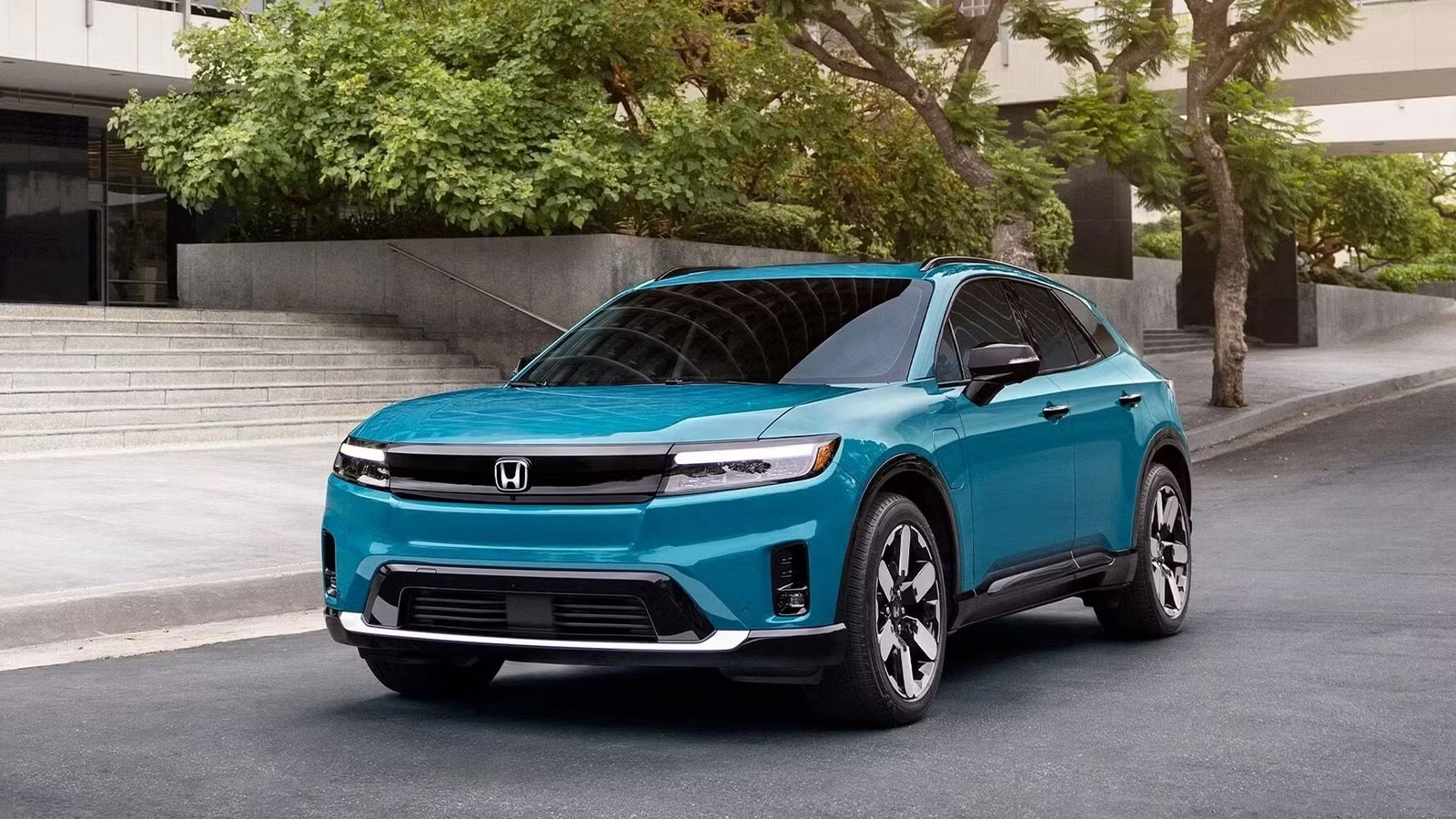
The Honda Prologue arrived in 2024 as an answer to an awkward problem. Honda needed an EV, fast, and didn’t have a dedicated platform ready. So it borrowed one. Built on GM’s Ultium architecture alongside the Chevrolet Blazer EV, the Prologue became Honda’s fastest EV solution, and its most scrutinized. With Honda now confirming the Prologue’s production will end after the 2026 model year, the platform-sharing question has taken on new weight. Here’s what’s genuinely Honda, what’s pure GM, and why the partnership didn’t last.
What Is the Ultium Platform and Why Does It Matter?

Ultium is General Motors’ modular EV architecture, a flexible skateboard chassis and battery system designed to underpin everything from the budget-friendly Chevy Equinox EV to the 615-horsepower Blazer EV SS. Rather than build its own EV platform from scratch under time pressure, Honda struck a deal with GM to co-develop the Prologue and its Acura ZDX sibling on this existing foundation, borrowing Ultium’s battery packs, motors, and core electrical architecture while wrapping it in Honda-specific sheet metal, cabin design, and software.

At the time, this made strategic sense. Honda’s own EV architecture, the one underpinning the since-shelved 0 Series concepts, wasn’t ready for volume production, and regulatory pressure demanded a Honda EV in showrooms quickly. The Prologue was conceived as a bridge model, buying Honda time while its in-house EV program matured. That bridge, it turns out, had an expiration date. Honda and GM ultimately abandoned plans to co-develop EVs beyond this initial batch, and Honda’s broader EV roadmap has since shifted dramatically toward hybrids instead.
How Honda Tuned the Prologue Differently From the Blazer EV


Sharing a platform is not the same as sharing a driving experience, and Honda’s engineers did real work here. Editors have noted that the dual-motor Prologue delivers more compliant suspension tuning than the Chevy Blazer EV, alongside a roomier cabin feel and peppy acceleration, differences owners can feel even if they can’t see them on a spec sheet. Honda also fitted its own Sensing suite of driver-assistance features, distinct interior materials and switchgear, and its own infotainment layer, running Google built-in software through an 11.3-inch touchscreen, smaller than the Blazer EV’s 17.7-inch display, but paired with standard wireless Apple CarPlay and Android Auto—something Chevy’s system notably lacks.

The two SUVs diverge more sharply once you get into powertrain specifics. Where the Blazer EV spans a huge range from a 220-hp front-wheel-drive base model to the 615-hp SS performance flagship, the Prologue sticks to a narrower band. A 220-hp single-motor FWD setup or a 300-hp dual-motor AWD system. That’s a deliberate choice; Honda positioned the Prologue as a sensible family SUV rather than a performance halo car, leaving the Blazer EV to chase enthusiasts with its SS variant. Even the efficiency numbers tell a story of fine-tuning rather than duplication. The Blazer EV edges the Prologue slightly in city and highway MPGe, a near-identical result that confirms both vehicles share the same underlying hardware, just calibrated with different priorities.
Range, Charging, and Battery Reality

Honda’s own EPA figures put the Prologue’s range at up to 308 miles, achieved by the FWD Touring trim, thanks to an 85-kWh battery pack. Configuration matters a lot here, as adding the dual-motor AWD system or stepping into heavier trims brings that number down toward 283 miles for the Elite. Real-world numbers rarely match EPA figures exactly, third-party estimates suggest highway range at 70 mph runs meaningfully below the EPA rating, and cold-weather driving can cut range further still, a caveat that applies to virtually every EV on sale, not just the Prologue.

Charging infrastructure is one area where Honda leaned entirely on GM’s engineering rather than building anything proprietary. DC fast charging tops out around 155 kW, enough to take the battery from roughly 20 to 80 percent in about 35 minutes, or add around 65 miles of range in just 10 minutes on a suitable charger. For 2026, Honda sweetened the ownership proposition by making a Portable Charging Kit standard equipment and offering buyers a choice between a wall-mounted home charging station with an installation incentive, or a sales credit toward the purchase price. What Honda didn’t inherit from GM is Super Cruise-style hands-free driving or Tesla Supercharger network access baked in from the factory; those remain Chevy-side advantages within the same Ultium family.
Prologue vs. Blazer EV vs. the Competition

Pricing places the 2026 Honda Prologue in a crowded middle ground. Honda’s lineup runs from around $40,000 for the base EX trim up to about $50,000 for the range-topping Elite AWD, while the Blazer EV starts slightly higher but climbs much further, topping out well north of $60,000 for the 615-hp SS. In other words, buyers pay a premium for GM’s performance ceiling, while Honda’s lineup stays tightly focused on practical trims without an equivalent halo model.

Against the wider EV field, the Prologue looks squarely average. The Tesla Model Y starts in the low $40,000s, with EPA range around 320 miles, beating the Prologue on both range and, depending on configuration, price. Hyundai’s Ioniq 5 undercuts everyone at the entry level, with its base Standard Range trim starting in the high $30,000s and delivering around 245 miles, while pricier Ioniq 5 trims stretch past 300 miles. None of this makes the Prologue a bad SUV; it’s competitively specced and comfortably equipped, but it doesn’t win outright on range, price, or performance against any single rival. Its case rests on Honda’s dealer network, reliability reputation, and a driving experience that feels more composed than the Blazer EV without demanding a price premium to get it.
Addressing the Controversy: Sales, Discontinuation Rumors, and Longevity

Honda confirmed to multiple outlets that the Prologue will conclude sales later this year, following completion of the 2026 model year, with sales continuing into 2027 based on remaining dealer inventory. The company has committed to ongoing service, parts, and warranty support for existing owners, but production itself is ending.
The sales trajectory explains why. The Prologue launched strongly, with more than 33,000 units sold in its first year, 2024, quickly making it one of the top-selling non-Tesla EVs, and momentum carried it to more than 39,000 units in 2025. But demand collapsed after the federal EV tax credit expired in September 2025; by the first half of 2026, sales had fallen sharply year over year. Over its full run, Honda still moved a respectable number of Prologues through dealers, well over 80,000 units, a figure that undercuts any narrative of the vehicle as a flop, even as it wound down.

The bigger story is Honda’s wholesale retreat from battery-electric vehicles in the U.S. The Acura ZDX, the Prologue’s GM-based cousin, was axed the previous September, and Honda has since canceled the Acura RSX EV and shelved its ambitious 0 Series concepts before they reached production. With the Prologue gone, Honda’s U.S. lineup will not include a single battery-electric vehicle, leaving hybrids, where the CR-V Hybrid and Accord Hybrid already account for a majority of those models’ sales, as the brand’s electrification strategy going forward. Whether that’s a temporary retreat or a longer-term repositioning depends on how quickly EV demand recovers and whether Honda’s proprietary architecture eventually reaches market.
Should You Buy a Prologue, and What’s the Ownership Experience?

For buyers shopping right now, the calculus has shifted. A discontinued model typically means dealer incentives get more aggressive as inventory needs to clear, and that’s already visible; several current listings show Prologues selling several thousand dollars under MSRP. That’s good news for someone who wants Honda styling, a comfortable ride, and a warranty-backed EV without needing the vehicle to remain in production long-term, since Honda has pledged continued parts and service support regardless of the model’s active-sales status.

The tradeoffs are real, though. There’s no federal tax credit cushioning the price anymore, since that incentive lapsed for EVs in September 2025, so the Prologue has to compete on its own merits against similarly priced gas and hybrid alternatives, including Honda’s own CR-V Hybrid, which now outsells it by a wide margin. Buyers should also factor in resale value uncertainty that comes with any discontinued nameplate, along with the reality that this is fundamentally a GM powertrain wearing a Honda badge, serviced through Honda’s network but built on someone else’s engineering foundation. Early ownership feedback has generally been solid on reliability, with the shared Ultium hardware benefiting from GM’s broader production experience across the Equinox EV, Blazer EV, and Cadillac Optiq. For a buyer prioritizing comfort and Honda’s dealer footprint over having the newest EV on the block, the Prologue remains a reasonable, if now historical, choice.
Sources: Honda U.S., CarBuzz, KBB & Jalopnik

Related posts


Latest Post


No Comments