
The Older Cruiser That Still Has Everything Riders Actually Want
In 1956, Harley-Davidson engineers faced a challenge. The K-model’s side-valve V-twin was getting outrun by the overhead-valve Triumphs and BSAs of the time, crowding into the American market. These were lighter bikes making more power from less displacement. The fix, launched in 1957, was a new overhead-valve Sportster, badged XL for “eXperimental Lightweight,” built specifically to go up against the British onslaught. The intent to build a lighter, more powerful cruiser has scattered across seven decades since, and finally gave birth to a cruiser that got everything right for a rider and then some.
The Journey From An 883cc To A 1,200cc Cruiser Platform

Fast-forward a few decades, and Harley bumped the Ironhead from 883cc to 997cc in 1972, chasing more midrange grunt so the Sportster could finally match the bigger British twins off the line. The bike’s styling, on the other hand, only caught up seven years later. The 1979 XLS 1000 Roadster, considered among the best Sportster models made, kept the sportier chassis but dressed it in chopped fenders and a staggered exhaust. With this new stretched-out look, riders started buying it as a local cruiser rather than the sport-touring machine Harley had pitched it to be.
That’s when the Sportster stopped being purely a performance-focused answer to the British, and began developing into its modern form. The Evolution engine arrived in 1986 and reset the platform yet again. It was first offered in 883cc and 1,100cc form with improved reliability over the older Ironhead. Two years later, Harley stroked the bigger engine out to 1,200cc for more low-end torque. And by the mid-1990s, the 1,200cc engine had its own dedicated cruiser trim built around it.
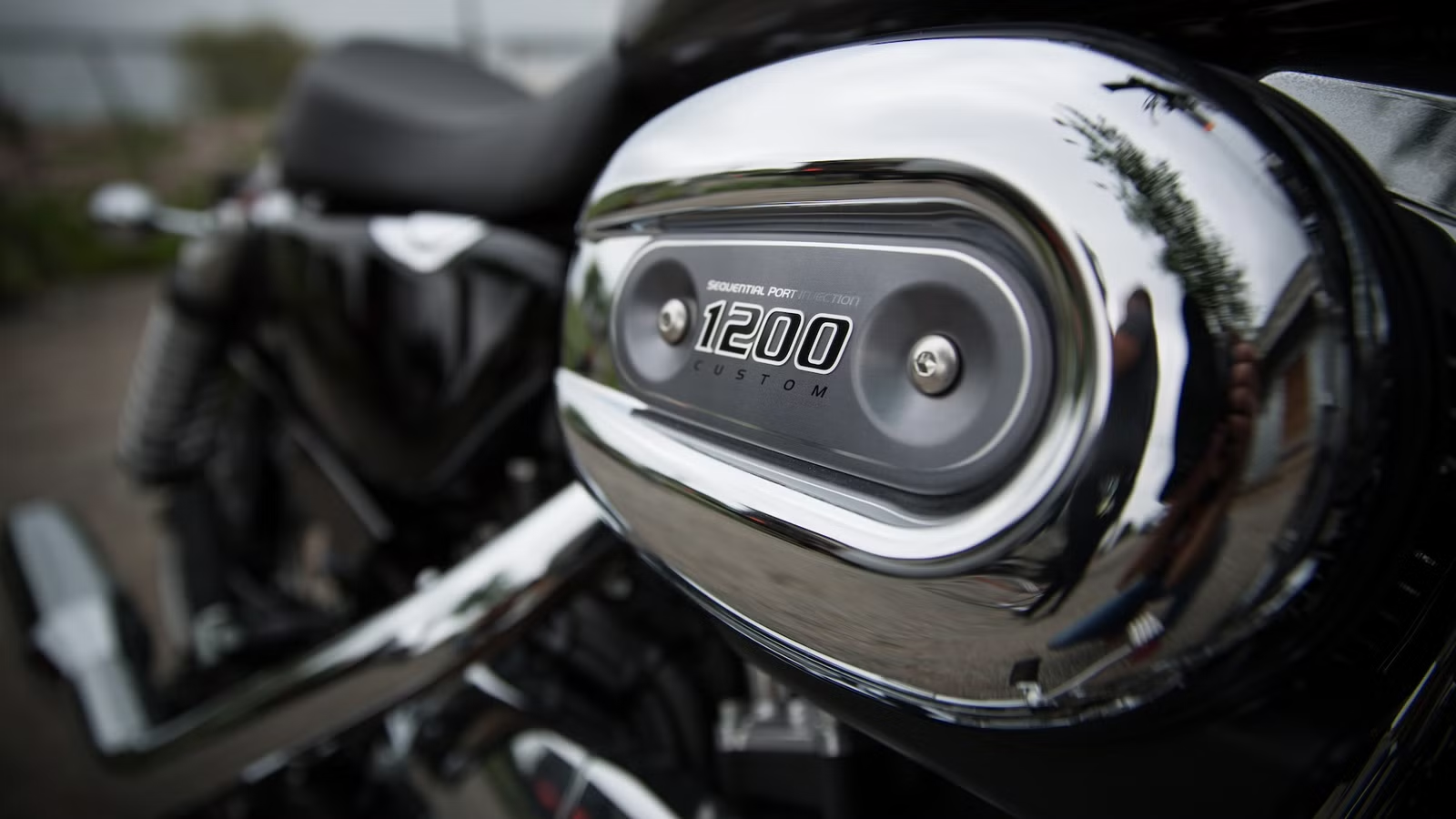
The Harley-Davidson Sportster 1200 Custom Is The Cruiser That Already Had It All


The Harley-Davidson Sportster 1200 Custom, badged XL1200C, spent twenty-five years, from 1996 to 2020, being exactly the cruiser most riders picture as a stripped-out but practical daily rider. Harley refined the mechanics underneath it along the way, adding rubber engine mounts in 2004 and fuel injection in 2007, but the silhouette remained. Wrapped around the big air-cooled Evolution V-twin that practically saved Harley from bankruptcy. A quarter-century is a long time for a formula to go untouched, and the only real explanation for it is that Harley got it right the first time around.
The 1,202cc Evolution V-Twin

Underneath the tank of the XL1200C sat the same engine architecture that Harley introduced in 1986, with a 45-degree, air-cooled V-twin that used two pushrod-actuated valves per cylinder. The cylinders themselves were finished in cast aluminum to keep things light. At 1,202cc, it’s rated at 73 lb-ft at 3,750 rpm, run through a five-speed gearbox and a belt final drive. That torque arrives low and stays flat to offer a progressive build-up of revs, making it ideal for just about any kind of riding scenario the road could throw at it.
Confidence-Inspiring Riding Position With Basic Underpinnings

Wide 16-inch wheels front and rear used fat tires that made it look distinct from the usual skinny front and fat rear tire look of the era. Ground clearance was a modest 4.1 inches, but tight enough to just about clear the pegs around a bend. At 591 pounds ready to ride, it carried heft, but aided by the low seat height of 26.6 inches, it gave the rider enough confidence to handle it while standing still. On the move, however, handling was a whole different story, along with other issues that may make one think that Sportsters are overrated.

There were gripes like the basic suspension, which used 39mm forks up front with about 4 inches of travel and preload-adjustable coil-over shocks offering barely 2 inches, were just not enough to cover broken roads. The vibey Evolution motor was another pain point, coupled with the heat it generated, and the brakes were subpar too.
Low-Maintenance Ownership And Aftermarket Support Make It Relevant Even Today

Nevertheless, the Sportster was more about mechanical simplicity than perfection. The reliability of the Evolution 1200 comes from the lack of electronics, so it’ll never need a software update to keep being relevant in your garage. Oil changes, primary chain adjustment, and spark plug swaps are jobs that most owners can handle in a home garage. And that kind of simplicity is what made riders pick up the Sportster more often than its siblings.

A quarter-century of production also means that the aftermarket is a thriving haven of parts and accessories to literally build your own version of the Sportster. Exhaust systems, air cleaners, seats, handlebars, and performance kits existed for nearly every year of the Custom’s run. Parts interchange freely within each generation of the platform too, as the engine internals and controls carried across most of the rubber-mounted era from 2004 to 2020. All of this still holds true, and it’s precisely why you’d want to hunt for a used Sportster.
Low Used Prices Still Make This An Easy Buy

The Evolution engine has produced some fine Harleys like the XL1200C, and a clean, used one isn’t hard to find, nor is it expensive. Listings on AutoTrader for the 1200 Custom currently run from roughly $4,990 up to just under $9,000, averaging around $6,822 across the used market. Cycle Trader’s broader Sportster 1200 category tracks close to the same numbers (between $3,500 and $9,000). That’s a fraction of what a new Sportster costs today, and it even undercuts what the Custom itself was worth when it was new. The 2018 model carried an MSRP of $10,999 for a solid color, $11,549 for two-tone paint, already well under the Sportster S’ starting price of $15,999.
The 1200 Custom Against Other Traditional Cruisers

Harley’s own Iron 883 is the closest in-house comparison. Stripped to a peanut tank, blacked-out finishes, and a smaller 883cc Evolution twin, the Iron carried an $11,249 MSRP in its final 2022 model year. It now trades on the used market for roughly $3,000 to $12,000, with most examples landing between $5,000 and $8,000.

Kawasaki’s Vulcan 900 Classic is the closer match on intent. It’s still in production, currently listed at $9,599, and built around a 903cc V-twin with a classic pulled-back cruiser silhouette. Buying new also means that a warranty is in place from day one, something that a used 1200 Custom can’t offer without a gamble on its individual service history.

Then again, a well-kept example splits the two, offering you more engine and more presence than the Iron 883, a lower buy-in than a new Vulcan, a cherished history of the name, and a solid foundation for any customization you have in mind. Its reliability and simplicity are more than appreciated in the increasingly chip-controlled bikes of today, and despite some of its shortcomings, the 1200 Custom still has everything that a rider would want today.
Source: Harley-Davidson

Related posts

Latest Post


No Comments