
The Supercharged V8 That Lost 77% Of Its Value In A Decade
The decline of British sports cars and the overarching automotive industry stems from widespread labor unrest, poor management, and weak quality control during the twentieth century. Consolidation under state-backed entities like British Leyland produced vehicles with persistent mechanical defects, electrical faults, and corrosion issues. These manufacturing missteps severely damaged the global reputation of British carmakers.

Today, this legacy persists. Modern buyers associate British luxury vehicles with high maintenance expenses, complex electrical systems, and expensive replacement parts. As a result, these automobiles face aggressive depreciation curves. High ownership costs and lingering reliability concerns suppress pre-owned demand, directly causing poor value retention rates across the secondary market.
How British Depreciation Compares To Other European Brands
The used car market features dramatic pricing divides. A ten-year-old Audi R8 with a high-revving engine still commands double its original value on used listing sites. High-performance German alternatives like the BMW M8 hold value far better over time. Meanwhile, British performance brands like Jaguar see their value decline on a steep curve.

The market punishes British luxury vehicles far harder than German competitors. High-mileage pre-facelift cars approaching 100,000 miles hit the bottom of the pricing scale. This steep drop reveals the massive contrast between initial luxury pricing and secondary market reality.
The Jaguar F-Type Fails To Hold Its Value Well

The Jaguar F-Type is a prime example of a premium British sports car that fails at maintaining a good resale value. It experiences an aggressive depreciation curve, losing approximately 50 percent of its original retail value within the first three to five years and up to 69 percent over a ten-year period. The final model year 2024 F-Type demonstrates this steep drop clearly. Base 2024 P450 trims with original starting prices around $77,000 now command used values between $48,000 and $54,000.
Top-tier 2024 P575 models with original sticker prices exceeding $116,000 trade between $70,000 and $77,000. The broader pre-owned market currently spans from a minimum of $23,000 for early high-mileage 2014 V-8s up to $77,000 for late production variants. Standard four-cylinder and V-6 variants continue to lose value over time, but late-model 2024 V-8 iterations flatten along their depreciation curve as driving enthusiasts pursue the final internal-combustion sports cars from the brand.
One Of The Best V-8s You Can Experience Today

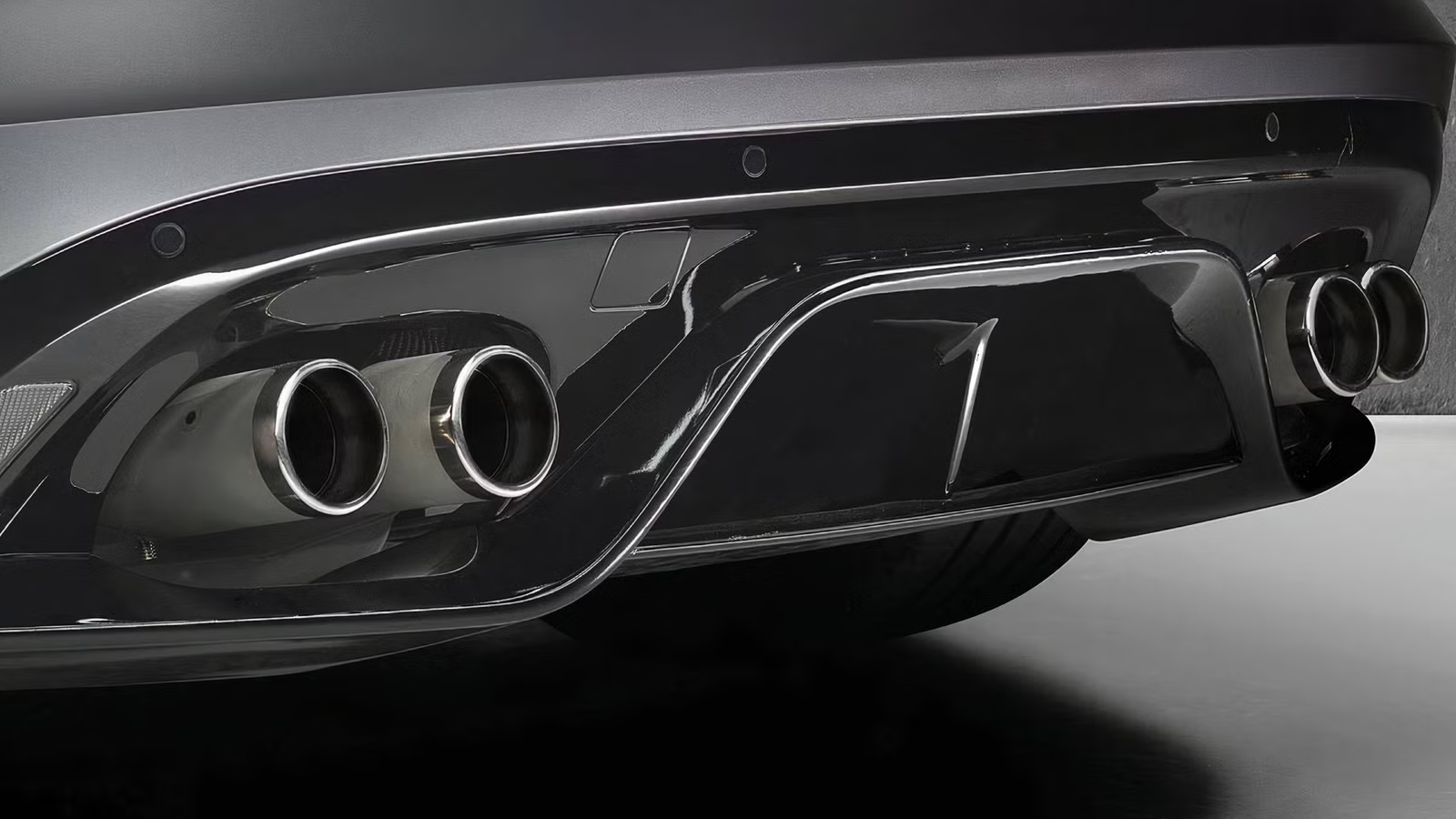
The heart of this British sports car is its 5.0-liter supercharged V-8 engine. Jaguar introduced the vehicle for the 2014 model year, featuring an aggressive exhaust note and immediate throttle response. The launch V8 S model produces 495 horsepower. Jaguar quickly escalated the performance war with later iterations. The upgraded R trim increases output to 550 hp. The hardcore SVR variant reaches 575 hp.
Performance metrics match the aggressive figures. The V8 R model accelerates from 0 to 60 MPH in just 3.5 seconds. Power transfers through a fast-shifting eight-speed automatic transmission. Early rear-wheel-drive V8 S models offer raw, untamed handling. Later high-output trims standardize all-wheel drive to keep the supercharged torque under control.
Understanding The F-Type’s Poor Value Retention Rates

The F-Type’s drastic price drop stems directly from known reliability concerns. Prospective buyers often fear British electronics and cooling systems. These specific mechanical issues lower secondary market values significantly. Cooling system failures pose a major threat to the 5.0-liter V-8 engine.
Plastic coolant pipes under the supercharger become brittle with age and heat cycles. These pipes crack, leak fluid, and cause rapid engine overheating. Replacing these components requires removing the entire supercharger assembly. Electrical glitches also plague the cabin and dashboard modules. Infotainment screens freeze or reboot unexpectedly. Door handle mechanisms stick, and body control modules draw excess battery power when parked. These recurring failures intimidate average buyers, causing market values to crash.
The F-Type Owners Know What They’re Getting Into

Buying a cheap supercharged sports car like the Jaguar F-Type requires realistic budgeting. The entry price may match a basic daily driver, but component costs reflect the original six-figure price tag.
Owners should budget between $1,441 and $1,500 annually for routine maintenance and unexpected repairs. Premium fuel consumption adds to running expenses. The supercharged V-8 consumes significantly more gasoline than four-cylinder or six-cylinder variants.
Brake replacements, high-performance tires, and specialized fluids carry luxury price premiums. Replacing worn suspension bushings or active exhaust valves adds thousands to upkeep costs. Buyers who fail to set aside dedicated repair funds face painful ownership experiences.
The F-Type’s Value Will Keep Plummeting

The used market now offers unprecedented access to a supercharged British GT. The extreme price collapse has reached its floor. Well-maintained V-8 models are unlikely to depreciate much further. The market now recognizes these vehicles as future classics. As Jaguar transitions to an all-electric lineup, demand for supercharged V-8 coupes will remain steady. Base models may struggle to gain value, but clean R and SVR trims will likely appreciate over time.
Purchasing a mid-$20,000 example requires clear financial expectations. Buyers who respect the $1,500 annual maintenance budget and address cooling weaknesses gain an extraordinary performance machine. It delivers exotic looks, supercar acceleration, and an unmatched exhaust note for the price of an ordinary commuter car. The 2024 Jaguar F-Type currently holds a 4.6/5 overall score on the Edmunds consumer review section. Noteworthy strengths include its visual appearance, driving experience, and audio system.
How To Find The Right F-Type For You

Navigating the pre-owned market requires isolating desirable trims from problematic years. The model range features diverse power plants, but value retention varies wildly across the lineup. Base four-cylinder and V-6 models anchor the bottom of the value curve. These variants lack the iconic sound and straight-line speed of the V-8, making them less desirable to collectors.
The 2014 to 2015 V8 S represents the ultimate performance bargain. It offers rear-wheel drive and 495 hp at the lowest purchase price. The F-Type R balances refined all-wheel-drive traction with 550 hp. The range-topping SVR features lighter titanium exhausts and unique aerodynamic bodywork. The SVR and late-model R variants hold the best value due to their rarity and performance capability.
On the reliability front, iSeeCars gives the 2024 F-Type a 7.2/10 reliability score, indicating that you can expect an average lifespan of 13.7 years or 79,642 miles. The publication also indicates a zero percent probability of reaching 200,000 miles.
Keeping Your F-Type In Pristine Condition

Jaguar specifies maintenance for the F-Type V-8 at intervals of 12 months or 16,000 miles, whichever comes first. Standard annual service includes synthetic engine oil and filter replacements, brake fluid checks, and multipoint inspections. Routine annual service costs between $600 and $900 during early ownership years. Major service milestones occur every 32,000, 60,000, and 100,000 miles. These larger service events require spark plug replacements, new air and cabin filters, and cooling system flushes. Major maintenance visits increase yearly upkeep costs to between $1,200 and $2,000 as the vehicle ages. Cumulative ten-year maintenance and repair expenses total roughly $14,000 for owners.
Multiple active safety recalls affect specific model years across the F-Type range. Seat belt pretensioners and locking retractors on 2021 and 2022 models present restraint risks during crashes. A software fault on 2020 models disables anti-lock braking and stability control systems during vehicle startup. Improperly manufactured crankshaft pulley bolts on 2019 V-6 and V-8 models cause pulley bolt fractures and sudden engine failure. Other recalls address fuel rail end-cap leaks on four-cylinder engines, incorrect tire pressure labels, and lighting circuit faults. Authorized Jaguar dealers inspect and perform all recall repairs free of charge for owners.
Cautionary Issues That You Need To Be On The Lookout For
Finding a solid used example requires rigorous pre-purchase inspections. Buyers must look past shiny paint and verify mechanical health before purchasing. Be sure to inspect the cooling system. Removing the engine cover reveals early signs of coolant leaks around plastic crossover pipes. Technicians should pressurize the cooling system to locate hidden hairline cracks.
Second, test all interior electronics thoroughly. Verify the motorized air vents rise smoothly from the dashboard. Check the central touchscreen interface, instrument cluster displays, and power seats. Inspect the rear differential for fluid leaks, as early units suffer from active differential seal failures.
Finally, examine service records closely. Consistent oil changes every 5,000 miles prevent expensive timing chain wear. Cars with documented maintenance command higher prices, but they help reduce major mechanical risks.
Jaguar’s Questionable Anti-V-8 Strategy

Automotive history gives this supercharged sports car special significance. The year 2024 marked the official end of internal combustion F-Type production. Jaguar is now pivoting entirely toward an electric vehicle future. This transition transforms the supercharged V-8 into the final chapter of traditional British sports car heritage. It represents the last analog performance vehicle from a brand with a legendary racing history.
Electric vehicles offer seamless acceleration, but they lack the mechanical soul of a supercharged engine. The sharp supercharger whine and popping exhaust notes cannot be replicated by synthetic sound generators. This mechanical character ensures long-term appeal among driving purists.
Sources: Jaguar, RepairPal, iSeeCars, Edmunds, and the NHTSA.

Related posts



Latest Post


No Comments