
The Rarest Muscle Car You’ve Never Heard Of Was Canadian
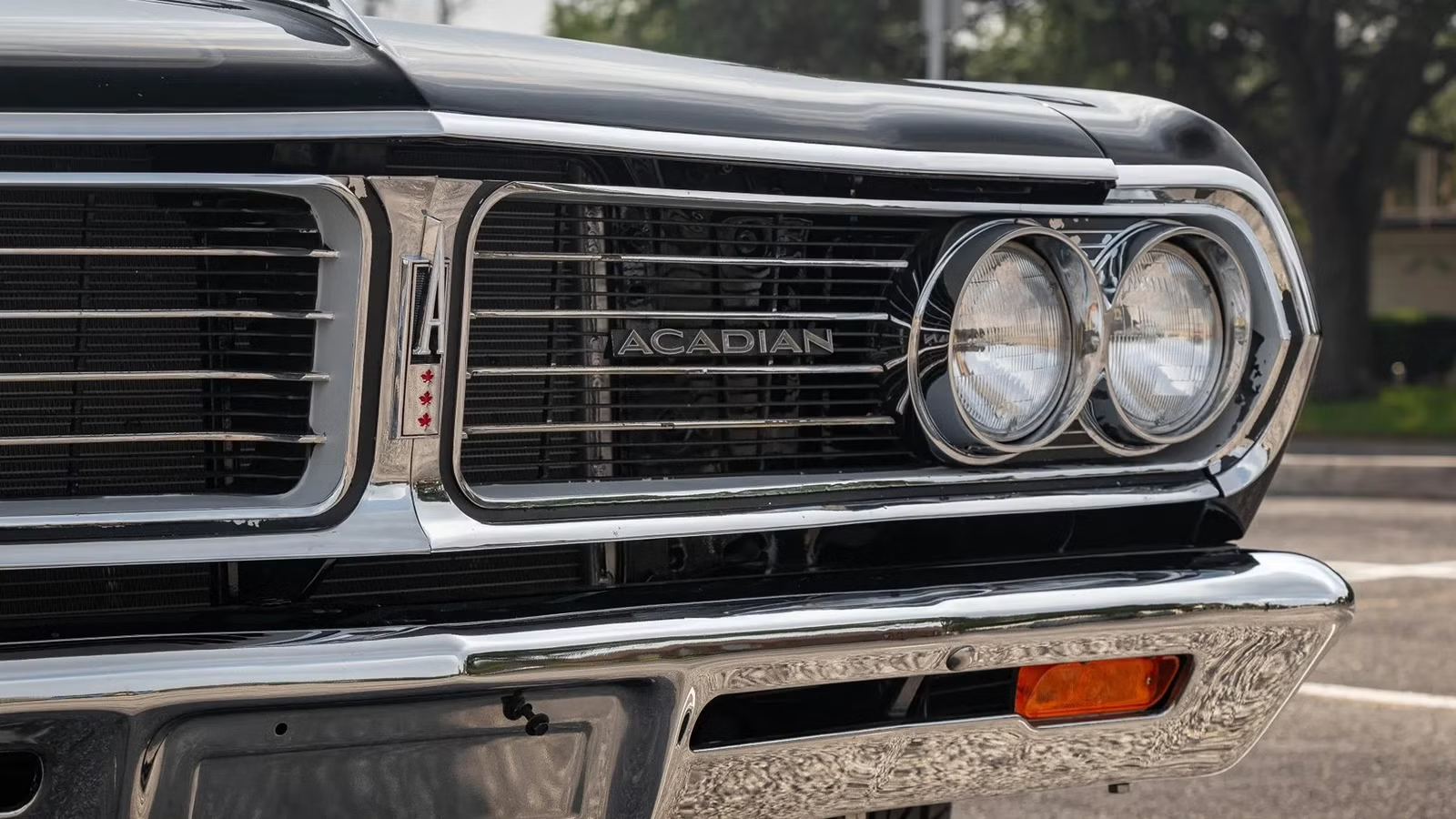
At a crowded classic carmeet, you walk up to a low-slung, mid-sixties car that looks like a Chevrolet Chevelle SS with a sweeping roofline and aggressive haunches. As you step closer, you will be left a bit confused, as the front reveals a Pontiac split grille with a chrome maple leaf badge. Get behind the driver’s seat. You will see a Pontiac Tempest instrument panel, with a Chevrolet 396 tucked under the hood. Well, this Frankenstein of a car sat right in front of you. Was it a special one-off from Detroit or a secret muscle car from Canada?
How Import Tariffs Accidentally Created Canada’s Rarest Muscle Car

To get to know this hybrid concoction better, we have to take a look back at how Canada treated imported American cars during the early 1960s. Back then, Canada slapped heavy trade tariffs on vehicles that were fully built and manufactured in America. If a Canadian enthusiast wished to have a taste of the sweet American muscle V8, a massive financial penalty was sure to follow in the form of import fees.
A massive financial penalty was sure to follow in the form of import fees to get the car across the border. No doubt this created a losing situation for General Motors of Canada. You see, in the US, Chevrolet and Pontiac operated as fierce competitors with distinct dealership networks.

Meanwhile, in Canada, because the market was considerably smaller, dealerships frequently combined franchises into unified Pontiac-Buick-GMC showrooms. When a Canadian dealer wanted to sell a high-performance legend like a Pontiac GTO, it directly meant passing the tariffs straight to enthusiasts.

By 1965, a Pontiac GTO imported from the US was around $3,982 CAD, and a domestically assembled model was around $3,000 CAD. The nearly $700 CAD difference was massive for the time. The price gap would have been enough to drive muscle car enthusiasts straight to rival showrooms at Ford and Chrysler dealerships. General Motors knew that it had to find a quick workaround to keep the buyers in-house.
How GM Combined Chevelle Hardware With Pontiac Trim In Oshawa

So General Motors decided to pursue a unique solution designed for the Canadian market: it created a series of hybrid brands directly on Canadian assembly lines in Oshawa. By using local labor and domestic steel, General Motors completely bypassed import tariffs while keeping its Canadian Pontiac-Buick dealers packed with high-performance muscle.
This strategy gave birth to two distinctly Canadian-only brands: the Acadian, a compact line for local Pontiac dealers serving as their own version of the Chevy II and Nova. And the Beaumont, which was initially offered as a trim level for the Acadian but later spun off into its own standalone mid-size brand built on Chevrolet’s intermediate A-body.
Manufacturing was a cross-brand effort: on the structural side, General Motors supplied a complete Chevelle A-body platform, including the frame and floor pans, heavy-duty suspension geometry, and full driveline options. On the styling front, the design featured distinct Pontiac elements, including split front grilles and Tempest dashboards, unique rear tail lenses, and custom maple leaf badging, all assembled on the Oshawa assembly floor.
Canada’s Chevelle SS: Big-Block Power In A Pontiac Shell

The result of the cross-engineering was the Beaumont SD 396. It became Canada’s muscle heavyweight in the big-block horsepower wars across North America. Underneath the long, sculpted hood sat Chevy’s 396-cubic-inch Mark IV big-block V8, named the “Econo-Jet” in Canadian sales magazines. Enthusiasts could pair the big V8 with a floor-shifted Muncie four-speed manual or a heavy-duty Turbo Hydra-Matic 400 three-speed automatic, putting down power through a rugged Chevrolet 12-bolt rear differential.
The Beaumont was not just an appearance package; it had the performance to match. According to road tests conducted at the time, the Beaumont SD 396 ran the 0 to 60 mph sprint in 7.6 seconds and completed the quarter-mile in 15.4 seconds at 92 mph, a blistering time for the mid-1960s.
There has been an ongoing dispute among historians regarding the horsepower figures for the Beaumont’s factory rating. The factory records and production sheets from the Oshawa plant differed from the US Chevrolet documents.

There are two documented versions: the LS3 396 V8 (standard) rated at 325 horsepower and the L34 396 V8 rated at 350 horsepower thanks to a higher-lift camshaft and quad-carburetion. Where the legend grows is that some catalogs suggest a 375-horsepower L78 396 was produced in a small batch of special-order Beaumonts. However, based on official sources, it is certain that the vast majority of cars that left the Oshawa plant were rated at 325 or 350 horsepower.
Beaumont SD 396 Production Numbers And The 1965 Auto Pact

Because the Beaumont SD 396 was created specifically for the Canadian market to circumvent tariffs, production numbers remained lower than anything that came out of Detroit. At the same time, Chevrolet cranked out tens of thousands of Chevelle SS 396s every single year. In 1968, a total of 66 Beaumont Convertibles were assembled, along with an estimated 370 total units of the Acadian Canso Sport Deluxe. And for Beaumont, under 2,000 total units across all body styles throughout its production years.
The final blow for Canadian-made muscle came in the form of the 1965 Automotive Products Trade Agreement (the Auto Pact). The cross-border trade treaty essentially eliminated tariffs on motor vehicles and components, which meant the financial reason for building unique, Canadian-specific vehicles vanished. By 1969, General Motors had phased out the Beaumont nameplate completely and opened Canadian showrooms to the standard imported Chevrolet Chevelles and Pontiac LeMans models.
Why The Beaumont SD 396 Is A Classic Muscle Car Grail Today

For decades after its demise, the Beaumont SD 396 has suffered a unique misunderstood identity. Buyers assumed they were just cosmetically modified Chevelles and nothing more, unaware of their history and rarity. Unaware of their history and rarity. Many American hot-rodders stripped these Canadian A-bodies for the Chevelle frames and discarded the rest.
Today, the sentiment has turned dramatically. Vintage car collectors and enthusiasts now recognize the Beaumont SD 396 for what it truly has to offer. It was an ultra-rare, factory-made hybrid that came out of necessity and became a distinct cult classic for a specific period. It delivered classic Chevelle SS big-block muscle wrapped in a Pontiac shell, making it one of the most historically rich and rare “hidden in plain sight” secrets in North American automotive history.
Source: Beaumont automobile, GM, Bring a Trailer, Mecum Auctions.

Related posts





Latest Post


No Comments