
Genesis Built A 641-HP Drift-Mode EV For Less Than A BMW M3
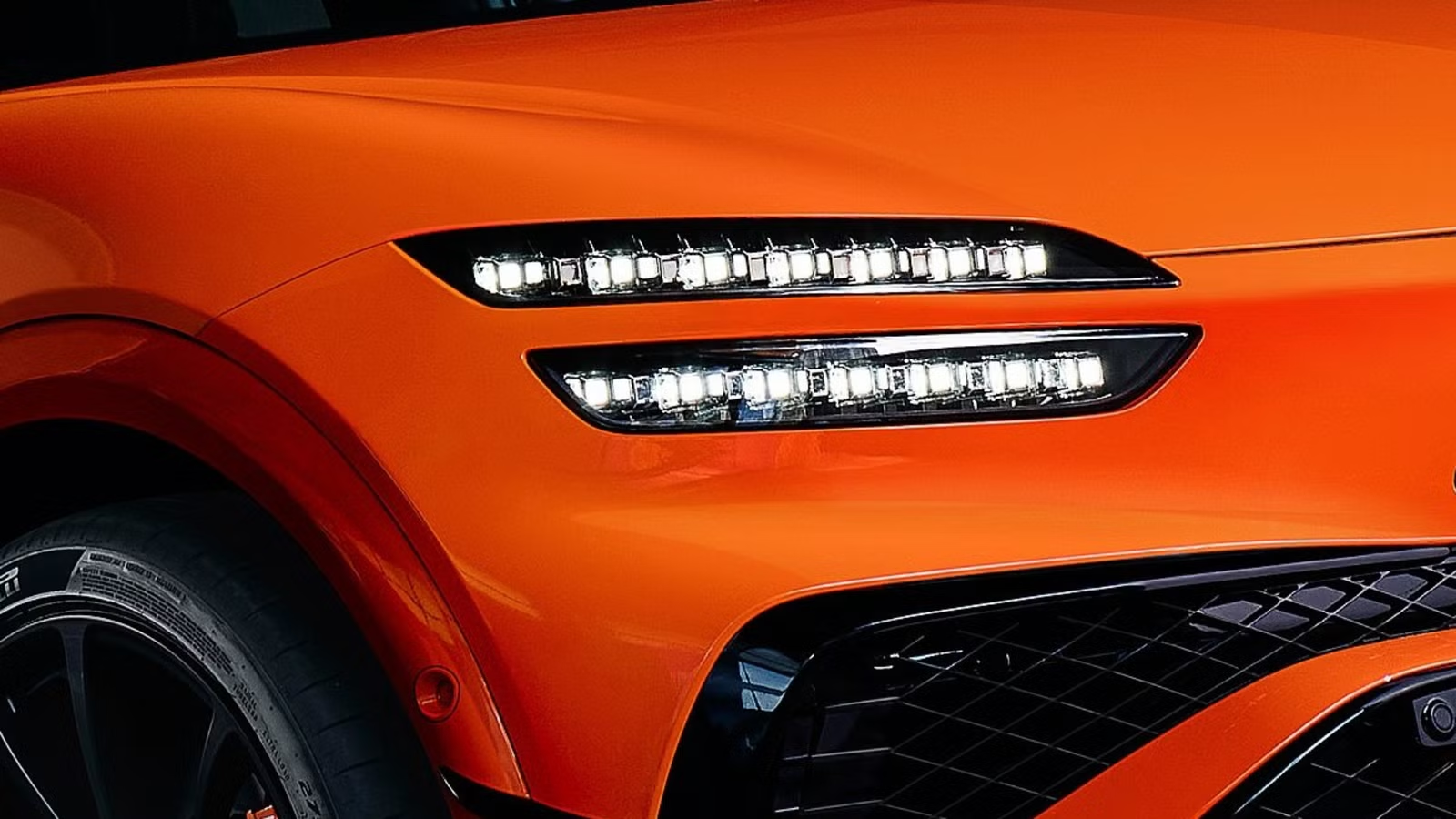
Roughly $70,000 has never bought much of a shortcut in the performance world. It gets you into the lower rungs of a German sports sedan lineup, or an electric crossover that costs more than its gasoline equivalent and delivers less range.

This new Genesis makes 641 horsepower, claims 3.4 seconds to 60 mph, and includes a drift mode straight from the factory, all for less than the cheapest BMW M3. A Korean luxury brand’s first performance car undercuts the M3 by more than $9,000 while out-powering the most expensive one. The catch isn’t the price.
What $70,000 Usually Buys In The Performance World
BMW asks $79,300 for the 2027 M3 Sedan, and that buys 473 hp and a claimed 4.1 seconds to 60 mph. The M3 Competition costs $83,500 for 503 hp and 3.8 seconds, while the Competition xDrive sits at $88,600 with 523 hp and a 3.4-second claim. All three use the same 3.0-liter twin-turbocharged inline-six.

Only the base car still comes with a manual transmission, with both Competition variants running an eight-speed automatic. That price ladder has defined the compact performance segment for two decades. Audi, Mercedes-AMG, Cadillac and Alfa Romeo have all built cars specifically to sit alongside it.

Electric performance models have generally made this math worse rather than better. Cadillac’s Optiq-V opens at $69,295 including destination, and Porsche’s Macan Turbo Electric climbs to roughly $106,000 for a 3.1-second sprint. Batteries, weight and luxury badges have kept the segment expensive no matter what powers the car.
The practical entry point to real performance in this class has hovered near $80,000 for years, gasoline or not. A brand with no performance history whatsoever has just walked in well underneath that figure, undercutting the cheapest M3 by more than $9,000 while making more power than the most expensive one. It also includes a factory drift mode BMW doesn’t offer at any price.
The Genesis GV60 Magma Drifts In At $69,950 With 641 HP

The 2027 Genesis GV60 Magma arrived with a $69,950 MSRP announced on July 29, 2026, making it the first vehicle sold in the United States under the brand’s new Magma performance line. Destination adds $1,545, bringing the delivered figure to $71,495. That still lands $7,805 below the entry M3.
The dual motors drive all four wheels, with 166 kW at the front axle and 282 kW at the rear. Combined output reaches 448 kW, which Genesis quotes as up to 600 hp and 546 lb-ft in standard operation.

Boost Mode lifts that to 641 hp and 583 lb-ft for 15 seconds at a time, triggered by a dedicated button on the steering wheel. Genesis describes the car as delivering up to 641 hp “with exceptionally refined balance, precision, and control,” a deliberate distinction from the more frantic Hyundai N models built on the same architecture.
Launch Control produces a claimed 0 to 60 mph time of 3.4 seconds, with 124 mph arriving in 10.9 seconds and a top speed of 164 mph. An 84.0-kWh battery supports an EPA-estimated 222 miles of range, and charging runs from 10 to 80 percent in as little as 18 minutes on a 350-kW, 800-volt connection.
Genesis also fitted monoblock front calipers on large-diameter discs, recalibrated suspension geometry with end-of-travel control, and 21-inch matte-finish forged wheels on wider tires. An electronic limited-slip differential handles rear-axle torque, and High-Performance Battery Control keeps the pack in its temperature window during repeated hard runs.
A Simulated 9,000-RPM V6 And A Factory Drift Mode

When you switch on Drift Mode in the GV60, it balances torque between the front and rear axles to hold controlled slides, and Genesis lets it run at the same time as the virtual gearbox and the synthesized engine sounds. Most manufacturers lock those systems out of each other. Keeping them live together is the whole point here.
Virtual Gear Shift recreates the feel of an eight-speed dual-clutch transmission using virtual RPM logic, motor-generated shift jolts, gear indicators in the cluster and paddles behind the wheel. Genesis engineers tuned the experience around the response and sound of a 9,000-rpm V6, with input from Magma Racing drivers André Lotterer and Pipo Derani and consultation from Jacky Ickx.
The GV60 Magma uses e-Active Sound Design Plus that pipes the engine note through two external speakers, one at the front of the car and one at the rear. The audio itself draws on recordings from the Goodwood Festival of Speed.

Magma Mode reconfigures the 27-inch OLED display into a three-dial layout showing motor temperature, battery temperature and g-force, prioritizing the readouts that matter during a track session.
Inside, Genesis fitted its first performance bucket seats, wrapped in suede with Magma Orange stitching against an Obsidian Black cabin. Magma-exclusive alloy pedals and dedicated Boost and Magma Mode buttons round out the changes, and Bang & Olufsen audio runs 18 speakers through a 14-channel, 1,400-watt amplifier.

Reviewers who have driven the car consistently report that the simulated shifts and sounds land as genuinely entertaining rather than as a gimmick, particularly on track. That reaction has followed this powertrain since it debuted in the Hyundai.
Where The Magma Beats The M3, And Where It Doesn’t

Compared on MSRP before destination, the Magma’s $69,950 sits under every M3 variant BMW sells, and its 641 hp beats the 523 hp of the $88,600 Competition xDrive. That works out to 118 more horsepower for $18,650 less. Against the $79,300 base M3, the Genesis holds a 168 hp advantage.
The Magma’s claimed 3.4 seconds to 60 mph beats the base M3’s 4.1 seconds by a comfortable margin, and the Competition xDrive can only match it.

An EPA-estimated 222 miles of range means a hard driving day ends at a charger, while an M3 needs five minutes at any gas station. Track use magnifies that gap considerably.
European specification data puts the Magma close to 4,960 lbs, roughly 1,000 lbs more than an M3 sedan. First-drive reports describe a car that disguises its mass well without ever escaping it.

One is a compact luxury crossover and the other is a sports sedan with a manual transmission option no electric car can replicate. This comparison is about what a given dollar figure buys in performance, not about two interchangeable vehicles.
Genesis buyers get three years or 36,000 miles of complimentary scheduled maintenance, a five-year or 60,000-mile bumper-to-bumper warranty, and 10 years or 100,000 miles of high-voltage battery coverage. Very little in the luxury performance segment matches that package.
Buying A GV60 Magma Is Harder Than Affording One

Genesis is launching the GV60 Magma at select retailers in California, New York and New Jersey only, with no announced plan for wider availability. Genesis further describes the initial run as highly limited. Most buyers who want one cannot walk into a dealership and order it.
Hyundai’s 2026 Ioniq 5 N makes the same 641 hp for $59,900 before destination, or $61,500 delivered, after a $6,300 price cut. Its Drift Mode also now offers 10 selectable stages rather than a single setting.

That $10,000 gap buys a materially different car rather than a faster one. The Genesis brings its own interior, unique performance seats, Bang & Olufsen audio, Magma-specific sound tuning and a Boost window that runs 15 seconds against the 10 seconds Hyundai’s N models allow.
Four exterior colors are offered: Magma Orange, Uyuni White, Vik Black and Makalu Gray Matte. The restraint suits a first attempt more than a full production program.

Magma is also the entry point to something considerably larger. Genesis has shown the Magma GT concept, entered a hypercar program in the World Endurance Championship, and committed to IMSA competition from the 2027 season.
A Korean luxury brand’s first performance car makes more power than any M3, matches the quickest one to 60 mph, and costs thousands less than the slowest one. It’s just that Genesis built something genuinely hard to buy, which makes the GV60 Magma read as a statement of intent as much as a product launch.
Sources: Genesis, BMW

Related posts




Latest Post


No Comments