
Why A 200,000-Mile Junkyard LS Still Humiliates Modern Turbo Fours
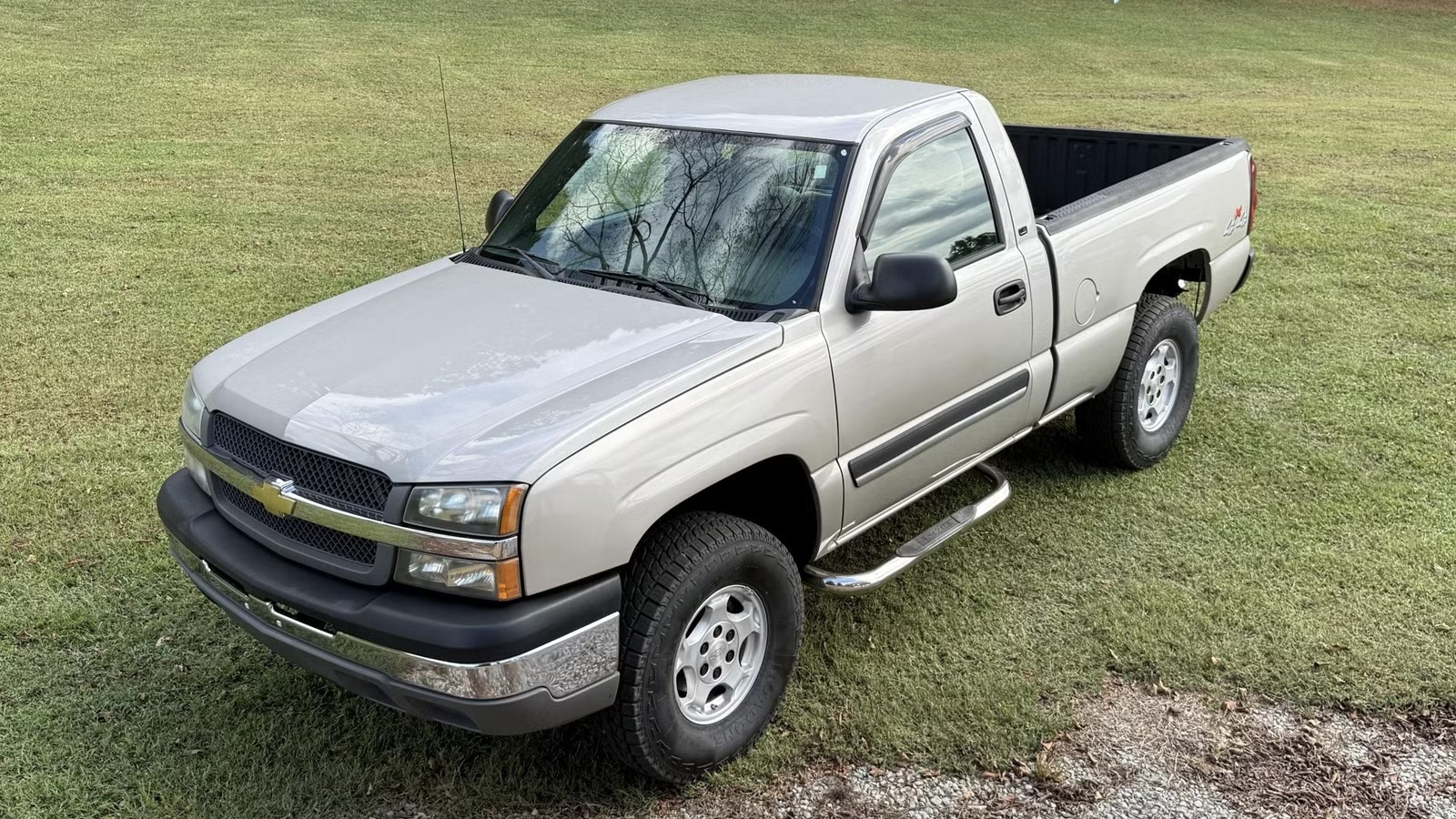
So, you want big horsepower, and you want it on the cheap. Amazingly, the exact recipe to achieve this goal hasn’t truly changed for decades. Step one is to find a 5.3-liter Chevy truck engine from a junkyard for about $500 and throw some go-fast bits on it. For less money than the short block of most modern turbo-four engines, you could easily build a 500+ horsepower monster using junkyard components.

It is remarkable that a truck engine designed in the 1990s still gets the job done for less than modern engines that use vastly more sophisticated technology. Even the current turbo-four benchmark engine, the BMW B48, can’t compare in terms of performance-per-dollar to a junkyard LS with some choice modifications.
The Modern Turbo-Four Has Changed What We Expect From Small Engines
Modern turbo-fours can produce remarkable power from relatively small packages, making them attractive for lightweight swaps and performance builds. But the same technology that makes an engine compact and efficient can also introduce more components, more complexity, and tighter limits when power is pushed substantially beyond stock.
The BMW B48 Shows How Far Turbo-Four Technology Has Come


If you are tapped into what is relevant in the modern engine-swap scene, the BMW B48 stands out as the go-to turbo-four. The B48 has grown in popularity because of its low weight of only about 310 pounds for the long block, twin-scroll turbocharged power, and impressive low-end torque. Additional benefits include a modern engine management system, a very large production volume, and a growing amount of aftermarket support.
For cars where a lightweight powertrain is critical to weight balance, the B48 offers clear advantages. Strom Motorsport has spent years developing the swap platform and demonstrated that the B48 is capable of handling competitive racing environments with strong reliability. Strom has partnered with Garagistic to develop a full swap ecosystem for the B48 that includes everything from mounts to wiring to drivetrain integration. The B48’s widespread availability, compact size, and modern characteristics make it a natural fit for lightweight chassis.
More Technology Doesn’t Automatically Mean More Power-Building Headroom

If the B48 has a real limitation, it is its top-end power potential on stock internals. By the time you reach the 350- to 400-whp range, you are certainly approaching the limit of what can be considered sustainable with even the most capable modern turbo-four engines. Will a stock-bottom-end B48 make 400 whp with the right modifications? No question. How long will it last at that power level? Nowhere near as long as it would at a more conservative output in the 300- to 350-whp range. It may sound like a cliché, but if maximum power is your ultimate goal, there truly is no replacement for displacement.
Meet The $500 LM7 That Refuses To Act Its Age

When it comes to pure bang-for-the-buck power, the 5.3-liter LM7, an iron-block V-8 found in vast numbers of Chevrolet and GMC trucks and SUVs, remains undefeated. Its factory output looks ordinary today, but that modest rating is exactly what leaves so much room for inexpensive modifications.
A 200,000-Mile Core Can Cost Less Than One B48 Modification

So, of all the engines out there, why would you choose a 285-horsepower 5.3-liter LM7, also known as the Vortec 5300, over the rest of the options? The answer is simple: cost and availability. The LM7 is readily available at junkyards and pick-and-pulls across the country, and you can obtain a full assembly, from throttle body to oil pan, in the $500 to $600 range. There are bigger and better engines available, but none that are more accessible and affordable than the LM7.
Sure, the engine you end up finding might have 190,000 miles on the clock, but even then, it may survive for years with proper upkeep and a good tune. If you compare the cost to that of a performance-focused specialty engine with low mileage, you’ll probably be looking at least a couple thousand dollars just for the long block. 285 horsepower might not seem like much, but the factory output doesn’t tell the whole story, and all it takes is a little encouragement to make this engine come to life.
The Iron Block And Simple Architecture Explain The Abuse Tolerance

The LM7 sacrifices weight savings for durability, and no detail about its engine architecture makes that clearer than the deep-skirt iron block with six-bolt main bearings. You are looking at about 518 pounds for a fully dressed LM7, which is not bad considering its power potential.
Mechanically, the LM7 is as simple as it gets, with a cam-in-block pushrod valvetrain, two valves per cylinder, and port fuel injection. This simplicity is one of its strongest attributes, because fewer moving parts means less to break. You won’t have to deal with complex direct-injection systems or high-pressure fuel pumps like those found in the B48. Neither the B48 nor the LM7 is indestructible, but the iron-block V-8 has the clear advantage of having much more headroom at the power levels enthusiasts commonly target.
The $900 Recipe That Turns A Truck Motor Into A Problem For Modern Cars

The LM7 is not just some interesting junkyard curiosity; it’s a legitimate performance proposition. A relatively inexpensive combination of forced induction, fueling, valvetrain upgrades, and calibration can more than double the engine’s factory output without transforming the project into an expensive custom-built motor.
Cheap Boost Can Push A Stock LM7 Into 500+ Horsepower Territory

So how exactly do you take a 285-horsepower LM7 and turn it into a 500-horsepower beast for the least amount of money possible? Well, there is more than one “correct” route to achieve this goal. But why is 500 horsepower the target for most enthusiasts?
Well, if you have ever been in a car in the 500- to 600-horsepower range, you should know that amount of power on the street can be downright scary, if not terrifying. You might think you want 800 or 1,000 horsepower, but 500 horsepower is more than enough to have fun and then some.

So, if you want this experience on a budget, your best bet is finding a junkyard LM7 and following this recipe: Pac1218-style valve springs along with an upgraded camshaft under 0.600-inch lift, which is the limit of the Pac1218 springs. Next, add Siemens Deka 80-pound injectors along with a Walbro 400 in-tank fuel pump, which will provide the fueling support you need for the 500- to 600-horsepower range.
For the turbo components, the ideal setup includes a 76mm T4 turbo and a 50mm wastegate, along with all the necessary intake and exhaust plumbing. Don’t forget that you’ll also need an intercooler and the associated piping, along with some form of engine management system, such as a MicroSquirt, which can be found with a plug-and-play harness for LS-based applications.

If you are retaining the stock GM electronically controlled overdrive transmission, your best bet is to stick with the stock PCM unit. Finally, to keep power consistent and reliable, you’ll also need methanol injection and someone to tune the engine management system for your specific setup. This might be one of the cheapest ways to unlock 500 whp, but that doesn’t mean it’s easy or necessarily a quick process.
500 WHP Isn’t The Same Thing As “Bulletproof Forever”

Let’s say you get your junkyard turbocharged and methanol-injected LM7 up and running, and everything is looking good. You want reliability, so you decide to get it tuned conservatively in the low-500-horsepower range. You made sure to go to the most well-known LS-swap tuner in your area, and they worked all the magic they could. We can’t emphasize enough that just because your 200,000-mile LM7 is making 500 horsepower now and runs well, it doesn’t mean it can sustain this feat indefinitely.
Are power figures in this range and well beyond it routinely achieved? Yes, but for how long is the better and more difficult question. At the end of the day, there are dozens of factors that will affect the longevity of your boosted LS, with the internal condition of the core engine being the most important. Next would be the quality of the tune and how the vehicle is actually going to be driven. The LM7 is an amazingly durable engine that is easily capable of doubling its stock horsepower output, but it is not indestructible.
Why The Junkyard LS Still Makes Sense In 2026

The LM7’s greatest advantage isn’t that it makes any modern engine obsolete; it’s that its combination of price, simplicity, and power potential remains difficult to match despite decades of engineering development. For someone building a performance car on a budget, the choice ultimately comes down to what matters more: modern packaging and refinement or maximum performance per dollar.
The LM7 Wins The Power-Per-Dollar Fight

If your goal is getting the most power for the least amount of money, you simply won’t find a better alternative to the LM7. The engine is as cheap as it gets, the supporting hardware is simple and well-documented, and the aftermarket is one of the largest of any engine platform. In comparison, the BMW B48 is considerably newer and features sophisticated electronics such as Valvetronic and direct injection, along with more expensive integration.
While Strom and Garagistic’s work in making B48 swaps more approachable has certainly advanced the case for lightweight applications, this does not erase the significant fundamental cost difference between the two swaps. The LM7 does not just offer more power potential; it is also significantly cheaper, has cheaper replacement parts, wider availability, a larger aftermarket, and proven forced-induction recipes for high-output applications.
The B48 Still Has Advantages The LM7 Cannot Match

However, to say that the LM7 is the perfect engine swap for all situations is simply incorrect. The LM7 has several notable disadvantages, most importantly its heavy iron-block construction and larger physical footprint. Could you fit an LM7 in a Miata? Without a doubt, but don’t be surprised if the end product requires modifying the frame. Even then, fuel consumption will be a significant ongoing expense.
The BMW B48 still makes more sense in lightweight platforms where compact dimensions are critical, such as the Mazda Miata or a BMW E36. If massive power is not the ultimate goal and refinement still matters, the B48 can be the perfect engine for a fun street car. 400 horsepower or so is still tremendously entertaining in a lightweight chassis, but as we have mentioned, there is no true universal answer to the question of what is right for you.

What we can assure you is that the LM7 will continue to be one of the best budget iron-block V-8 engines you can buy if you want big power without breaking the bank. The LM7 is more than just an old engine; it is one of the clearest examples of how overbuilt, mass-produced hardware can remain relevant decades after newer technology arrives.
Sources: BMW, Chevrolet, Strom Motorsports, Garagistic, Speedway Motors, Grassroots Motorsports, Sloppy Mechanics Wiki, Performance Racing Industry

Related posts





Latest Post


No Comments