
The Fiat Dino That Secretly Funded Ferrari’s F2 Program
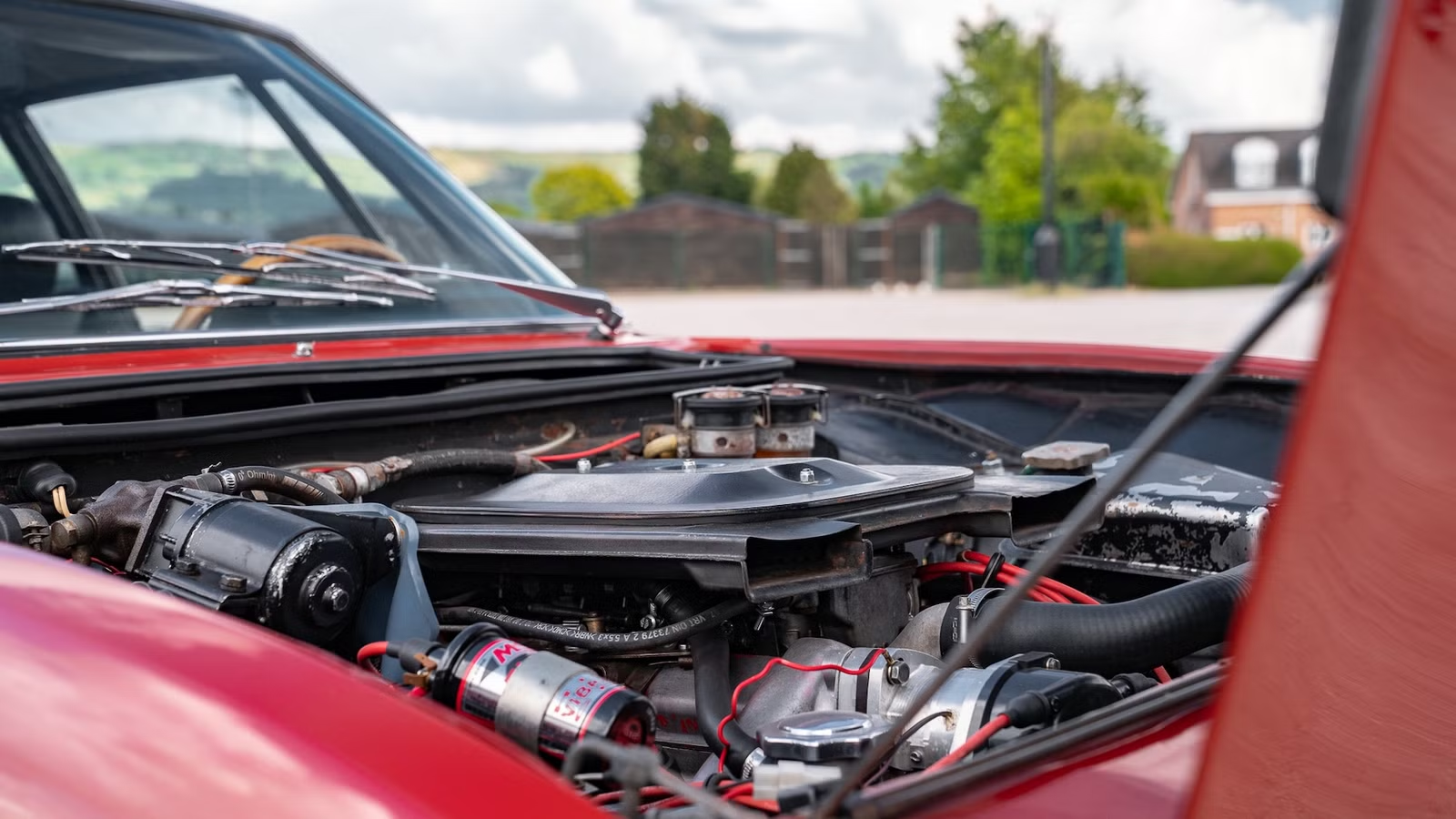
Here’s a puzzle: By the 1970s, you could buy Ferrari’s first mid-engine sports car. The automaker claimed its V6 engine was in the purest category of thoroughbreds, a powerplant originally developed for cutting-edge Ferrari race cars. But if you tore one down, you’d find “Fiat” stamped on the block. The truth is that a forgotten 1966 Fiat GT car secretly made Ferrari’s Formula 2 program possible.
Scuderia Ferrari Was A Racing Team That Happened To Sell Road Cars

Enzo Ferrari went to work for Alfa Romeo in 1929, founding a factory racing team named “Scuderia Ferrari.” In 1939, he left Alfa, but wasn’t able to get his self-named car company off the ground until after WWII.
Ferrari continued doing exactly what he was great at: operating the “Scuderia Ferrari” racing team. He sold just enough road cars to fund his passion. How many road cars? By modern standards, next to none.

In 1960, Ferrari sold approximately 306 road cars. This number climbed and fell throughout the decade. But in 1969, the automaker sold approximately 619 cars. Compare that with another Italian company: Fiat. By the late 1960s, the Turin-based automaker was selling well over a million vehicles annually. Ferrari was a major contender in multiple racing series. Then the FIA unveiled a new rulebook. If it had been trying to push Ferrari out of competition, it couldn’t have designed a more effective way.

Shifting Formula 2 Rules Seemed Targeted At Ferrari

In the early 1960s, Ferrari completely dominated endurance sports car racing. It won every single 24 Hours of Le Mans held between 1960 and 1965. But by the late 1960s, competitors such as Ford were challenging Ferrari’s dominance. It sought to up its game elsewhere.
Ferrari had claimed both the Drivers’ and Constructors’ Championships in F1’s 1961 season. It had repeated the Constructors’ title in 1964. The FIA has often fielded a Formula 2 championship as a cheaper alternative for automakers and privateers. Ferrari first entered Formula 2 in one of its first seasons: 1948. But then the FIA changed everything for Formula 2’s 1967 season. Competitors could only enter an engine that was derived from production cars with 500 units produced within 12 months.

This put Ferrari in quite a bind. If it yanked every V12 car from dealerships and only sold road cars with the V6 it used in F2, it still might not be able to qualify the engine. And doing so would be brand suicide. Enzo wouldn’t be able to compete in the 1967 F2 season unless he found a partner. And nothing would keep Enzo’s cars off the track, if he could help it.
The 1966 Fiat Dino Made Ferrari’s Formula 2 Program Possible

Buyers walking into Fiat dealerships in 1966 were greeted by a handsome sight: The automaker was offering a sporty new GT car. The front-engine, RWD convertible had a body designed and built by Pininfarina and boasted a five-speed manual and 2.0-liter V6. The next year, Fiat even added a 2+2 coupe, with a body by Bertone, to its GT lineup. What drivers didn’t know was that buying the Fiat Dino meant they were bankrolling Ferrari’s racing team. Enzo had licensed his V6 to Fiat for one reason only. The Fiat Dino gave Ferrari the street car production numbers it needed to use the same engine in F2. Meanwhile, Fiat got a Ferrari-engineered V6 to drop in its latest sports car.

The engine in question was a 1,987 cc aluminum-block V6. It was essentially a detuned version of the V6 used in F2 cars, built at Fiat’s factory. Fiat claimed 160 hp at 7,500 rpm. The coupe weighed 2,800-3,042 pounds, depending on configuration. The spider tipped the scales at 2,545-2,734 pounds.
What Fiat saved in engineering costs, it poured into an all-new technology. The Fiat Dino was the first production car with electronic ignition. The automaker had so little trust in the Magneti Marelli Dinoplex system that it installed a regular coil system as well. If/when your electronic ignition failed, you could pop the hood, push a big “emergenza” (emergency) button, and swap the system over.
For the 1969 model year, Fiat increased the V6’s displacement to 2,418 cc and swapped to a more reliable cast-iron block. The larger engine earned a 180 hp rating.
Why Four Different Cars Wore Dino Badges

Historians disagree on the Fiat Dino’s exact production numbers, but between 1966 and 1973, the automaker sold somewhere between 7,600 and 7,800. Roughly three-quarters of these were coupes while a quarter were spiders. One of the most confusing aspects of this car’s history is its Ferrari cousin. At the exact same time, Ferrari was assembling its own Dino. And it wasn’t the only way these two car companies were stepping on one another’s toes. In 1967, Ferrari launched something all new: a mid-engine sports car. It had a transverse-mounted 2.0-liter V6. And its badges read…Dino.

Enzo was so serious about the “Dino” name, he didn’t even put a Ferrari badge on the little mid-engine car. He envisioned Dino as its own sub-brand. And there may have been a good reason why.
Alfred “Dino” Ferrari was Enzo’s son who died of Duchenne muscular dystrophy in 1956 at just 24. He’d proven a talented engineer, designing an all-new V6 for his father’s company. One of his innovations was setting the cylinder banks at a 65-degree angle to allow for straight intake ports.
Even while Alfred was alive, Enzo honored him by naming multiple concept vehicles and race cars “Dino.” After Alfred’s death, Enzo continued using the name. Fiat named its new GT cars after the engine, and to honor Alfred. Then Enzo insisted on using the name again on his first mid-engine production car because it featured the Fiat-built V6.

Thus, by 1970, you could have your choice of Italian Dino cars, be it a mid-engine Ferrari, a front-engine Fiat coupe, or a Fiat roadster. Soon, Ferrari would roll out a new Dino model, bringing the total to four. But the early Dino by Ferrari had “Fiat” stamped on its engine block.
One other intriguing fact is that Ferrari took 160-horsepower Fiat engines, installed them in its own Dino, and advertised them at 180 horsepower. Perhaps something was lost in translation. Or perhaps Ferrari couldn’t stand to advertise a car with the same power as a Fiat.
The Fiat Dino Was Enzo’s Most Important “Non-Ferrari”

The Fiat Dino may not have been a Ferrari, but it proved pivotal in Ferrari’s history. First and foremost, it accomplished its mission. Ferrari was allowed to race in F2 with its V6 engine. But it played another crucial role in the company’s history.
Ferrari sold only 152 of its Dino 206 GT sports cars between 1967 and 1969. But it discovered the public had a serious appetite for light, (comparatively) cheap, mid-engine Ferraris. It also discovered that it could assemble bodies built by Pininfarina and V6 engines built by Fiat in Modena much faster than its previous bespoke cars.
When it upgraded to the new 2.4-liter V6 and rebadged the car as the Dino 246 GT/S, Ferrari ramped up production significantly. Between 1969 and 1974, Ferrari built 3,569 Dinos. That’s 10x more than its entire production—across all models—just a year previous.

Soon, Ferrari would ramp up production even further. First, it took over assembly of the V6 from Fiat. Finally, Ferrari insisted on assembling all Fiat Dinos in Maranello. The Dino 246 GT/S was Ferrari’s first high-volume production sports car. And it changed the future of the company forever. It was made possible by an engine mass-produced by Fiat for its own Dino. It all started because Enzo wanted to go racing. But it was Fiat that showed Enzo the world was ready for a more accessible Ferrari.
Sources: Stellantis Heritage, Ferrari History, and The Design Museum

Related posts
Latest Post


No Comments