
7 Factory Delete-Option Muscle Cars Rarer Than Full-Load Trims
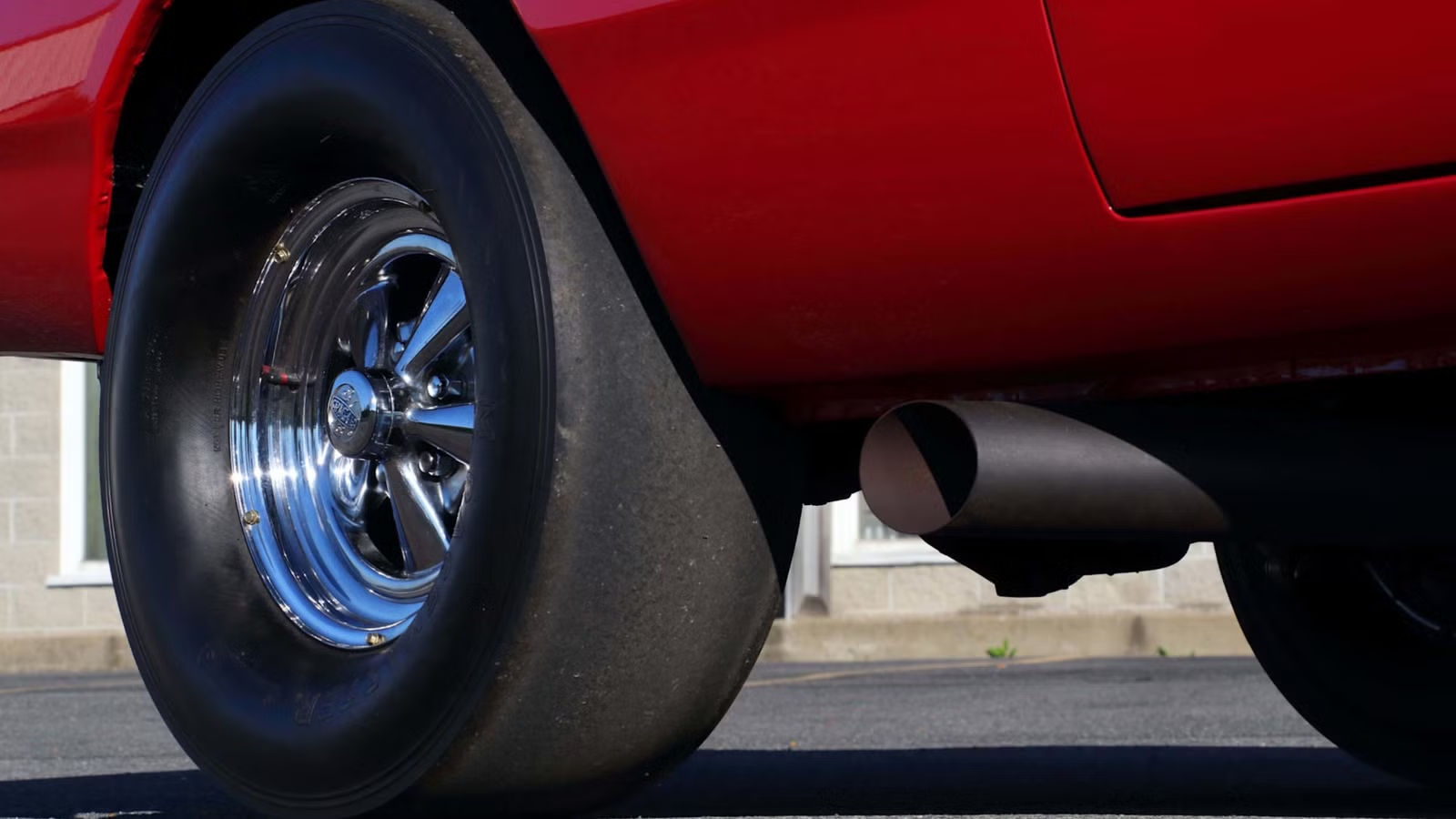
Conventional wisdom says car buyers want their rides loaded with goodies, the more the better, but there was a time when less was best. In the Golden Age of American Muscle, there were highly desirable rides that put the kibosh on features and creature comforts alike. Sometimes, luxury features were deleted to make the car lighter for racing applications, but other times amenities like AC and power steering had to be nixed just to fit a massive big-block V8 in the engine bay. As unconventional as it sounds, some of these delete-option muscle cars are worth way more than their fully-loaded counterparts, proving that luxury add-ons aren’t always a factor in classic car prices.
7
1968 Plymouth Road Runner
Production: 44,599 Units

Unlike many cars on this list, the 1968 Plymouth Road Runner wasn’t built for racing, or at least not for organized competition, but it was a delete-option superstar. Conceived as a bare-bones speed machine, the Road Runner came standard with a 335-horsepower 383 V8, a 3-speed auto or 4-speed manual transmission, steel wheels, a vinyl front bench seat, a “beep beep” horn, and not much else, so it was missing most features buyers take for granted. There were options available, but there were also deletes like the back seat and carpets that could shave a few more bucks off the price. Starting at just $2,896, it was already dirt cheap, but if you had no need to haul around passengers and didn’t mind a rubber mat on the floor, it was even cheaper.
Because the Road Runner was so cheap, upgrading to the 425-horsepower 426 Hemi V8 wouldn’t blow the budget and, in fact, 1,019 budget-conscious speed freaks exercised that option in 1968, more than any other Dodge or Plymouth muscle car model year. This created a kind of weird dynamic of a stripped-down ride with a luxury engine, but again, it was a small price to pay for a dominant 13-second street machine. The GTX was the same basic ride as the Road Runner, only it came with every option and feature Plymouth offered, but it isn’t nearly as collectible as its sibling. A loaded ’68 Hemi GTX hardtop has a Hagerty Concours condition value of $136,000, while a no-frills Hemi Road Runner tops out at $176,000.
6
1970 Plymouth AAR ‘Cuda
Production: 2,724 Units


The 1970 Plymouth AAR ‘Cuda (All-American racer), like its name would suggest, was actually designed for competition, and more specifically, the Sports Car Club of America (SCCA) Trans-Am racing series. The SCCA had a 5.0-liter (305 cubic-inches) cap on the engines, so the AAR ‘Cuda’s 290-horsepower 340 Six Pack V8, with a trio of two-barrel carbs, seemed in violation of that, but the race versions were stroked to meet the displacement requirements. The race version was a delete-option blueprint to strip everything unnecessary to going fast, but the homologation special sold to the public was also devoid of many common features. Things like a radio, power steering, and bucket seats were options, but no matter what, the AAR ‘Cuda could not be equipped with factory air. The 340 Six Pack’s unique induction system made it impractical to retrofit an AC unit, so AAR ‘Cuda owners relied on speed with the windows down to stay cool.
In a production number that we can’t stop loving, Plymouth built exactly 666 of the wicked 1970 Hemi ‘Cuda, with 652 hardtops and just 14 drop-tops. The Hemi ‘Cuda convertibles sell in the multi-millions, so an AAR ‘Cuda is obviously not going to challenge them on the auction block. The Hemi ‘Cuda hardtops, on the other hand, are within reach. An AAR ‘Cuda sold for $308,000 at Mecum Kissimmee 2023, which is only $57,750 less than the top-selling 1970 Hemi ‘Cuda, and it should be noted that dozens of Hemi ‘Cudas have sold for less than the big-dog AAR. Of course, the comparison of a 340 small-block car and a 426 Hemi big-block is not fair, so we’ll throw out the $242,000 the best-selling ’70 ‘Cuda 440 V-code 6BBL went for as proof that the delete-option AAR ‘Cuda is more valuable than a loaded version.
5
1969 Ford Mustang Boss 429
Production: 859 Units

The first thing the 1969 Ford Mustang Boss 429 deleted was the Ford assembly plant as its 375-horsepower 429 Cobra Jet V8 was too big to fit under the hood and had to be modified by a third party. Ford would ship the fastback Mustangs without engines and transmissions to Kar Kraft, a specialized engineering and manufacturing company, for final assembly. Though not necessarily deletes, the front shock towers had to be moved and reshaped, plus the battery was relocated to the trunk to make room for the massive big-block. The AC, however, was deleted simply because there was no more room in the engine bay, and automatic transmissions were out due to the nature of the Boss 429. Engineers paired the 429 with a close-ratio Toploader 4-speed manual to keep the engine in its power band, and it was a homologation model that would have cost a ton of extra dough to develop an automatic version to achieve certification.
The Boss 429, unlike many other cars on this list, was actually loaded with features including power steering, AM/FM radio, and tinted glass to name a few, but it definitely had enough deletions to qualify for this list. When it comes to value versus a loaded similar vehicle, it has one of the biggest gaps. A ’69 Boss Mustang has a Concours condition value of $419,000, and that’s actually conservative considering they generally sell for over a half-million, including one that hit $660,000 at a 2026 Mecum auction. The closest car available in this comparison is a 1969 Mustang Mach 1 fastback with a 428 Cobra Jet V8, of which the top seller is $203,500, and while that’s a lot of scratch, it’s not close to the Boss 429. Some of that comes down to the numbers, with 15,132 Mach 1 428s sold in 1969 versus only 859 Boss 429s, but also the latter is simply special and collectors know that.
4
1967 Chevrolet Camaro Z/28
Production: 602 Units

Like the 1970 Plymouth AAR ‘Cuda, the 1967 Chevy Camaro Z/28 was built to compete in the SCCA Trans-Am racing series, but unlike the Mopar, it was actually successful, winning championships in 1968 and 1969. The Z/28, which would go on to be the Camaro’s top performance trim well into the new millennium, started out rather modest due to the SCCA’s 5.0-liter engine cap. Equipped with a 302 small-block that was rated at 290 horsepower, the car was probably more like 375+ ponies, as Chevy tended to underrate their engines for insurance purposes. Like many homologation cars, the ’67 Z/28 had a lot more features than its racing counterpart, but it still came with some significant deletes. Due to everything that was going on under the hood to make the Z/28 a formidable race car, there wasn’t any room for AC, and because it was geared toward performance, the automatic transmission was crossed off the options list.
The ’67 Camaro Z/28 wasn’t intended as a drag car or even street machine, but rather an endurance racer, so it never blew off any doors or force-fed some dust, but it is actually one of the most valuable Golden Age GM muscle cars. The Camaro was a smash hit in its 1967 debut, selling 220,906 units, so it’s one of the most common Golden Age cars, but just 1,138 SS 396s left the factory with a 375-horsepower L78 big-block, so that’s what we’re comparing here. A ’67 L78 sports coupe has a concours condition value of $115,000, which is not cheap, while a Z/28 of the same year comes in at $152,000. Hagerty values are sometimes theoretical in nature, and for the Z/28 that’s certainly true, as a ’67 driven by race legend Mark Donohue was bid up to $925,000 at a 2025 Mecum auction, but failed to hit the reserve and didn’t sell. If someone is willing to pay almost a million bucks for a car, that’s what it’s worth.
3
1965 Shelby GT350
Production: 562 Units

Carroll Shelby was the mastermind behind Ford’s crushing defeat of Ferrari in the 24 Hours of Le Mans, and when he wasn’t making Enzo weep in despair, he dabbled in making the Mustang faster. He got his feet wet with the 1965 Shelby GT350, which transformed a mediocre Mustang GT into a formidable race car. Shelby started with the 289 K-code V8 that normally produced 271 horsepower and, through induction and exhaust mods, got it up to 306 ponies. Shelby added a lot, like heavy-duty suspension and brakes, but also deleted unnecessary features. The back seats were deleted, as well as AC, power steering, the automatic transmission option, and most interior features that didn’t support performance. Interestingly enough, the GT350 wasn’t named after an engine or horsepower rating, as many number-named cars are, but rather the number of steps it took Shelby to walk from his office to the production facility.
The point of the ’65 GT350, besides giving the Mustang the kind of performance it should have from the factory, was to homologate it for SCCA competition. There were a total of 562 cars produced, including 34 GT350R competition cars and 2 Shelby race team rides. The rarity and collector’s interest in Shelbys makes the GT350 an insanely expensive Golden Age car. A ’65 GT350 has a top condition value of $836,000, and a GT350R maxes out at $1.5 million. The GT350R prototype sold for $3.8 million in 2020, and another reached $2.7 million in 2026. A run-of-the-mill ’65 GT350 sold for $990,000 in 2025, obliterating the Hagerty value, but for the most part, these are half-million-dollar rides. The Mustang GT 289 was the baddest available factory car in 1965, and while its $108,000 Concours condition value is impressive, compared to the Shelby GT350 it’s in the bargain bin.
2
1969 Pontiac GTO Judge Ram Air IV
Production: 239 Units

The Pontiac GTO kicked off the muscle car craze in 1964, but it was never truly awesome until mid-model year 1969 with the introduction of the Judge performance trim. Pontiac, like all GM divisions, was under a silly and pointless 400 cubic inch cap for intermediate cars, which of course, were muscle cars. Pontiac did the best they could with the hand they were dealt and got their 400 V8 up to 370 horsepower with the Ram Air IV package, which included performance everything. The 1969 GTO Judge Ram Air IV was actually closer to 400+ horsepower and the biggest reason to believe that is because it was the first GM muscle car to run a quarter-mile in the 13s, while higher-rated engines like the 375 horsepower 396 had the Chevelle running in the 14s. The ’69 GTO Ram Air IV had some unusual headers and other equipment that made factory air an instant delete, as it would have taken some serious improvisation to make it fit.
With this one, the 400 Ram Air IV is the star, not the delete-option, and there is really nothing to compare it to. There is no car with the same or better engine to put it up against, but we’ll still throw some values out there. A 1969 GTO Judge Ram Air IV coupe has a perfect condition value of $235,000 and the drop-top has a drop-dead price of $632,000. A ’69 Judge Ram Air III is still worth a lot with a Concours condition value of $109,000, but that’s not even half of what one with an extra Roman Numeral commands. At auction, GTO Judge Ram Air IVs hit and exceeded the Hagerty value with a top sale of $319,000 and almost all within the $200,000 range. With only five Judge Ram Air IV convertibles, the car is apparently so rare that one has never been listed, but going by the million-dollar+ sale of a 1970 drop top, when one does come up for auction it will be a doozy.
1
1968 Dodge Hemi Dart
Production: 80 Units

When Chrysler unleashed the 425-horsepower, 490 lb-ft of torque 426 Street Hemi in 1966, all Dodge and Plymouth intermediate cars could option the legendary engine. As a compact, the Dodge Dart was out of the running, and that was probably a wise choice, because that much power in such a small, light set of wheels would have been too much for most people. We don’t even have to play the “what-if” game on this one, because Dodge figured out a way to get around Chrysler’s Dart Hemi ban by teaming up with Hurst Performance to build the 1968 Hemi Dart. The Darts were shipped sans engine to Hurst, where they were transformed into super-powered drag cars. To strip all unwanted weight, the Hemi Dart went on an option-delete frenzy, ditching the back seats, radio, heater, carpet, and soundproofing. It lost some additional pounds with a fiberglass hood and front fenders, aluminum bumpers, as well as acid-dipped body panels. If it wasn’t necessary for speed, it had to go.
The ’68 Hemi Dart was technically street legal and was even sold through the Dodge dealership network, but its use anywhere besides the track was heavily discouraged and even came with a disclaimer stating as much. Most of the 80 units produced ended up in the hands of professional race car drivers, but there were a few that went to everyday buyers who quickly discovered the car was too much for them to handle. Hagerty doesn’t have a value for the ’68 Hemi Dart, but curiously does for Mr. Norm’s 440 GSS, which is a dealer build. Instead, we head to Mecum to see how much these Mopar Missiles are going for and besides a top sale of $330,000, most are fairly cheap, including one that sold for just $93,500 in 2026. The problem is, most of these are actual race cars, which collectors aren’t crazy about, so the prices aren’t as extreme as they should be. The best ride we can think of to compare the delete-option champion Hemi Dart with is a fully-loaded ’68 Mr. Norm’s Dart GSS, with a best auction sale of $75,000, which ain’t much of a comparison at all.
Sources: Hagerty, Mecum

Related posts





Latest Post


No Comments