
Chevrolet’s Wildest Golden Age Muscle Car Is Still An Absolute Bargain
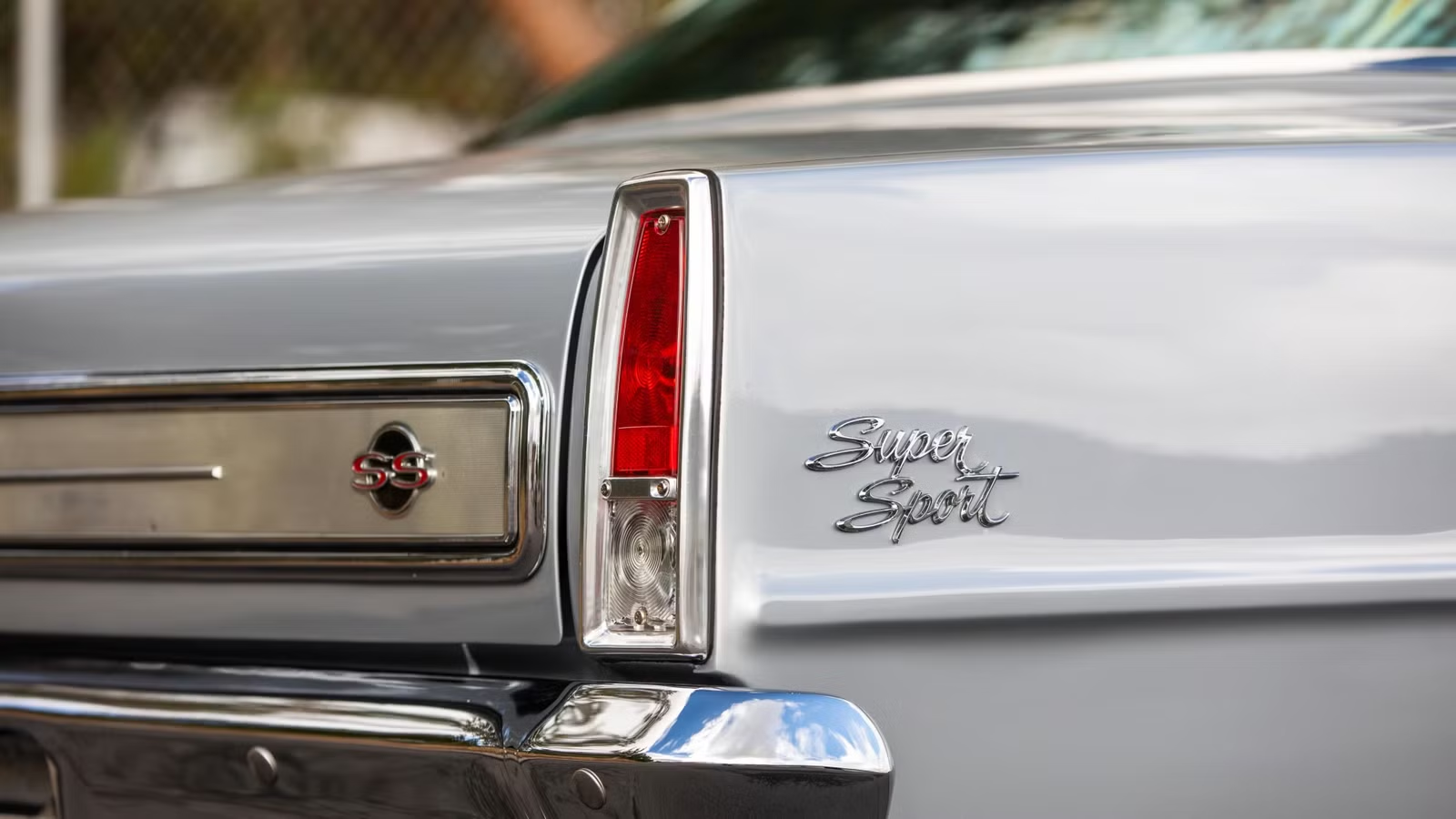
You don’t need to spend hundreds of thousands of dollars to access iconic small-block V8 power. There is one Chevrolet car with tons of power from the highly coveted golden age that’s an absolute drag strip monster hiding right under your nose. It’s insanely affordable compared to cars with more popular monikers, as it hides in the shadows as an ultimate sleeper model. It punches well above its weight to give icons like the Chevy Camaro and Corvette a run for their money.
Chevy Wanted To Fight the Ford Falcon

As many automakers were focused on developing the fastest muscle cars, the compact segment wasn’t exactly being neglected. Chevy needed to compete in the lightweight segment against more practical compact options like the Ford Falcon, which arrived in 1960, a few years before the Mustang hit the track.
The Ford Falcon started with inclined six-cylinder engines. For example, the 250 cubic-inch (4.1-liter) inline-six engine delivers 155 horsepower and 250 lb-ft of torque. It can accelerate from 0 to 60 mph in about 10.7 seconds and complete a quarter mile in roughly 17.0 seconds with a top speed of 110 miles per hour based on the model year and gear ratio.
Later, the more athletic Falcon Sprint dropped with a 289 cubic-inch Windsor V8 engine. The potent K-code V8 churns out up to 271 hp and 312 lb-ft of torque. It helps the Falcon Sprint accelerate from 0 to 60 mph in around 7.2 seconds with a 16.5-second quarter-mile time and top speed of 124 mph. But it didn’t go unchallenged by a Super Sport rival.

The Second Generation Chevy Nova Gained Insane Power

The first Chevy Nova debuted in 1962 and, like the Falcon, it started as an economy sedan with modest power. It had an available 327 cubic-inch V8 engine with 250 hp and 350 lb-ft of torque in the 1965 model. With this engine, the Chevy II Nova can accelerate from 0 to 60 mph in about 7.2 seconds and complete a quarter mile in around 15.5 seconds with a top speed of roughly 120 mph.
Then, in 1966, the second-generation Chevy II Nova was born with more power and aggressive styling upgrades. The Chevy Nova SS borrowed the 327 V8 L79 high-performance engine from the Corvette to boost its power output to 350 hp and 360 lb-ft of torque. This helped its 0 to 60 mph time improve to about 5.8 seconds and provided the ability to finish a quarter mile in 14.5 seconds with a top speed of 123 mph.

This put the Chevy II in Camaro territory. But while the Camaro was available with the 327 ci engine, you could also go for the 396 cubic-inch 6.5-liter V8 with 375 hp and 415 lb-ft of torque. It reaches 60 mph in roughly 5.4 seconds with a 14.1-second quarter-mile time and top speed of around 140 mph.
Aside from stout power and a compact size, the Chevy II Nova stands out as being wild due to its transformation from a plain, boxy vehicle to a sporty beast with sharper bodylines, a lowered stance, LED headlights, and modern 15-inch to 18-inch custom wheels with Mag or five-spoke designs. Under the hood, you’ll find a high-rise aluminum intake manifold, high-compression pistons, and distinct double-hump iron cylinder heads.
Here’s Why The Chevy Nova Is The Ultimate Sleeper Car

The Chevy Nova SS was never as popular as the Chevy Camaro because the vehicles were built for extremely different purposes. It was known as a bland, older, and simple family car that was built as a more practical and affordable alternative to fuel-burning muscle cars. Young buyers simply wrote it off as a grocery getter as the golden age struck.
Meanwhile, the 1967 Chevy Camaro launched with an attractive, hot style incorporating a long hood design, short rear end, and aggressive lines. It was built to tackle the infamous Ford Mustang, giving it serious bragging rights among younger drivers back when cars were winning on Sunday and selling on Monday.
In 1967, the Camaro sold about 220,906 models with immediate fame. About 34,244 SS trims were sold, and only 602 cars with the Z/28 high-performance package were sold. Meanwhile, the 1966 Chevy Nova is responsible for about 106,430 sales. Only 8,213 SS models with the V8 engine were sold.

But people didn’t realize that the Nova was a serious track weapon, as it got ignored in the Camaro’s shadow. It weighs in at about 2,410 to 2,885 lbs with V8 power stuffed under the hood. The Camaro is a bit heftier at 2,750 to 3,500 pounds. However, that extra weight and the vulnerability to being caught by compact economy cars didn’t impact its coolness factor.
Now The Chevy Nova Is A Secret Bargain

You can save a lot of money on a potent muscle car from the peak performance era by going for the Chevy Nova instead of the incredibly popular Camaro. Nova models found in project car condition can be scooped up for between $5,200 and $10,000. Then options in average or good condition fetch between $13,750 and about $35,000.
Then high retail examples or models in excellent condition cross the auction block for between $32,000 and over $65,000. Of course, L79 SS models with the high-output V8 engine are the most valuable, with prices ranging between $54,000 and $126,000. Other factors that pump up the value include two-door hardtop configurations and sport coupes.
The value of the 1967 Chevy Camaro starts at around $5,000 to $15,000 for models in project car condition. Then Camaro cars in good condition or driving quality often fetch between $22,000 and about $31,000. Examples found in excellent to mint condition go for between $36,500 and over $70,000. Then SS models in pristine condition sell for between $85,000 and over $150,000. Models with the Z/28 upgrade can go for well over $175,000.
Source: How Stuff Works, Hagerty, Chevrolet, Ford,

Related posts


Latest Post



No Comments