
The Bulletproof Performance Engine Tuners Still Worship
A great tuner engine doesn’t have the flashiest brochure numbers, the highest cylinder counts, or the most exotic architecture. In many cases, these are very modest engines on paper, but with one incredibly important distinction: a massive margin of safety built into the engine to make it as durable as possible, allowing clever enthusiasts to double or even triple factory outputs with just bolt-ons. That’s why the tuner engines that dominate enthusiast forums and engine-swap lists today are the ones that left their factories with closed-deck blocks, forged rotating assemblies, robust oiling systems, and balanced designs – and did so in massive numbers for endless aftermarket support. With time, some of these power plants have outgrown the cars they originally powered and become pure internet mythology. America has more than a few, and so does Europe, but the greatest tuner engine everyone worships today comes from Japan.
How Japanese Engines Revolutionized Tuner Culture

Apart from making the country rich, Japan’s late-1980s bubble economy also gave brands like Toyota, Honda, Nissan, and Mazda nearly unlimited development budgets at the exact time when turbocharged performance cars were exploding in popularity. While America was barely starting to recover from the oil crisis and returning to the V8 recipe, Japanese engineers were quietly building engines that were more durable and sophisticated than most of their Western counterparts, and power levels started to skyrocket. Nissan, for example, started to rule touring and endurance racing with its turbocharged RB26 inline-six and AWD, taking wins everywhere from Japan to Australia and even Europe’s Spa 24 Hours and Macau Grand Prix.

Meanwhile, on Japan’s public roads, fatalities started to rise, and the last thing Japanese automakers wanted was an all-out horsepower war that would draw the kind of regulatory scrutiny that had crushed the American muscle-car era two decades earlier. So in 1989, they agreed to cap production car power outputs to “just” 276 horsepower in every new car, along with a 180-kmh (111.8 mph) speed limiter.
The genius move was what they did next. Instead of actually detuning the hardware, they kept building race-bred engines and simply published the lower number. Nissan’s RB26DETT left the factory with forged internals and a closed-deck block that could handle far more than the claimed 276 hp. Mitsubishi’s 4G63 and Honda’s high-revving fours followed the same pattern. That environment produced some of the most tuner-friendly powerplants ever sold. And right at the peak of it sat one particular 3.0-liter twin-turbo inline-six that took every one of those advantages and forged them into a legend.

The Toyota 2JZ-GTE Became The Ultimate Tuner Engine

The 2JZ-GTE needs no introduction. It’s the epitome of the bulletproof inline-six and widely considered the Japanese equivalent of a Chevy LS. Some would even say that all the worship has made it an overrated engine, but the evidence proves otherwise.
Toyota first dropped the 3.0-liter twin-turbo 2JZ-GTE into the Japanese-market Aristo sedan in 1991 as a continuation of the successful 2.5-liter 1JZ-GTE. It generated little fanfare. But when the same engine hit the American streets in the MkIV Supra two years later, it immediately became the benchmark that every tuner measured others against. JDM versions stayed at the Gentleman’s Agreement figure of 276–280 hp, but America got a more accurate picture, where the 2JZ-GTE versions were rated at 320 hp and 315 lb-ft. Even by the spec sheet, the Supra was the most powerful Japanese car on the market for the entire ’90s era. In period testing, it rocketed to 60 mph in 4.6 seconds and covered the quarter mile in 13.1 seconds, completely stock.

Almost as soon as the 2JZ-GTE hit the market, tuners found they could push outputs well above 600 hp without the engine coming close to breaking. In 1997, a 750-hp Blitz Supra set a record-breaking Nürburgring lap at 7 minutes and 49 seconds, and that same year, drag racer Vinny Ten turned a salvaged MkIV Supra with a 2JZ-GTE into the first 10-second Supra in America, eventually getting his 1/4 mile times down to 8.7 seconds in 1999.
The 2JZ Becomes A Legend

However, it wasn’t until the early 2000s and the release of the first installment of the Fast and the Furious franchise that the floodgates truly opened. Grassroots drag racing already had stock-block 2JZs running mid-10s and high-9s well before that, but these films brought the Supra to a global audience and sent its prices and popularity into the stratosphere. Suddenly, every enthusiast builder wanted one, and the aftermarket responded with everything from single-turbo kits to billet blocks, creating an ecosystem that continues to support the engine three decades later. Few factory engines have ever matched that combination of real-world durability, cultural weight, and parts availability.
Let’s dive into exactly what made the 2JZ-GTE so overpowered and how to get one for yourself.
Toyota 2JZ-GTE: The Anatomy Of A Bulletproof Inline-6

The foundation of the 2JZ’s toughness lies in its closed-deck cast-iron block. That single design choice is why stock 2JZ blocks routinely withstand 25–30 psi without the cylinder-wall flex that kills head gaskets on lesser engines. It minimizes flex under extreme boost, making the rotating assembly the first failure point for anyone pushing these engines into four-digit hp outputs. The consensus is that 2JZ-GTEs can still reach 700–800 hp outputs on completely stock internals. This alone puts it in the company of very few six- and eight-cylinder engines ever built. And while the crankshaft is forged steel and incredibly robust, anything over those figures and the powder-forged rods and cast aluminum pistons will need to be swapped out.

Enthusiasts also know that an inline-six is naturally one of the most balanced engine configurations in existence, thanks to matching piston pairs and even firing intervals that effectively cancel out primary and secondary forces. And with a square 86×86 mm bore and stroke geometry that balances low-end torque with the ability to rev, a 2JZ will happily out-rev something like a Chevy LS. Meanwhile, its non-interference valvetrain means a snapped timing belt is an inconvenience rather than a catastrophic failure.
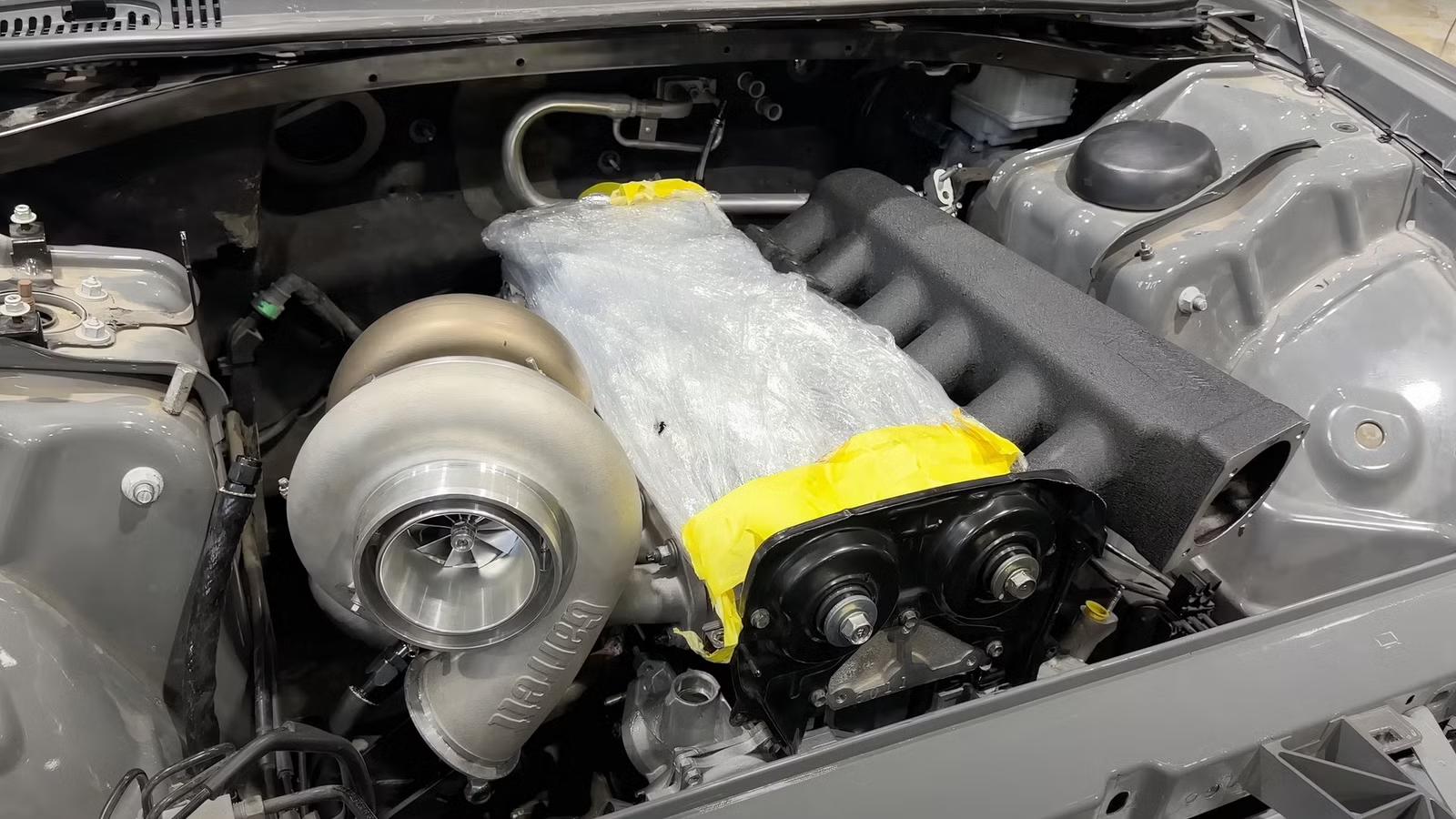
The 2JZ-GTE did come with a sequential twin-turbo setup from the factory, but almost every 1,000-hp 2JZ build now uses a large single turbo instead, such as a Garrett G42-1200, since it eliminates the complexity and heat-soak issues of running a twin-turbo system.
2JZ-GTEs In The Wild & How To Find One

While Toyota produced many 2JZs in its GTE variant, its factory applications didn’t come in many varieties: only the MkIV Supra and the Japanese-market Aristo ever received one. In fact, most 2JZ-GTEs on the market today are JDM Aristo engine pulls rather than Supra units simply because Japan produced far more of those, while Supra cores now command collector premiums. Hagerty says an average good-condition turbocharged MkIV Supra will set you back $88,000. This is why some tuners opt for the more ubiquitous, naturally aspirated 2JZ-GE variant instead, found in everything from the Supra to the Toyota Soarer, Altezza, Lexus IS300, GS300, and SC300 between 1991 and 2002, depending on the model.

These are significantly cheaper and easier to find, and they share the same basic short-block architecture but with a few key caveats. For example, these GE engines lack the oil squirters that keep the pistons cool and are designed for higher compression (10:1 vs. 8.5:1) with flat piston tops. In other words, they’re not as ideal for high-powered builds as the GTE and will need more parts swapped out, but they’re a good bargain alternative. For example, a used 2003 Lexus IS300 trades in the $10,000 to $15,000 range.
The Other Greatest Tuner Engines

As revered as it may be, the 2JZ-GTE is not the only great tuner engine. Over the years, enthusiasts have found several alternatives that are almost as potent and even better for certain applications. Some hail from the legendary JDM era, just like the 2JZ, and boast similar capabilities. Others are massive, near-bulletproof V8s with tough bottom ends and high-flow port heads perfect for low-end torque on a budget. And some are overengineered German turbocharged marvels found in dozens of models still in production, capable of producing significant extra power with minimal modification.
Chevy LS: The Volume King Of Cheap Power

The LS family remains the most accessible high-power engine on the planet for a reason. Chevy’s bulletproof small-block family powers everything from Corvettes and Camaros to trucks and countless engine swaps. Among them, the Corvette-sourced aluminum block LS1 and LS3 dominate engine swaps.
The LS1 is the entry-level budget option, with a 5.7-liter displacement, cathedral-port heads, and near-infinite aftermarket support given its sheer ubiquity on the market. The LS3, on the other hand, launched in the Corvette C6 with a 6.2-liter displacement and a stronger block, wider bore, higher compression ratio, and rectangular port heads for much better flow. Stock, they make around 430 hp, but a turbo, a new camshaft, and valve springs can easily push output close to the four-figure range. Still, none of them really match the 2JZ’s sustained boost potential or high-rpm stress.
Nissan RB26DETT: The Challenger

The legend of the RB26DETT is almost as big as that of the 2JZ, and in fact, Toyota developed its engine as a direct answer to Nissan’s dominance around the racing circuit in the late ‘80s. Found under the hood of R32, R33, and R34 Skyline GT-Rs, the RB is a true race engine that shares the 2JZ’s closed-deck iron-block design, a forged crankshaft, and a power tolerance on stock internals that is almost as impressive as the 2JZ’s. The consensus is between 500 and 600 hp. That’s just as impressive if you consider that the RB displaces just 2.6 liters.
Aside from the lack of displacement that forces the turbo to work harder, the factory oil pump is a known weak link, and so is the less practical packaging compared to the 2JZ. The RB’s oil pan is designed for AWD and physically integrates the front differential housing directly into the lower engine oil sump structure, which makes swaps into non-GT-R chassis a significant challenge.
BMW B58: The Modern 2JZ-GTE

Last but not least, BMW’s B58 is the closest thing the current generation of gearheads has to a factory-built 2JZ, and the same goes for its more extreme and expensive S58 version. Yet another closed-deck inline-six with a forged crankshaft (but an aluminum block), the twin-scroll turbocharged B58 has been on the market for over a decade, pushing up to 382 hp from the factory but proving itself capable of over 600 hp on stock internals with just a hybrid turbocharger, downpipe, and a proper tune.
Its importance lies in its modernity and ubiquity. It features in everything from the new Toyota Supra MkV to the BMW Z4, M240i, M340i, M440i, and M540i, including BMW’s SUV lineup. It’s also surprisingly fuel-efficient and features BMW’s direct injection, dual VANOS, and sophisticated thermal management systems. The B58 is well-suited for up to around 600 to 700 hp, after which point the twin-turbo S58 with forged pistons and stronger connecting rods becomes a better choice.
Sources: Hagerty, Jspec Garage, Motor Trend, Toyota

Related posts


Latest Post


No Comments