
The Cheapest Way Into Hemi-Powered Muscle In 2026
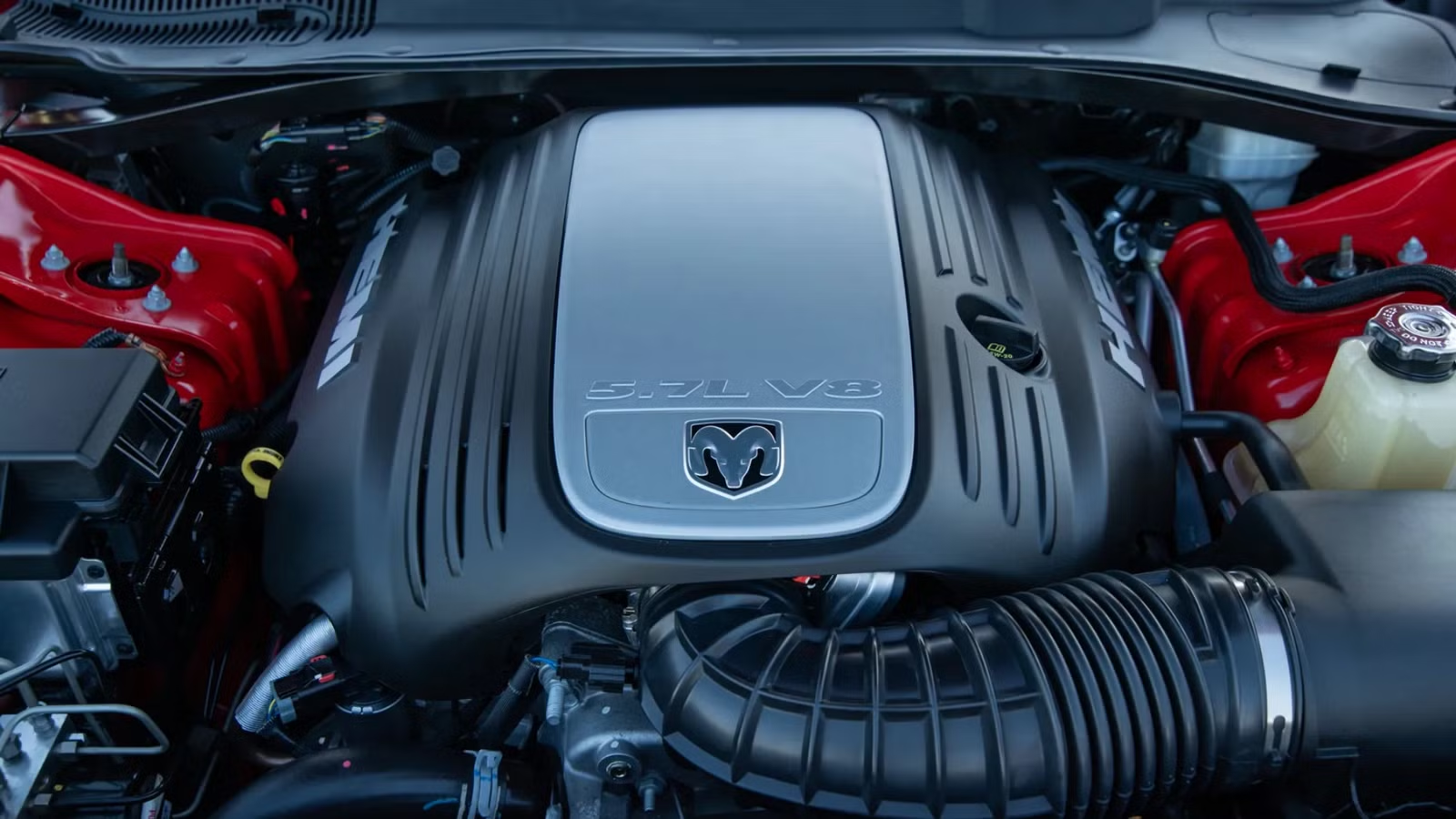
HEMI V8 power is at something of a premium nowadays. Even with the vast majority of HEMI V8 muscle cars relegated to the used market, a robust fanbase and decades of effective advertising mean that name holds value far better than other V8s. Whether it’s fair or not is another question entirely, but that doesn’t mean there aren’t a few workarounds to get your hands on HEMI power. Obviously, you could just buy an old Ram 1500 and call it a day, but there is at least one slightly more practical way to do it.
The High Cost of Hemi Horsepower Explained

The modern HEMI engine as we understand it is well over 20 years old now. In that time, there has been more variation in cubic displacement, valvetrain layouts, and internal architecture than could realistically be unpacked in a single sitting. In a used engine space where 6.4L Scat Packs, late-model 5.7s, and modern Ram trucks still command steep prices, budget-conscious buyers face a tough entry barrier. In effect, their steep prices are justified through perceived performance potential as much as through clever marketing and decades of word-of-mouth hype.
In a perfect world, it would be easy to say the best choice is the 5.7 HEMI, but even that runs into problems once the minutiae are accounted for. Suffice it to say, not every 5.7 HEMI built between 2003 and 2026 is the same. Especially towards the beginning, they were quite different in a few respects. For starters, the earliest 5.7 HEMIs were, by many accounts, a little “stone age.” Sporting pushrods and lacking any form of variable valve timing or forced induction, the early 5.7 was almost like a two-barrel carburetor atop a 440 big block from decades prior.

Of course, this limited horsepower potential to some degree, as did the hardware variance across multiple different chassis in those pivotal formative years. Still, when Mopar made the call to slap the HEMI logo across that plastic engine cover, it was enough to make the fans and faithful spill into Dodge and Chrysler dealerships regardless. It was a classic case of brilliant PR and clever advertising that the Chrysler Group honed to perfection over decades. With this in mind, none of the mechanical shortcomings seemed to hinder sales, and that meant older HEMIs are available today in abundance.

The Heart of the Beast: The Early 5.7L HEMI V8

In the moment, it was easy for automotive journalists and car snobs to quip about early 5.7 HEMIs, decrying them as immediately outdated the moment they hit dealerships via the Chrysler 300 and Ram 1500 in 2003 and 2004. Never mind that GM’s LS V8 also used pushrods, lacked VVT, and depending on the application, didn’t make as much power as the equivalent Mopar. Sometimes, brand loyalty trumped any kind of objective fact.
And yet, that very same stone age mentality about early HEMIs was precisely what made it valuable to wrenchers, DIY mechanics, and anyone who just wanted something uncomplicated with lots of displacement as a daily driver. Without variable valve timing, upgrades to internal parts like the camshaft, the valves, and the cylinder heads were considerably cheaper than those on 5.7 HEMI variants from 2009 onward. Thanks to their rock-solid iron engine blocks, these HEMIs could handle considerable thermal loads and boost pressures while staying within their operating parameters, and they didn’t even require delicate electronic timing adjustments to make everything work as it should.

Those early “pre-Eagle” HEMIs, as they’re called, separating them from variants produced after 2009, did have one or two modern features. Specifically, Chrysler’s Multi-Displacement System (MDS) allowed the 5.7 HEMI to shut off half its cylinders in the blink of an eye while poking around town or cruising on the highway. While brilliant in concept, the system had a tendency to seize rollers and damage cam lobes, and it caused a distinct drivetrain noise called the “HEMI tick.” This prompted a number of companies to offer workarounds that disabled MDS via the vehicle’s OBD-II port or at the ECU via a tune. Some even went a step further, swapping out the lifters and camshaft before flashing the ECU to delete the MDS functionality entirely. Once that was done, you had a genuine HEMI with at least 340 horsepower on your hands. On the used market, that generally led people to one vehicle in particular over all the others.
2006-2009 Dodge Charger: The Best Path to a Cheap HEMI

Predictable? Maybe. Unwelcome? Certainly not. Somehow, a perfectly normal four-door sedan, based in no small part on a W211-series Mercedes E-Class, wound up being the early 5.7 HEMI’s most famous and most attainable point of access for the average buyer. Granted, lesser Chargers, most notably very early models with the 2.7-liter EER V6, were nothing to write home about. Still, the minute the 2006 Charger R/T trim was revealed as having a 5.7-liter HEMI under its hood, the curb appeal kicked up several notches.
Cheaper than the 6.1 HEMI-powered SRT-8 and by all accounts far more reserved, the Charger R/T of 2006 to 2009 was a sweet spot in the lineup. One that could be optioned with a Road/Track performance package for a ten hp boost up to 350 total, plus a far nicer ride than the stiff SRT. Power was fed to a Daimler-derived five-speed automatic transmission with auto-stick capability. It won’t replace a proper manual, but as far as mid-2000s American sedans were concerned, the Charger was at least a halfway decent sports sedan.

Compared to equivalent four-door sports cars, like the front-wheel-drive Impala SS or the upmarket BMW 550i, the Charger R/T was either purer in its sportiness or considerably less expensive. It was a happy middle ground that might not have had an interior worth writing home about, but made up for it with a launch MSRP of just $30,030. Of course, that works out to just under $50,000 in 2026 money, but just imagine how much that BMW would cost adjusted for inflation. That was how the Charger established itself as the go-to American sports sedan in the pre-Hellcat years. All these years later, and that same Charger is the cheapest method of getting your hands on a 5.7 HEMI that doesn’t involve buying a pickup truck.
By the Numbers: Why Older Chargers Bring HEMI Nirvana Cheaply

Picture yourself scrolling Facebook Marketplace and Bring a Trailer at two in the morning, perhaps still covered in grease, when your groggy eyes suddenly go wide at the going rate for the Charger of your childhood. You scroll right past the endless rows of V6 SXTs selling for not much more than $3,000 in some cases, and land on a treasure trove of ’06 to ’09 Charger R/Ts on offer for as little as $8,000 for a high-mileage example.
For examples with odometer readouts of around 75,000 miles, and even with the Daytona graphics package in some instances, expect to pay no more than $12,000 to $15,000, depending on the level of wear, tear, and mileage. Of course, the Chrysler 300 that rode on the same platform might work just as well, but it’s fair to say folks took far better care of their Chargers over the years than the equivalent 300. With that in mind, it’s fair to call the Charger the better pick. Even with the practically mandatory MDS delete, buyers are still not paying all that much for a form factor that, in 2026, simply no longer exists.
Source: Dodge, Autotrader

Related posts





Latest Post


No Comments