
The Honda That Quietly Earned A Reputation For Lasting Forever
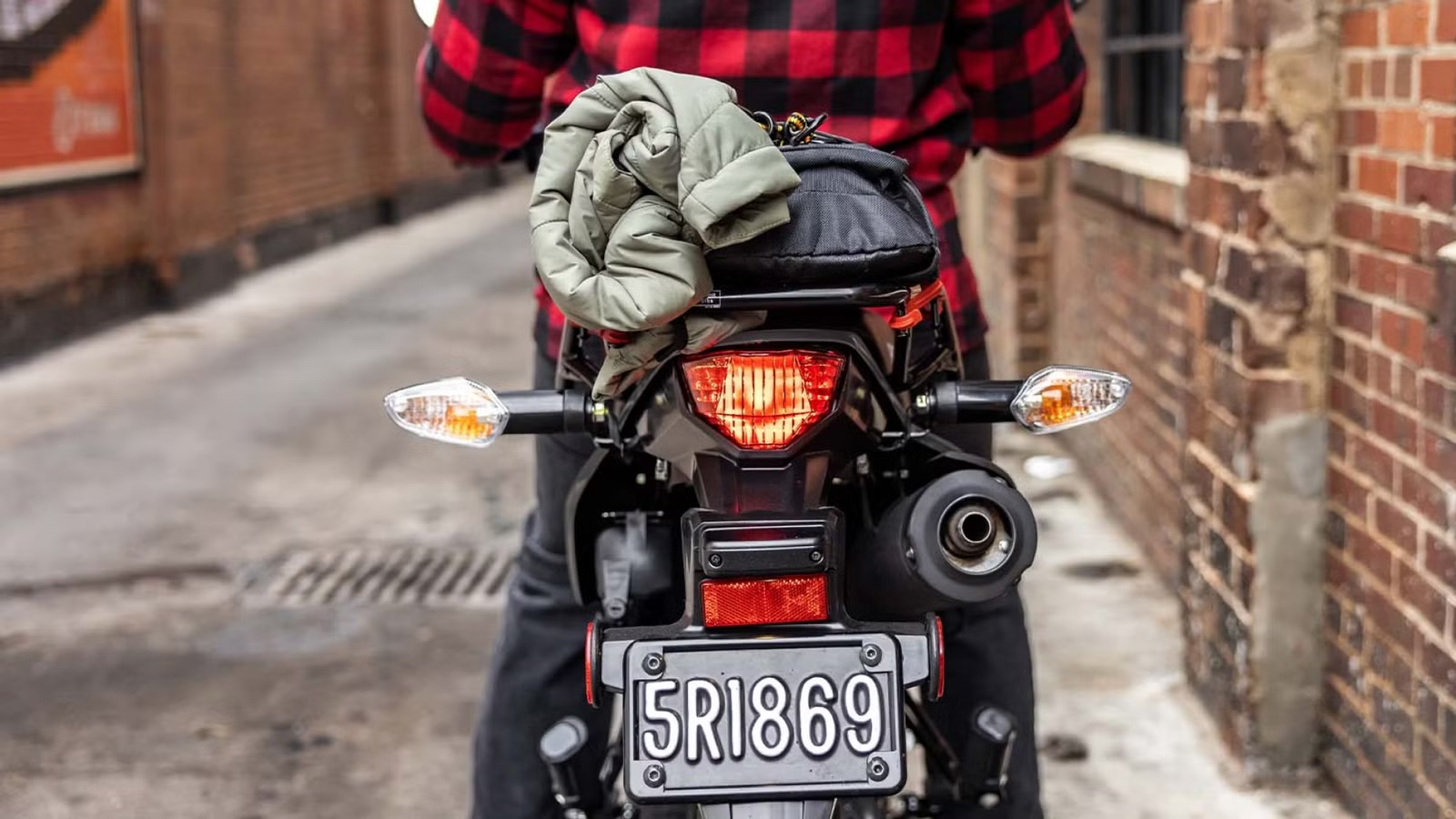
Forever motorcycles are your cheat code to enjoying freedom on two wheels for the long term. The primary requirements for a motorcycle to last forever include reliability and refinement. No manufacturer aces these two factors better than Japanese motorcycles. Sure, we have a bunch of popular forever bikes like the Honda Gold Wing, the Suzuki V-Strom 650, and even the entry-level Kawasaki Ninja sportbikes. But there are also hidden gems that aren’t celebrated or widely popular.

There is a plain and simple Honda dual-sport that fits this bill perfectly. This bulletproof Honda has been around for over 10 years now, and very little has changed. It still packs an air-cooled mill and has little to no electronics. Over the years, it has racked up miles and eradicated all the niggles that came along. Furthermore, it is dirt-cheap. Overall, it’s easy to buy and own thanks to its simple design, which doesn’t compromise riding fun.
Why Most Japanese Motorcycles Are Certified Forever Motorcycles
As mentioned earlier, this is primarily because of the emphasis on reliability and refinement. Furthermore, long production timelines help minimize failure rates and strengthen after-sales support, with great accessibility to spare parts. While this has also given Japanese motorcycles the infamous label of having “no soul,” it is not always the case.

We have examples like the grin-worthy Suzuki Boulevard M109R, the custom-styled Honda Shadow Phantom, and the timeless Yamaha V-Star 250 showing us that performance, style, and old-school charm can go hand in hand with superior reliability ratings. Among the big-four Japanese brands, Honda stands out with the most vibrant lineup of motorcycles.
Honda Has The Most Diverse Line-Up Of Long-Lasting Motorcycles

Japanese motorcycle makers are branded “safe” when it comes to experimenting with new technology or expanding their horizons with more styles of motorcycles. But Honda proves otherwise by offering the most diverse lineup of any motorcycle brand worldwide. Their road-going motorcycles range from cute little minimotos, to do-it-all cruiser bikes, to benchmark luxury tourers, to grin-worthy sportbikes, to value-packed nakeds, and even the only factory chopper on sale today.
All of them have one thing in common—proven refinement and reliability levels. But amidst this sizable bunch, there are a few motorcycles that go unnoticed primarily because of their age. The beginner-friendly Honda XR150L is one such motorcycle that offers practicality, refinement, durability, and fun riding appeal — all for a price tag cheaper than some of the Honda scooters.
The Humble Honda XR150L Quietly Lasts Forever
Its Secret To Longevity Is Simplicity

The XR150L has a very basic formula with no complex components whatsoever. This is the primary reason for its forever appeal. The chassis is bare-bones; there are barely any electronic features, and durable hardware components are designed to be easily serviced when needed. Also, with little to no updates since 2014, Honda has had ample time to refine the whole package and address any minor issues that arose. Add this to Honda’s proven reliability, and the XR150L has become the perfect do-it-all motorcycle for a first-time rider on a budget.
At the heart sits a reliable and tractable single-cylinder engine. It is a humble 149 cc air-cooled engine with an undersquare construction. Other internal stats include an OHC valve train with two valves per cylinder, and a 22 mm bore carburetor for fueling.

The compression ratio is 9.5:1, and the XR150L produces nearly 12 horsepower at 7,750 RPM and 9.2 pound-feet of torque at 6,000 RPM. Over seventy percent of its peak torque is available from around 2,000 RPM, which contributes to its peppy character both on and off the road. Power is sent to the rear wheel via a five-speed manual gearbox with a final chain drive.
A Steel Chassis And Long-Travel Suspension That Shrug Off Rough Terrain

Its simplicity seeps into its underpinnings too. The XR150L has a steel split-downtube chassis that houses the engine. It is suspended on 31 mm telescopic front forks with 7.1 inches of travel. The rear gets a preload-adjustable monoshock with 5.9 inches of travel.
The long-travel suspension offers ample ground clearance, too (9.6 inches) to help with comfortable off-road runs. Braking duties are handled by simple hardware comprising a single 240 mm disc up front and a 110 mm drum setup at the rear. Its dual-sport nature is further complemented with knobby 90-section front and 110-section rear tires mounted on 19-inch front and 17-inch rear spoked wheels.
At 282 Pounds and $3,399, The XR150L Is The Most Approachable Dual-Sport You Can Buy

Despite its tall-riding stance, the XR150L is a very compact motorcycle owing to its beginner-friendly nature. It has a short wheelbase of 53.5 inches and weighs just 282 pounds. This helps the XR150L stay nimble on and off the tarmac and also builds confidence for new riders. The seat height is on the higher side, though, at 32.8 inches.
Less Technology = Fewer Things To Break

On the technology front, there are barely any features on this dual-sport. In fact, it doesn’t even get ABS. This is not a bummer though, as it doesn’t break the riding experience.
The no-ABS layout actually makes this entry-level dual-sport a fun bike that experienced riders can enjoy as well. The “electronics” on this dual-sport at most include an electric starter and a sealed battery. Also, the bare-bones nature gives it a timeless appeal, helping it stay relevant for longer without any updates. This also helps keep the prices low.
Accessories To Dial Up Its Practicality

For someone who is not happy with the standard package, Honda does offer a suite of practical accessories on the XR150L. They are in place to enhance off-roading comfort and even help with mile-munching sessions. Notable add-ons include a skid plate, hand guards, a 12V accessory socket, a tank bag, and even soft saddlebags.
The Most Affordable Full-Sized Motorcycle Of 2026

The most affordable cruiser bike today is the 2026 Yamaha V-Star 250, priced at $4,799. It is also the smallest V-twin motorcycle on sale today. The most affordable sportbike today is the 2026 CFMoto 300SS, priced at $4,599. The most affordable naked/roadster today is the 2026 CFMoto 300NK, priced at $4,199. So, it’s safe to say that the most affordable motorcycles out there hover around the $4,000 mark, which is already quite affordable.
But the Honda XR150L impresses us by being priced at just $3,399. That’s even cheaper than many urban-only scooters and minimotos out there. This aggressive pricing is only possible because Honda has kept the XR150L unchanged for years while still being relevant in riding appeal. Since its pricing is so low, it actually doesn’t have any direct rivals, at least not in its price bracket.

Its closest rival is the fairly new 2026 Yamaha WR125R, priced at $3,999. Other counterparts in the vicinity include the $5,199 Kawasaki KLX 230 S and the $4,999 Yamaha TW200. Taking all its rivals into account, it is safe to say that the XR150L is one of those overlooked hidden gems that deserves all the attention, especially from new riders.
Sources: Honda Powersports, Yamaha Motorsports, and Kawasaki.

Related posts


Latest Post


No Comments