The Last Supercharged V8 Super Sedan America Will Probably Ever Build
8 minutes reading
Sunday, 16 Aug 2026 13:00 0 5 autotech
The super sedan as we’ve known it, naturally aspirated or supercharged, rear-wheel-drive, unapologetically analog, is running out of road. Regulatory pressure, electrification mandates, and shrinking sedan demand have pushed nearly every rival toward hybrid assistance or turbocharged downsizing. Yet one holdout remains.
A car that pairs a supercharged V8 with an honest-to-goodness manual gearbox and no electric motor in sight. It undercuts pricier German competition by tens of thousands of dollars and, unusually for a six-figure performance sedan, is holding its value rather than shedding it. This is the story of the last car of its kind, and why waiting to buy one is starting to look like the riskier move.
Why The Era Of Unfiltered Super Sedans Is Ending Faster Than Expected
2025 BMW M5 Front Three QuarterWilliam Clavey | TopSpeed
For decades, the super sedan formula was simple: take a mainstream four-door, stuff in a big engine, stiffen everything, and sell it to buyers who wanted supercar performance with room for car seats. BMW’s M5, Mercedes-AMG’s E63, and Audi’s RS7 built entire identities around this idea, each one-upping the others with more cylinders, more boost, more horsepower.
That formula is unraveling faster than most enthusiasts expected. The latest BMW M5 now carries a plug-in hybrid powertrain, adding over 1,000 pounds of mass in exchange for hybrid-assisted power. Mercedes-AMG has similarly shifted the E63 toward electrification, with the C63 already having swapped its V8 for a turbocharged four-cylinder hybrid setup. Audi’s RS7 remains V8-powered for now, but industry signals point toward the same electrified direction as emissions regulations tighten globally.
Why Highly-Advanced Super Sedans Lose To Mechanical Honesty
Rear 3/4 shot of 2025 BMW M5William Clavey | TopSpeed
The shift isn’t really about performance; these hybrid systems often produce blistering power figures. It’s about character. A 5,400-pound sedan with a battery pack and electric motors drives differently than one built purely around a mechanical relationship between throttle, supercharger, and rear wheels. Purists argue that something is lost in translation, even when the spec sheet says otherwise.
Against that backdrop, one nameplate has become an accidental holdout. A car built before this transition fully took hold, powered by a genuinely enormous supercharged V8, still offered with a manual transmission, and still purely internal combustion. Nobody planned for it to become the last of its kind this quickly. But with its window of production narrowing and no direct successor confirmed to carry the same formula forward, it’s increasingly looking like America’s final unfiltered super sedan—or at least the last one we’re likely to see for a very long time.
The Cadillac CT5-V Blackwing Delivers 668 Supercharged Horsepower With A Manual
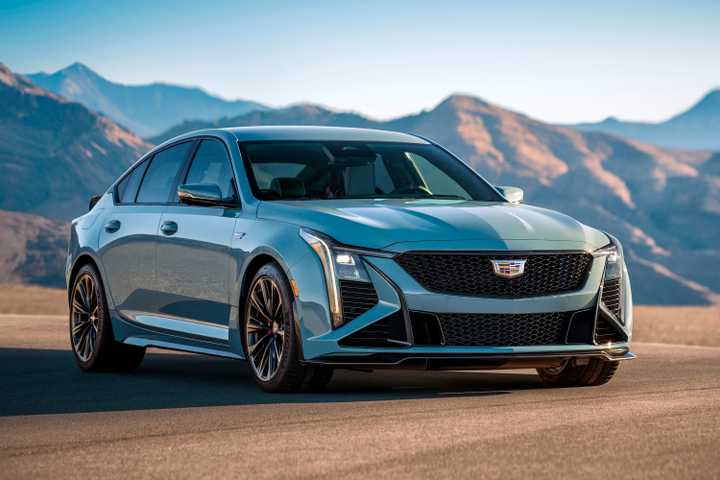
2025 Cadillac CT5-V Blackwing front 3/4 shotCadillac
That car is the 2026 Cadillac CT5-V Blackwing, and it makes its case with numbers that sound almost anachronistic in 2026. Under the hood sits a 6.2-liter supercharged V8 producing 668 horsepower and 659 pound-feet of torque, figures that would have topped the segment outright a decade ago and still comfortably compete with anything German rivals can muster today.
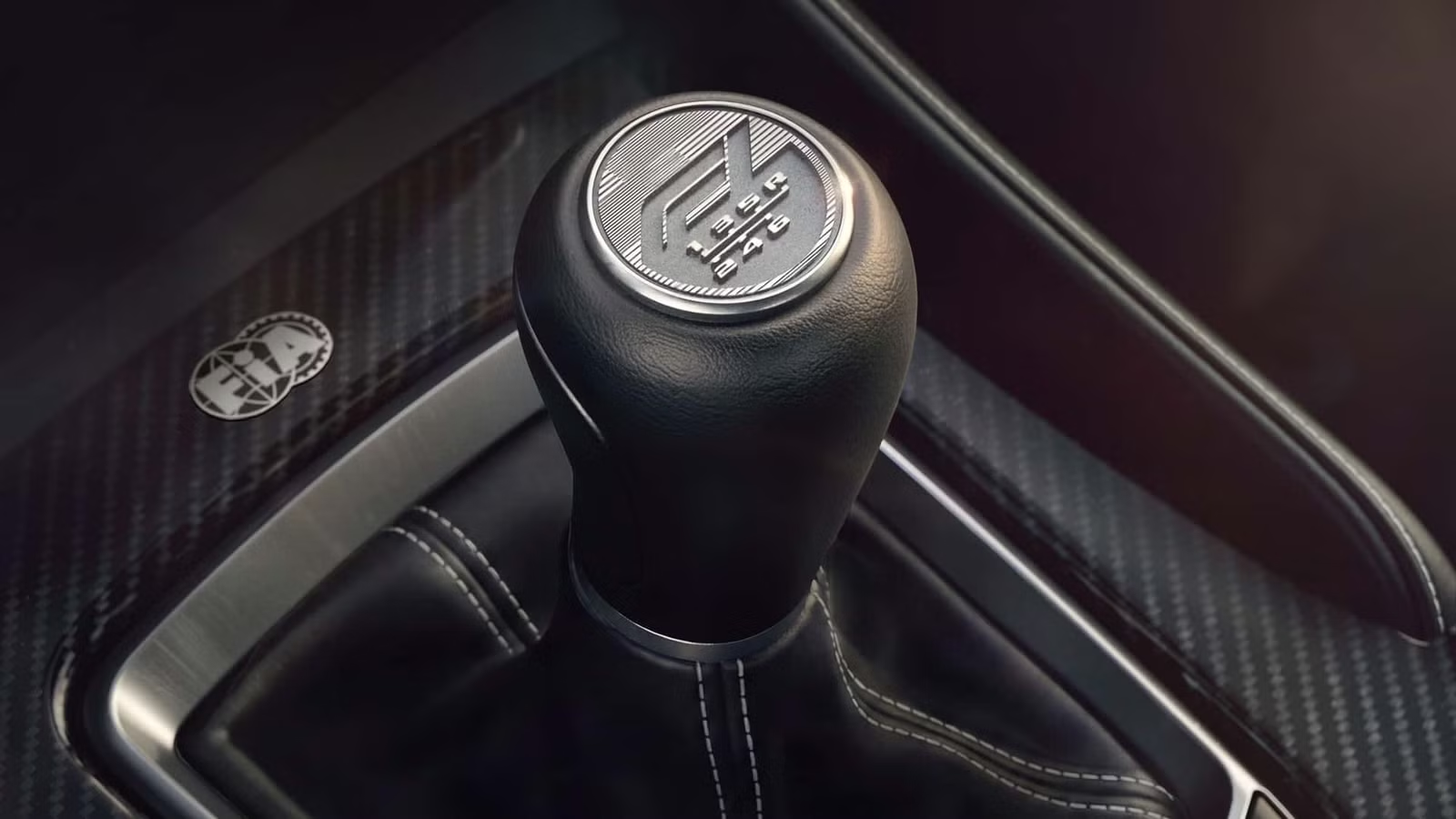
What makes the Blackwing genuinely unusual isn’t just the output, but how buyers can access it. Cadillac still offers a six-speed manual transmission alongside a 10-speed automatic, a combination that has all but vanished from this segment. Reviewers have noted that the manual isn’t a token gesture either; it’s a properly weighted, mechanically satisfying gearbox that rewards drivers willing to work for their acceleration.
Rear 3/4 action shot of 2025 Cadillac CT5-V Blackwing being driven on roadCadillac
Speaking of acceleration, the automatic-equipped CT5-V Blackwing has been recorded hitting 0-60 mph in roughly 3.4 seconds, with the manual only slightly behind at 3.6 seconds. Those numbers put it in the same performance bracket as cars costing significantly more, and they arrive without sacrificing everyday usability. Reviewers consistently point to the Blackwing’s Tour driving mode and magnetic ride control as proof that Cadillac tuned this car to be genuinely livable and not just track-focused. It’s the kind of chassis calibration that lets an owner drive to work in comfort and then find a back road on the weekend without the car fighting them the entire way.
The result is a sedan that reads as a full-throated final statement rather than a compromise. Cadillac built the Blackwing without hedging on displacement, without adding electrification, and without diluting the manual option, even as competitors moved in the opposite direction.
It Outruns Pricier German Rivals While Costing Tens Of Thousands Less
2025 Cadillac CT5 V Blackwing exterior front detailTopSpeed | Garret Donahue
Performance numbers only tell half the story; pricing is where the Blackwing’s case becomes genuinely compelling. For 2026, the CT5-V Blackwing carries a base MSRP of $98,900 before destination and gas guzzler fees, a figure that positions it well below the segment’s German benchmarks.
The current BMW M5, now saddled with plug-in hybrid hardware, starts north of $123,000, putting roughly $24,000 of daylight between it and the Cadillac. The gap widens further against the Audi RS7, which starts closer to $132,700, nearly $34,000 more than the Blackwing’s asking price. Even accounting for standard equipment differences, that’s not a marginal discount; it’s the kind of price separation that changes which shoppers cross-shop these cars at all.
2025 red Cadillac CT5 V Blackwing exterior sideTopSpeed | Garret Donahue
What makes this pricing dynamic particularly notable is that the Blackwing isn’t winning on a technicality. It isn’t undercutting rivals by offering less power or a smaller engine; if anything, its supercharged V8 delivers output competitive with, or exceeding, hybrid-assisted alternatives that cost tens of thousands more. Buyers aren’t being asked to accept a lesser car for less money; they’re getting comparable or superior straight-line performance, a manual gearbox unavailable elsewhere in the segment, and a lower sticker price simultaneously.
Most performance sedans at this price point depreciate aggressively within three years. The Blackwing is doing something almost no one expected — and the used market numbers tell a story that changes the math for anyone still on the fence.
Strong Resale Values Suggest This Is A Future Collectible
Six-figure performance sedans typically depreciate hard. Complex hybrid systems, expensive maintenance, and shifting buyer tastes usually combine to punish resale values within a few years of purchase. The CT5-V Blackwing is defying that pattern in a way that’s caught the attention of the used market.
Average used sale prices for the Blackwing hover around $91,457—remarkably close to its original MSRP—and clean, low-mileage examples have sold for as much as $111,000, above what many paid new. Perhaps most striking, early 2022 model-year Blackwings have reportedly lost only around 10 percent of their value over four years, a depreciation curve that would be unusual for almost any performance sedan, let alone one wearing a Cadillac badge in a segment historically dominated by German prestige.
That said, the resale story isn’t universally rosy, and it’s worth being upfront about the exception. The limited-run 120th Anniversary Edition, which carried a considerably higher MSRP of $142,530, has been reported losing nearly $50,000 in value after just a few thousand miles. That’s a meaningful counterpoint, and it suggests the Blackwing’s depreciation resistance applies most reliably to base and moderately optioned cars rather than heavily marked-up special editions where buyers paid a significant premium at the outset.
2025 Cadillac CT5-V Blackwing front cabinTopSpeed | Garret Donahue
Scoped correctly, though, the pattern holds: a well-optioned but not excessively loaded Blackwing appears to be one of the rare modern performance sedans that behaves more like a collectible than a depreciating asset, exactly the kind of signal that tends to precede genuine collector-market attention.
Limited Editions And A Shrinking Window Of Opportunity Make Waiting The Biggest Risk For Buyers
If there was any doubt that the collector market has already started forming around this car, Cadillac’s own product decisions confirm it. For 2026, the brand introduced an F1 Collector Series variant limited to just 26 units, bumping the supercharged V8’s output to 685 horsepower. A production run that small isn’t a mainstream sales strategy; it’s a deliberate move to create scarcity around a car that’s already becoming a send-off.
That’s the broader signal worth paying attention to. Cadillac isn’t positioning the Blackwing as an ongoing, iterative nameplate with a clear multi-generation future in this exact form. Every cue—the shrinking field of direct rivals, the industry-wide pivot toward electrification, the low-volume special editions—points toward a car nearing the end of its production life in its current, unhybridized form.
The front 3/4 view of a black 2026 Cadillac CT5-V Blackwing F1 Collector Series.Cadillac
For prospective buyers, that context changes the calculus considerably. Waiting for a discount, or assuming another manual, V8-powered, non-hybrid super sedan will simply appear from a rival automaker, looks increasingly like wishful thinking. The used market data already suggests other buyers have reached the same conclusion, which is part of why prices have stayed firm rather than sliding the way they typically would for a car this powerful and this expensive.
The Cadillac CT5-V Blackwing isn’t just a strong performance sedan competing on specs and price. It’s a closing chapter, quite possibly the last of its kind that American buyers will get to choose with a stick shift and no battery pack in sight. For anyone who’s been circling one, the market is already signaling that the window to buy in before values climb further is narrower than it looks.








No Comments