
The Most Affordable V8 American Muscle Car On The Market
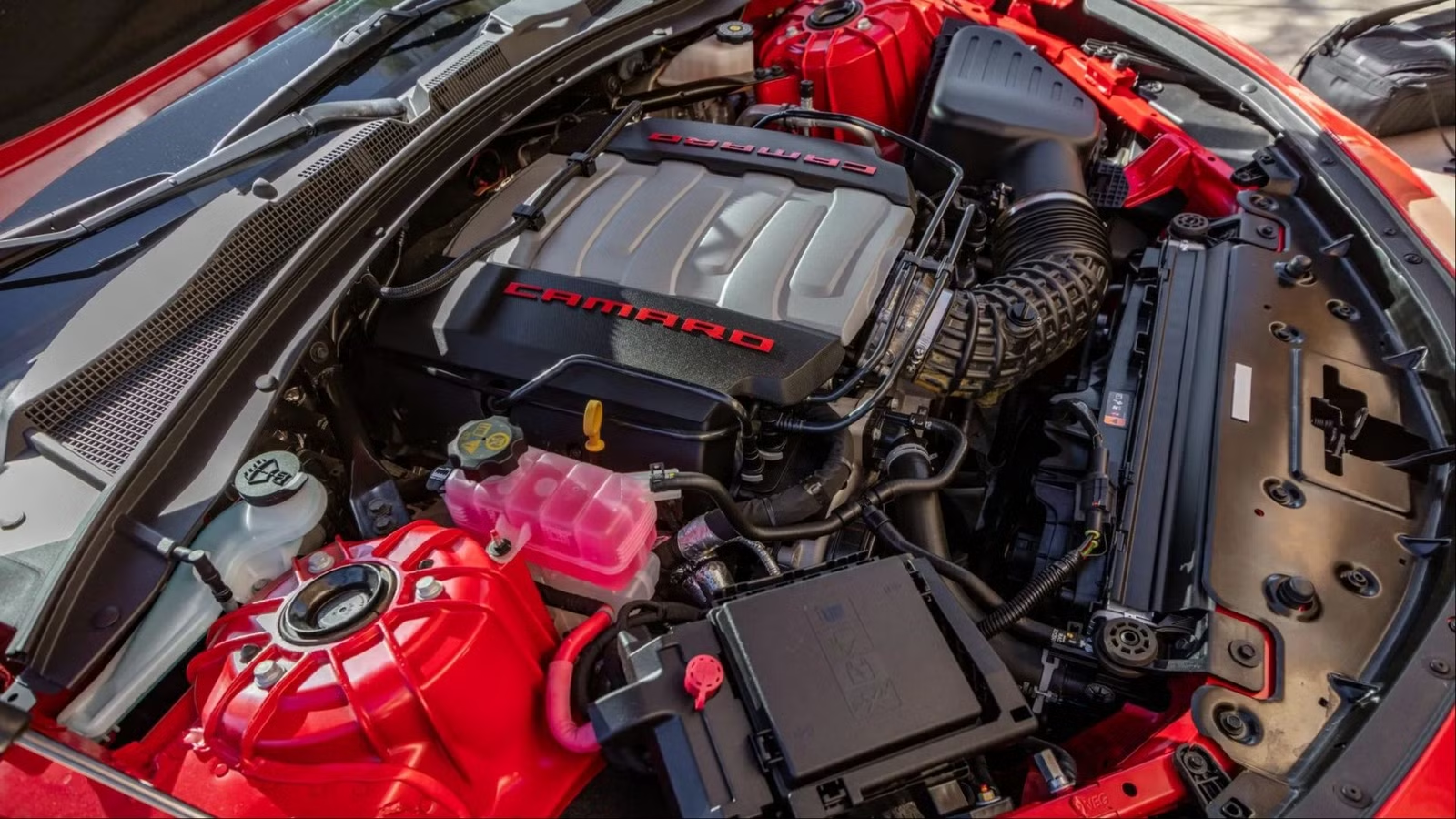
The V8 American muscle car is a dying breed — and that makes finding one at a reasonable price more urgent than ever. With Chevrolet having closed the book on Camaro production, the window to grab a new, affordable, fire-breathing American muscle car is narrowing fast. The term muscle car has always carried some baggage: purists demand a large-displacement engine, rear-wheel drive, and a Detroit zip code on the birth certificate, but beyond those basics the definition gets slippery. The original pony car, the Ford Mustang, earned its muscle car credentials in the early 1970s when Ford dropped some of its most powerful engines under the hood — and the segment has been debated ever since.

Around the same time, the Chevrolet Camaro and Dodge Challenger joined the pony-car wars and then quickly dropped large V8s into their models to also join the muscle car wars. Affordability is another constant, because if nobody can afford to buy a muscle car, the segment will wither away. With all of that in mind, HotCars takes a close look at the most affordable V8 American muscle car you can still find on the market — the Chevy Camaro LT1.
The Camaro LT1 Is The Most Affordable V8 American Muscle Car In 2024
Along with the pony-car pioneer Mustang, the Chevrolet Camaro is one of those cars that has a lineup to suit both the pony-car and muscle-car segments, because of its choice of engines.

Powered by a V6, the Camaro remains affordable and powerful enough to satisfy buyers who want a low-cost sporty coupe. But the real story is the muscle car Camaro — specifically the LT1 with its 6.2-liter V8 — which stands as the least expensive of all the new muscle cars on the market.
2024 Chevrolet Camaro LT1 Specs and Performance
|
MSRP |
$38,800 |
|
Engine |
6.2-Liter V8 |
|
Power |
455 HP @ 6,000 RPM |
|
Torque |
455 LB-FT @ 4,400 RPM |
|
Transmission |
6-Speed Manual, 10-Speed Automatic |
|
Curb Weight |
3,619-3,927 Pounds |
|
0-60 MPH |
4.0 Seconds |
|
Quarter Mile |
12.4 Seconds @ 114.6 mph |
|
Top Speed |
180 MPH |
(Specs courtesy of Chevrolet)
If you’re wondering why you can no longer configure a 2024 Camaro on Chevrolet’s website, it’s because all 2024 Camaros were built out as of January 2024 and are only available through existing dealer inventory. That matters because, while the Camaro LT1 is the cheapest new American muscle car you can buy, shoppers will need to search dealer lots where sticker prices may vary from the base MSRP.
This model is also available as a convertible, and in either body style it comes with a 6.2-liter V8 producing 455 hp. This particular Camaro falls short of what the Mustang GT offers on peak power, but it handily outguns the remaining Dodge muscle car offerings.
The Camaro SS Is Another Affordable V8 Muscle Car
If you can’t track down one of these affordable Camaro LT1s on a dealer lot, rest assured that other trim levels remain relatively accessible. The closest relative to the Chevy Camaro LT1 is the Camaro SS, which shares its 6.2-liter V8 and much of its styling and feature set with the LT1. Visual differences are most evident in the design of the lower front grille and rear end, along with model-specific badging.
The Camaro SS can also be optionally fitted with the 1LE package, which was originally developed in 1988 to make Camaros ready to compete in showroom stock race series. Today, it adds magnetic ride control, an electronic limited-slip differential, staggered 20-inch wheels with Goodyear performance tires, Brembo brakes, a track cooling package, and a host of interior upgrades.
The Range-Topping Camaro ZL1
Like its stablemates, the Camaro ZL1 comes in coupe and convertible form but pumps up the muscle with a supercharged version of the 6.2L V8 that produces 650 horsepower and an equal amount of torque. It can also be had with the track-ready 1LE performance package, but only in coupe form.
To mark the end of Camaro production, Chevrolet created a limited run of just 350 Collector’s Edition ZL1s finished in Black Panther matte black paint with additional cosmetic touches. It’s certainly not as affordable as the Camaro LT1 or SS, but the ZL1 is an outstanding V8-powered muscle car for buyers with a larger budget.
Chevrolet Camaro SS And ZL1 Specs and Performance
|
Camaro SS |
Camaro ZL1 |
|
|
MSRP |
$42,300 |
$72,100 |
|
Engine |
6.2-Liter V8 |
6.2-Liter Supercharged V8 |
|
Power |
455 HP @ 6,000 RPM |
650 HP @ 6,400 RPM |
|
Torque |
455 LB-FT @ 4,400 RPM |
650 LB-FT @ 3,600 RPM |
|
Transmissions |
6-Speed Manual, 10-Speed Automatic |
6-Speed Manual, 10-Speed Automatic |
|
Curb Weight |
3,685-3,999 Pounds |
3,907-4,151 Pounds |
|
0-60 MPH |
4.0 Seconds |
3.4 Seconds |
|
Quarter Mile |
12.4 Seconds @ 114.6 mph |
11.5 Seconds @ 124 mph |
|
Top Speed |
180 MPH |
198 MPH |
(Specs courtesy of Chevrolet)
The Camaro And Mustang Rivalry And Comparison

So long as there’s been a Mustang, there’s been a Camaro. If ever there were a superhero comparison to be made in the auto world, the Mustang vs. Camaro conflict would be the equivalent of Batman and the Joker — they both exist to outdo the other.
They started off as competitors in the pony-car wars, then moved on to muscle-car battles, and here they are today, still slugging it out for buyers with plenty of serious V8 powerplants to choose from. On price, the Camaro LT1 edges the Mustang GT by roughly $3,500, but the Mustang GT counters with 31 more horsepower.
When it comes to the current crop of Mustang muscle cars, both the GT and Dark Horse are probably more suitably pitted against the SS Camaro. As it stands, both the GT and Dark Horse Mustangs outdo the Camaro SS on horsepower output but lack bottom-end torque. The GT is mildly more expensive than the Camaro SS, while the Dark Horse MSRP falls between the Camaro SS and ZL1 pricing.
Ford Mustang GT And Dark Horse Specs and Performance
|
Mustang GT |
Mustang Dark Horse |
|
|
MSRP |
$42,460 |
$58,935 |
|
Engine |
5.0-Liter V8 |
5.0-Liter V8 |
|
Power |
480-486 HP @ 7,500 RPM |
500 HP @ 7,250 RPM |
|
Torque |
415-418 LB-FT @ 4,900 RPM |
418 LB-FT @ 4,900 RPM |
|
Transmissions |
6-Speed Manual, 10-Speed Automatic |
6-Speed Manual, 10-Speed Automatic |
|
Curb Weight |
3,991-4,012 Pounds |
3,949-3,993 Pounds |
|
0-60 MPH |
4.3 Seconds |
3.7-4.1 Seconds |
|
Quarter Mile |
12.5 Seconds @ 117 MPH |
12.0-12.5 Seconds @ 118 MPH |
|
Top Speed |
155 MPH |
166 MPH |
(Specs courtesy of Ford)
The 1997 Pontiac Trans-Am Is The Most Affordable Used V8 Muscle Car

Around the turn of the century, Camaros and Mustangs were as embroiled in their power wars as ever, driving prices for those vehicles on today’s used car market up to around $20,000, depending on condition. If you want to save some money but stay in the Camaro family, you can find a very good Pontiac Trans Am for half the cost. Classic.com puts the average price for a 1997 Trans-Am at $13,173, based on transactions over the past five years, while Kelley Blue Book pegs the Fair Purchase Price at just $7,342.
1997 Pontiac Trans-Am Valuation
|
Concours Condition |
$22,900 |
|
Excellent Condition |
$14,300 |
|
Good Condition |
$8,900 |
|
Fair Condition |
$6,800 |
|
Original MSRP |
$23,339 |
(Specs courtesy of Classic.com)
The 1997 Trans-Am has held its value remarkably well over the decades — a Concours-condition example will fetch roughly the same money as its original MSRP. By comparison, V8 Camaros and Mustangs from the same era are now valued at nearly double their original sticker prices, which makes the Trans-Am the best used muscle car for the money from that generation.
1997 Pontiac Trans-Am Specs
|
Engine |
5.7-Liter V8 |
|
Power |
285 HP @ 5,000 RPM |
|
Torque |
325 LB_FT @ 2,400 RPM |
|
Transmissions |
6-Speed Manual, 4-Speed Automatic |
|
Curb Weight |
3,490-3,610 Pounds |
|
0-60 MPH |
5.9 Seconds |
|
Quarter Mile |
14.4 Seconds |
|
Top Speed |
160 MPH |
(Specs courtesy of Chevrolet)
The End Of The Affordable V8 Camaro
There is no telling when or in what form the Chevrolet Camaro will return to the lineup, but a V8 engine seems unlikely to be part of that future. For now, though, you can still purchase one of the last V8-powered Chevy Camaros through dealer inventory, making it the least expensive muscle car on the market today.
Sources: Chevrolet, Ford, Classic.com, Hagerty, KBB

Related posts



Latest Post


No Comments